The Watchtower — Study Edition · September, 2026
Study Edition
pp. 1–32

Study Edition
SEPTEMBER 2026
STUDY ARTICLES FOR: NOVEMBER 2–DECEMBER 6, 2026
© 2026 Watch Tower Bible and Tract Society of Pennsylvania
This publication is not for sale. It is provided as part of a worldwide Bible educational work supported by voluntary donations. To make a donation, please visit donate.jw.org.
Unless otherwise indicated, Scripture quotations are from the modern-language New World Translation of the Holy Scriptures.
Table of Contents
p. 32
Table of Contents
IN THIS ISSUE
Study article for November 2-8, 2026
2 Trust In Jehovah for Protection
Study article for November 9-15, 2026
8 How to Develop “an Obedient Heart”
Study article for November 16-22, 2026
14 Sharing the Good News in “All the Languages of the Nations”
Study article for November 23-29, 2026
20 How the Priesthood Reveals Jehovah’s Love
Study article for November 30, 2026–December 6, 2026
26 Guard Against “the Spirit of the World”
32 Bible Phrase—“Let the Peace of the Christ Rule in Your Hearts”
Trust In Jehovah for Protection
pp. 2–7
NOVEMBER 2-8, 2026
SONG 3 Our Strength, Our Hope, Our Confidence
Trust In Jehovah for Protection
“You said: ‘Jehovah is my refuge.’”—PS. 91:9.
FOCUS
Why we can trust in Jehovah’s protection now and in the future.
1-2. What earthshaking events will soon occur?
WE ARE living in the last of the last days. Earthshaking events will soon occur. Jehovah will put into the hearts of the nations “his thought”—that they give “their kingdom to the wild beast,” the United Nations.a (Rev. 17:17) Then that greatly empowered beast, along with the full cooperation of all political powers, will remove the world’s false religious organizations once and for all. (Rev. 17:16) That event will mark the start of the great tribulation. Then what?
2 Further climactic events will follow. The nations of this world will launch a coordinated, all-out attack on Jehovah’s people. (Ezek. 38:14-16) Why? The book Pure Worship of Jehovah—Restored At Last! explains: “Egged on by Satan, the nations will try to efface true worshippers—and along with them pure worship—from the earth.” What will follow this will be the most momentous event of all—the war of Armageddon. Jesus will lead his heavenly executional forces, including his 144,000 corulers, in removing this wicked world and in delivering us into a righteous new world.—Rev. 16:14-16; 19:11-21.
3. What will we consider in this article?
3 Should we fear the coming execution of divine judgment on this wicked world? No! Why not? Because Jehovah promises to protect us. He had this promise recorded in his Word: “A thousand will fall at your side and ten thousand at your right hand, but to you it will not come near.” (Ps. 91:7) Let us examine Psalm 91 and answer the following questions: What kind of protection does this psalm promise? How does Jehovah protect us now? How will he protect us in the future? But first, let us get an overview of Psalm 91.
A PSALM ABOUT TRUST AND PROTECTION
4. How do the opening words of Psalm 91 assure us of Jehovah’s protection? (Psalm 91:1, 2)
4 The basic message of Psalm 91 can be summed up in a few words: Trust in God’s protection. From the opening two verses, we are assured that Jehovah will protect those who put their trust in him. (Read Psalm 91:1, 2.) What could make us feel more secure than knowing that we are under the protective shadow and wings of the Most High, the Almighty? (Ruth 2:12; Ps. 17:8) The nouns “refuge” and “stronghold” remind us of the protection that a walled city provided in Bible times. The city’s inhabitants were protected within its walls, and those in outlying areas could run into the city to be safe from enemies. In the verses that follow, the psalmist uses vivid imagery to assure us that Jehovah can protect His people no matter what dangers they may face.—Ps. 91:3-13.
5-6. Psalm 91 ends with what promise, and what confidence does this give us? (Psalm 91:14-16)
5 In the closing verses of Psalm 91, we find the strongest assurance of all: In a dramatic shift, the psalmist goes from words about Jehovah’s protective care to words from Jehovah himself. Jehovah makes a promise—or guarantee—to his worshippers. (Read Psalm 91:14-16.) Note the words “I will” in these verses. Jehovah promises to protect his people because they trust in him, acknowledge his name, and call on him. We can have complete confidence in the Fulfiller of promises. (Josh. 23:14) His protection is not a mere possibility or probability; it is an absolute certainty!—Num. 23:19.
6 Jehovah inspired the psalmist to record the words found in Psalm 91 for our benefit. (Rom. 15:4) We echo the psalmist’s confidence and say to Jehovah: “You are my refuge and my stronghold.” (Ps. 91:2) But what kind of protection can we look to Jehovah to provide?
WHAT KIND OF PROTECTION DOES PSALM 91 PROMISE?
7. What kind of protection does Psalm 91 promise?
7 As our publications have explained, Psalm 91 is a promise of spiritual security, or protection. We can be sure that Jehovah will always provide what we need so that we can protect ourselves from spiritual dangers and safeguard our precious friendship with him. But does this psalm promise only spiritual protection? No. This psalm is also a promise that Jehovah will protect his people as a group from physical and emotional harm at the hands of their enemies. Why can we say that Psalm 91 also applies to physical and emotional protection?
8-9. How did Jesus respond to one of Satan’s temptations, and what can we learn from his response? (Matthew 4:5-7)
8 Consider how Jesus responded when Satan tempted him and quoted the words found in Psalm 91. (Read Matthew 4:5-7.) Referring to the words of Psalm 91:11, 12 as a promise of physical protection, Satan tempted Jesus to jump off the temple battlement to see if angels would protect him from harm. How did Jesus respond? He did not say: ‘You are mistaken, Satan! That psalm does not promise physical protection.’ Rather, Jesus replied: “You must not put Jehovah your God to the test.” What can we learn from Jesus’ response?
9 Jesus was fully aware that his Father had at times used angels to protect His people from physical harm at the hands of their enemies. (2 Ki. 6:15-17; 19:34, 35; Dan. 3:19, 20, 26-28; 6:16-22) But Jesus refused to test his Father by expecting angels to protect him from physical harm if he behaved recklessly. So Satan misused Psalm 91, not by referring to it as a promise of physical protection, but by using it to justify putting Jehovah to the test.b Based on Jesus’ response to Satan’s temptation, we may conclude that Psalm 91 is a promise of complete protection: spiritual as well as physical and emotional protection.
10. What confidence do we have?
10 The inspired words found in Psalm 91 fill us with confidence. We are convinced that Jehovah is the Protector of all those who trust in him as their refuge and stronghold. So we do not need to live in fear of the earthshaking events just ahead. Let us take a closer look at how Jehovah protects us now and how he will protect us in the future.
HOW DOES JEHOVAH PROTECT US NOW?
11. How is Jehovah protecting us spiritually?
11 Jehovah protects us spiritually. This means that he gives us the help we need to combat spiritual dangers—influences that could threaten our relationship with him. Consider, for example, our ongoing battle against our sinful condition. Jehovah fully understands the powerful grip that sin has over us. (Rom. 6:16; 7:21-23) Let us examine some of the ways that he helps us in this fight.
12-13. How can we win the fight against sinful desires? (Matthew 5:28, 29)
12 His Word. Jehovah’s Word not only warns us about sinful desires but also tells us how to win the fight against them. For instance, note Jesus’ words found at Matthew 5:28, 29. (Read.) Jesus is talking about a man “who keeps on looking at a woman so as to have a passion for her.” Such a man, Jesus says, “has already committed adultery with her in his heart.” What is the lesson for us?
13 If we continue looking at immoral images, we will arouse passion in our heart. And when passion meets opportunity, the likely result is sexual immorality. (Jas. 1:14, 15) To combat such wrong desires, we need to take strong measures. Jesus gives us what one Bible commentator refers to as “the surgical cure.” We need to cut passion-arousing images out of our lives as if they were a cancerous tumor. (Col. 3:5) When we apply that counsel, we safeguard our friendship with Jehovah.
14. How can holy spirit help protect us?
14 His holy spirit. Jehovah also uses his spirit to help us in our fight against our sinful flesh. If we keep praying for holy spirit, he will give it to us. (Luke 11:9-13) How can holy spirit protect us? The apostle Paul says: “Keep walking by spirit and you will carry out no fleshly desire at all.” (Gal. 5:16) The study note on this verse explains: “A person who walks by spirit seeks the direction of God’s spirit and allows it to influence his thoughts and actions. Though he may have sinful desires, he rejects them immediately, refusing to entertain them.” Jehovah’s spirit does not eliminate wrong desires. But it can help strengthen our resolve to do what is right and to avoid acting on them. And that resolve will help protect us spiritually.
15. How has Jehovah’s organization safeguarded us spiritually? (See also pictures.)
15 His organization. Through his organization, Jehovah provides timely publications to safeguard us spiritually. Consider: Because of our imperfect, sinful nature, we may at times struggle with negative thoughts and feelings. For example, we may fight unrelenting guilt, extreme insecurity, or undue anxiety. Satan, “the Tempter,” exploits such feelings, trying to get us to give up. (Matt. 4:3; 6:13) God’s organization has provided us with spiritual food designed to assure us of Jehovah’s forgiveness, to convince us of our worth in his eyes, and to strengthen our confidence in his promise to care for our needs. (Ps. 86:5; Matt. 10:29-31; Luke 12:28; Heb. 13:5) Can you recall reading something in one of our publications that touched your heart and caused you to think, ‘That was written for me’? Remember that Jehovah provides such timely information that can protect us spiritually.

Through his organization, Jehovah provides timely publications to protect us spiritually (See paragraph 15)
16. What trials has Jehovah allowed some of his worshippers to face, and of what can we be sure?
16 Jehovah protects his people as a group from physical harm at the hands of their enemies. However, Jehovah has at times allowed individual worshippers to face persecution and even death at the hands of opposers in order to prove Satan a liar. (Rev. 2:10; 6:9) But Satan is not content with these relatively few deaths. Enraged, he would like to see opposers exterminate all of God’s faithful people. (Matt. 24:9; Rev. 12:9-12) However, that will never happen! We can be sure that Jehovah is using his angels to protect his people as a group so that pure worship continues uninterrupted on earth.—Heb. 1:7, 14.
17. What reason do we have not to expect that Jehovah will protect us from all physical harm at this time?
17 Jehovah does not protect us as individuals from all physical harm. When we live by his principles and standards, we are protected from many practices and situations that could hurt us physically. (Prov. 14:29, 30; 22:3; 2 Cor. 7:1) Still, we do not expect him to protect us from all physical harm at this time. If He were to do that, Satan would surely promote the lie that we serve Jehovah only because of the protection that He provides. (Job 1:10, 11) We understand that because of the great issue involving the sanctification of his holy name, Jehovah has “tolerated with much patience” wicked people who oppose and mistreat his worshippers. (Rom. 9:22) However, his toleration of such injustice is nearing its end. Meanwhile, he will help us to endure whatever trials we face so that we may protect our precious friendship with him.—1 Cor. 10:13; 1 Pet. 5:10.
HOW WILL JEHOVAH PROTECT US IN THE FUTURE?
18. How will Jehovah protect us in the future?
18 During the great tribulation, Jehovah will continue to protect his people spiritually. What about physical protection? When the nations launch an all-out assault on his people, Jehovah will not allow his worshippers to be exterminated as a group. (Ezek. 38:1, 2, 10-16) This will lead to the war of Armageddon when Jehovah will unleash his executional forces—Jesus Christ and his heavenly armies. They will take action against God’s enemies. (Rev. 17:12-14; 19:11, 14, 15) How will Jehovah protect his people during Armageddon?
When Jesus and his heavenly armies execute divine judgment at Armageddon, not one of God’s enemies will be left standing. . . . But during that war, not one of God’s precious sheep will be killed at the hands of His enemies
19-20. Why do we not need to fear the coming execution of divine judgment at Armageddon? (See also picture.)
19 We do not need to fear the coming destruction of this wicked world in the war of Armageddon. Why not? We trust in Jehovah as our refuge and our stronghold. So we can be absolutely sure of this: When Jesus and his heavenly armies execute divine judgment at Armageddon, not one of God’s enemies will be left standing. (Jer. 25:33; Zech. 14:12) But during that war, not one of God’s precious sheep will be killed at the hands of his enemies—human or demonic.—Luke 21:28; 2 Pet. 2:9.
20 During the war of Armageddon, the psalmist’s inspired words may literally prove true: “A thousand will fall at your side and ten thousand at your right hand, but to you it will not come near. You will only see it with your eyes as you witness the punishment of the wicked. Because you said: ‘Jehovah is my refuge,’ you have made the Most High your dwelling.” (Ps. 91:7-9) Once Armageddon begins, we can expect that Jehovah will provide complete physical, emotional, and spiritual protection for his people not just as a group but also as individuals. Because you say: “Jehovah is my refuge,” Jehovah promises: “To you it will not come near.” Let us, then, face the future with confidence, knowing that we can fully trust in Jehovah for protection.

During Armageddon, we will be protected from physical and emotional harm (See paragraphs 19-20)
SONG 8 Jehovah Is Our Refuge
a See “Questions From Readers” in The Watchtower of November 2025.
b In the past, our publications have reasoned that Psalm 91 is a promise of spiritual security and that Satan misused it by suggesting that it promised protection from physical harm. See The Watchtower of December 1, 1974, p. 722.
How to Develop “an Obedient Heart”
pp. 8–13
NOVEMBER 9-15, 2026
SONG 36 We Guard Our Hearts
How to Develop “an Obedient Heart”
“Grant your servant an obedient heart.”—1 KI. 3:9.
FOCUS
How we can obey Jehovah from our heart.
1. Why might people obey those in authority?
PEOPLE obey those in authority for a variety of reasons. Many might do so only if they are being watched or if they want to avoid punishment. When it comes to obeying God, some make a show of obedience to gain prestige, as did the religious leaders in Jesus’ day. (Matt. 23:5) In contrast, we obey Jehovah because we see the benefits of his guidance. (Isa. 48:17, 18) That is a fine motive for showing obedience, but we have an even more important reason to obey him.
2. What is our main reason for obeying Jehovah?
2 The main reason we obey Jehovah is that we love him deeply. (Matt. 22:37, 38) Our love moves us to be “obedient from the heart.” (Rom. 6:17) Love for Jehovah and “an obedient heart” motivate us to do our best to observe his commands not just when others are watching or when we see the immediate benefits of doing so but at all times. Admittedly, our heart is treacherous, so maintaining the right attitude can at times be a challenge. In this article, we will look at two Bible accounts that can help us to develop an obedient heart. First, we will consider the time when Jehovah delivered the Israelites from Egypt. Then, we will look at the fine example of King Jehoshaphat of Judah.
FIRST OBEDIENT AND THEN REBELLIOUS
3. How may Jehovah’s command to splash blood on the doorposts have tested the Israelites’ obedience? (See also picture.)
3 Before Jehovah delivered the Israelites from Egypt, he gave them a command that tested their obedience. To avoid the tenth and final plague, they were to sacrifice a ram or a male goat and splash its blood on the doorposts of their houses. (Ex. 12:5, 7) Jehovah would pass over the dwellings marked with the blood and spare the firstborn of man and of beast of each household. However, the Israelites could have been tempted to disobey. Why? They might have feared retaliation from the Egyptians, who considered rams to be sacred. (Ex. 8:25-27) Still, the Israelites saw the urgent need for obedience and “did just as Jehovah had commanded.” (Ex. 12:28) Jehovah blessed them by sparing their firstborn.
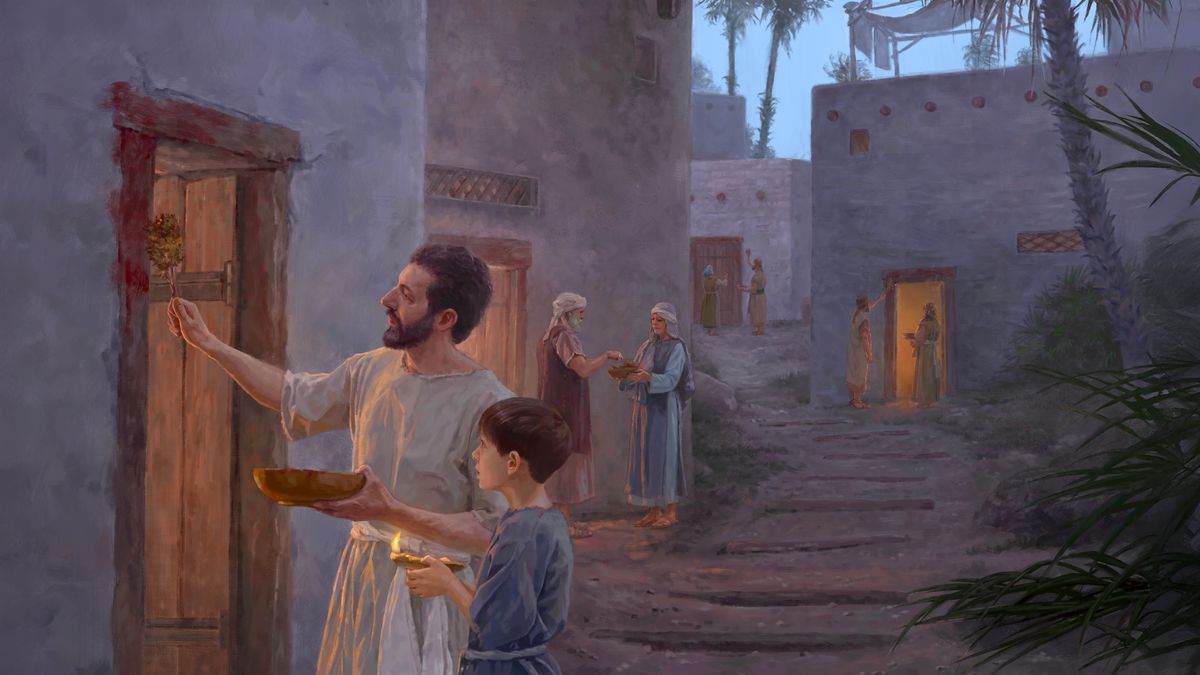
The Israelites obeyed Jehovah regardless of how the Egyptians might have reacted (See paragraph 3)
4. What unusual instructions did Jehovah give the Israelites on their way out of Egypt?
4 That very night, the Israelites left Egypt. Jehovah first led them toward the northern end of the Red Sea, but then he gave them instructions that defied human logic. He told them to turn south and encamp between the sea and the mountains. At that campsite, it seemed that they would be trapped between Pharaoh’s army that was pursuing them and the Red Sea. Yet, the Israelites once again did as Jehovah had commanded through his servant Moses. (Ex. 14:1-4) But when they saw the Egyptians approaching, they “became terrified” and even accused Moses of leading them to their death! (Ex. 14:5-11) Why did they begin regretting their decision to obey? And how did Jehovah view their attitude?
5. What did the Israelites fail to do at the Red Sea? (Psalm 106:7 and footnote)
5 The Bible says that at the Red Sea, the Israelites “did not appreciate [Jehovah’s] wonderful works” in Egypt or “remember” his loyal love. (Read Psalm 106:7 and footnote.) They had observed how Jehovah protected their firstborn during the tenth plague. But they did not fully grasp Jehovah’s love for them or trust that he would save them again. Discerning their heart condition, Jehovah said that the people “rebelled . . . by the Red Sea.” Even though they followed Moses through the Red Sea, they never corrected their attitude. Jehovah ultimately rejected that entire generation of Israelites and did not allow them to enter the Promised Land. (Ps. 106:21, 24-26) What can we learn from their experience?
LEARN FROM THE ISRAELITES’ WARNING EXAMPLE
6. What will an obedient heart enable us to do? (Jeremiah 23:4)
6 The Exodus account shows that we need to examine our reasons for obeying Jehovah and those he assigns to lead his people. Do we obey only when we see some immediate benefits? It’s possible that some of the Israelites sprinkled the ram’s blood on the doorposts simply to save their firstborn. Also, does our obedience depend on what others do? On the night of the Passover, Jehovah gave the Israelites “favor in the eyes of the Egyptians.” (Ex. 12:36) But when the Egyptians later turned against them, the Israelites lost their trust in Jehovah and rebelled. (Ex. 14:10-12) In contrast to their attitude, if we have an obedient heart, we will be moved to trust in Jehovah and in those he has raised up to take the lead. (Read Jeremiah 23:4.) We will follow the direction we receive even if we do not fully understand all the reasons for it or if doing so angers those who hate Jehovah. How can we avoid making the same mistakes the Israelites made and develop an obedient heart?
7. How will strengthening our love for Jehovah help us to obey him?
7 Strengthen your love for Jehovah. Our obedience can be tested when we do not see the immediate benefits of theocratic direction or when we face challenges because of our obedience. If that happens, we need to remember that we obey Jehovah primarily because we love him and trust in him. (1 John 5:3) Our love helps us to wait patiently for him and to admit that we may need time to see the good results of our obedience.—Eccl. 7:8; Mic. 7:7.
8. How did two Witnesses show their determination to be obedient?
8 In our time, God’s people have set a fine example in being obedient even when they could not see the immediate benefits of doing so. For instance, during the COVID-19 outbreak, congregations were directed to use videoconferencing for their meetings. An elder in Peru recalls: “At first, I thought that the direction was not practical for our area.” Despite his concerns, he remained determined to obey God and trust in him. (Prov. 3:5, 6) The outcome? “I saw how Jehovah rewards obedience,” he says. “Our congregation became stronger and more united.” Consider another example. Later in 2020, the organization changed the guidelines for foreign-language congregations and groups. When a sister in Japan learned that the group she was serving with would be discontinued, she said: “I want to be obedient to the adjustment and not speak negatively about it. I look forward to seeing the benefits.”
9. How can we prepare to be obedient despite opposition? (See also picture.)
9 Prepare for opposition. This is especially important to do when it comes to our Kingdom-preaching work. In many parts of the world, we still enjoy favorable conditions. Even so, our preaching the good news of God’s Kingdom includes telling others that this wicked system will soon come to an end. We will keep preaching that message until just before this system ends at Armageddon. (Matt. 24:14) Moreover, during the great tribulation, the message we preach may become more forceful and direct, causing people to decide whether they will accept the Kingdom or not. To those who hate Jehovah, our message may seem like an “unusually great” plague.a (Rev. 16:21) No doubt, they will become enraged, just as Pharaoh had become at the Red Sea. We can prepare for future opposition by being obedient now to the command to preach despite how others may view us.

Our obedience now prepares us to face opposition in the future (See paragraph 9)
IMITATE KING JEHOSHAPHAT’S OBEDIENCE
10. How did King Jehoshaphat feel when he was threatened by invading nations?
10 The Bible also contains fine examples of individuals who were obedient. For instance, King Jehoshaphat faced three nations that had joined forces in order to wage war against Judah. Understandably, Jehoshaphat and his people were afraid. (2 Chron. 20:1-3) But the king was not paralyzed by fear; he took action. Imitating what Jehoshaphat did next can help us to develop an obedient heart.
11. What did Jehoshaphat do when he became afraid? (2 Chronicles 20:5, 6, 10-12)
11 Resolve to search for Jehovah and obey him. When Jehoshaphat became afraid, “he resolved to search for Jehovah.” (2 Chron. 20:3) Jehoshaphat had already set a pattern of looking to Jehovah for guidance. (2 Chron. 19:3) But in this difficult circumstance, he “resolved,” or strengthened his determination, to look for Jehovah and obey whatever direction He provided. Jehoshaphat then followed through with a heartfelt prayer. (Read 2 Chronicles 20:5, 6, 10-12.) When we are dealing with stress, let us follow his example. We can resolve to obey Jehovah, search for his guidance through prayer and study, and trust that he will help us.—Ps. 119:112.
12. How can we strengthen our resolve to obey Jehovah?
12 Build your Bible knowledge. Jehoshaphat’s prayer revealed his depth of knowledge. He understood how Israel had inherited its land through God’s promise to Abraham. (Gen. 12:7) Jehoshaphat’s words were similar to those Solomon had uttered when praying at the inauguration of the temple. (2 Chron. 6:28-30; 20:5-9) Jehoshaphat’s knowledge strengthened his trust in Jehovah and his resolve to obey Him. To strengthen our resolve, we need to keep building our “treasure store” by adding new truths to what we already know. (Matt. 13:52) As we do, we strengthen our determination to obey Jehovah even during challenging situations.
13. How can humility help us to be obedient?
13 Cultivate humility. Jehoshaphat’s prayer also reflected his humility. As king, he could have been tempted to rely on his strength and ability to handle the threat. Instead, in a public prayer, he humbly acknowledged that Judah needed God’s help. (2 Chron. 20:12) The king’s humble attitude made it easier for him to accept God’s direction. Humility will likewise help us to maintain an obedient heart in any circumstance.—Phil. 2:5, 8.
14. How did Jehoshaphat respond to God’s instructions?
14 Consider how your actions affect others. Jehovah answered Jehoshaphat’s prayer by giving him clear instructions through the prophet Jahaziel, who told the people that they would not need to fight. Instead, he instructed them: “Take your position, stand still, and see the salvation of Jehovah in your behalf.” The Bible says that Jehoshaphat then “bowed low with his face to the ground.” At that, all the people “fell down . . . to worship Jehovah.” The next day as they went out, the king urged the people to “put faith in Jehovah” and “in his prophets.”—2 Chron. 20:14-20.
15. How did Jehoshaphat show the depth of his faith?
15 Showing the depth of his faith, Jehoshaphat appointed men to sing praises “as they went out ahead of the armed men.” (2 Chron. 20:21) Jehoshaphat took that step only “after he consulted with the people.” What a fine example he set in motivating his subjects to trust in Jehovah and be obedient! Jehovah rewarded them by causing the invaders to annihilate one another.—2 Chron. 20:22-24.
16. What can those in authority learn from Jehoshaphat? (1 Kings 3:9) (See also picture.)
16 Elders, parents, and others in authority can learn from Jehoshaphat. His heartfelt obedience had a good influence on those under his care. In this regard, he was like King Solomon. When Solomon was faithful, he prayed for an obedient heart. Solomon made this request, not for his own benefit, but for the benefit of the people. He wanted to judge them according to Jehovah’s way. (Read 1 Kings 3:9.) Jehoshaphat listened humbly to God’s prophet, consulted with the people before making an important decision, and encouraged them to obey Jehovah’s direction. Wise elders follow his example. They humbly consult God’s Word, our publications, and other elders before making decisions that affect the congregation. (Prov. 15:22) And by word and deed, they persuade God’s people to be obedient from their heart. Likewise, parents recognize how their example of obedience, whether positive or negative, affects their children.—Prov. 1:8; 14:1.

Wise elders listen to Jehovah, to the organization, and to one another (See paragraph 16)
17. Why should we continue to have an obedient heart?
17 No matter what challenges we might face, when we have an obedient heart, we can count on Jehovah’s care and direction. As in Bible times, he will no doubt provide direction through his earthly representatives. And if his instructions seem unusual, we should not be surprised. Jehovah’s ways and abilities are far superior to ours. (Isa. 55:9) So let us continue to develop an obedient heart.
SONG 88 Make Me Know Your Ways
a See “Questions From Readers” in the August 2025 issue of The Watchtower.
Sharing the Good News in “All the Languages of the Nations”
pp. 14–19
NOVEMBER 16-22, 2026
SONG 84 Reaching Out
Sharing the Good News in “All the Languages of the Nations”
“Ten men out of all the languages of the nations will take . . . hold of the robe of a Jew.”—ZECH. 8:23.
FOCUS
Appreciating the role of Jehovah’s people in the fulfillment of Zechariah 8:23.
1. Why is it essential for the good news to be preached in many languages? (Romans 10:13, 14)
JEHOVAH frustrated the efforts of the rebellious builders of the Tower of Babel by confusing their language. As a result, the human family was fragmented into language groups and scattered throughout the earth. (Gen. 11:6-9) But it is Jehovah’s declared purpose to unite “a great crowd . . . out of all nations and tribes and peoples and languages” and lead them through the great tribulation and into the new world. (Rev. 7:9, ftn., 10, 14) This great crowd can call on Jehovah’s name during the great tribulation because the Kingdom message has reached them in a language they understand. (Read Romans 10:13, 14.) What a privilege we have to share in that lifesaving work!
2. What was the prophet Zechariah inspired to foretell?
2 Centuries before the apostle John wrote the book of Revelation, Jehovah inspired the prophet Zechariah to foretell that “many nations [would] join themselves to Jehovah . . . and [would] become [His] people.” (Zech. 2:11) Later in his prophetic book, Zechariah wrote: “This is what Jehovah of armies says, ‘In those days ten men out of all the languages of the nations will take . . . firm hold of the robe of a Jew, saying: “We want to go with you, for we have heard that God is with you people.”’” (Zech. 8:23) This exciting prophecy is being fulfilled in our day. Let us see how each of us can have a part in its fulfillment.
REACHING “TEN MEN OUT OF ALL THE LANGUAGES”
3. Who today are represented by the “Jew,” and who are represented by the “ten men”?
3 The “Jew” in Zechariah’s prophecy represents those whom God has anointed with holy spirit. They are also known as “the Israel of God.” (Gal. 6:16) These have “the heavenly calling.” (Heb. 3:1) The “ten men” represent humble ones who hope to live forever in Paradise on earth. They come from all linguistic and national backgrounds.
4. What happened after Jesus appointed “the faithful and discreet slave” in 1919?
4 When Christ appointed “the faithful and discreet slave” in 1919, those making up that slave recognized that their commission was international in scope, one that would involve translating the Bible’s message into numerous languages. (Matt. 24:45) The Bible Students had already been presenting the “Photo-Drama of Creation” to international audiences, but the faithful slave saw the need to do more. For example, the Bible study aid entitled The Harp of God, released in 1921, was eventually translated into 36 languages. In 1935 the “great crowd” was clearly identified, revealing the enormous scope of the work. Thus, during the first few decades of the 20th century, Jehovah laid the foundation for the witnessing work to expand and completely fulfill Zechariah’s prophecy.
“YOUR PEOPLE WILL OFFER THEMSELVES WILLINGLY”
5-6. How is Isaiah 2:2-4 being fulfilled today? (See also picture.)
5 As the good news continued to spread, righthearted people were found among many language groups. As foretold, people from all nations were invited to Jehovah’s house so that they could be instructed about his ways. (Read Isaiah 2:2-4.) In order to reach these potential disciples and care for them, God’s people have “offer[ed] themselves willingly” not only to preach but also to translate, to print, and to ship the lifesaving message contained in our publications in an ever-growing number of languages. (Ps. 68:11; 110:3) In addition, computer programmers and other skilled workers have designed and maintained programs, including JW Library®, as well as a multilanguage website.
6 People of all nations and language groups benefit from the spiritual food provided by the faithful and discreet slave. One way they show their appreciation is by providing financial support, making voluntary donations to the worldwide preaching work. As a result of this united effort, lifesaving Bible-based publications have become available in over 1,100 languages. And each year, hundreds of thousands of individuals get baptized.

People of all nations and language groups benefit from the spiritual food provided through the faithful and discreet slave (See paragraphs 5-6)
7. How are we affected by seeing the fulfillment of Revelation 14:6?
7 Jehovah’s people are now equipped with tools that transcend language barriers. Under angelic direction, they are unitedly declaring “everlasting good news . . . to every nation and tribe and tongue [or, “language,” ftn.] and people.” (Read Revelation 14:6.) When we see how the thrilling prophecies recorded by Zechariah and by John are being fulfilled in modern times, we are moved to trust Bible prophecy and to cling to the organization that God is using to proclaim the good news.
A MODERN-DAY MIRACLE
8. At Pentecost 33 C.E., how did Jehovah reverse the effects of what he had done at the Tower of Babel?
8 On the day of Pentecost 33 C.E., Jehovah revealed that he had the power to reverse the effects of what he had done at the Tower of Babel. He miraculously enabled Christ’s disciples to speak in languages that they did not know. (Acts 2:4-10) Why did he do so? In order to make known “the magnificent things of God” to an international crowd of God-fearing persons. (Acts 2:11) Today, our publications enable us, in effect, to speak in the tongues of interested ones.
9. How can we help those who speak a language that we do not know to learn about the good news?
9 People need to hear the good news in a language that they understand. Consider this illustration: A person travels overseas, but he becomes seriously ill and needs medical attention. If he does not speak the local language, he will need an interpreter to help him understand what the doctor is instructing him to do to get well. Similarly, countless people today are suffering spiritually and emotionally, and they are in need of hope and comfort. The remedy they require is found in the Bible’s message. When we meet someone, we can help him to receive that lifesaving remedy in a language that he understands. We have the tools we need—printed literature, videos, and digital publications.
10-11. What do you learn from the experience of a brother named Robert and from the account in the box “A Refugee Finds Hope”?
10 How can we effectively use the spiritual tools available to us? Note the experience of Robert, who speaks English. While doing harbor witnessing, he met a man from Türkiye who was working on a ship. The man spoke little English but accepted the brochure Good News From God! in Turkish. Robert was thoroughly familiar with the brochure’s contents, so he was able to direct the man to read selected portions in his language. The Turkish man then asked a number of questions about world conditions and was shown the Bible’s answers in Turkish, using the JW Library app. He exclaimed: “It is as if you knew my language!” Robert relates: “We spoke for about an hour. During the conversation, it was clear that this man’s respect for the Bible and his understanding of its message greatly increased.” What a privilege we have to help sincere individuals hear God’s message in the language of their heart!
11 Something as simple as sharing a tract or an article on the jw.org website in a language that another person can understand could have amazing results. Why not make it a goal to prepare to share the Bible’s message with those who do not speak your language?
MAKING JEHOVAH’S NAME KNOWN AMONG THE NATIONS
12. What effect does reading and studying the New World Translation have on Jehovah’s people?
12 All of us depend on the work done by translators. Bible translation is not new.a Translators have worked tirelessly to ensure that the message of God’s Word reaches more people. In recent years, a remarkable tool for unifying Jehovah’s people has been the New World Translation of the Holy Scriptures. Note what an elder who serves in Nepal says about this translation: “Reading this translation in my language has made Jehovah more real to me. It has helped me draw closer to God and has strengthened my faith.” The New World Translation is available, in whole or in part, in well over 300 languages. That is one reason why Jehovah’s people are able to think and speak in agreement—they use this clear, reliable Bible translation that conveys the same message regardless of language. (1 Cor. 1:10) However, this translation does much more.
13. Why do few modern Bible translations use God’s name?
13 The New World Translation is one of the few Bibles being distributed in the 21st century that continues to honor Jehovah’s name by using it throughout the Bible text. At the beginning of the last days, it was common to find the name Jehovah in many translations of the Bible, especially in the Hebrew Scriptures. However, the leaders of Christendom, who claim to represent God, have become increasingly opposed to making known or to using God’s name, Jehovah. The leaders of the Catholic Church have removed it from their Bibles and from related literature.b Most Protestant denominations likewise omit the name from their translations of the Bible. In contrast, the New World Translation consistently restores the divine name to its rightful place in the Scriptures, regardless of language. Why is this significant?
14. According to the Scriptures, why is it important to know and to use God’s name?
14 The Scriptures repeatedly highlight the importance of knowing and using God’s name. The psalmist urges God’s servants to “praise the name of Jehovah.” (Ps. 135:1) When teaching his disciples how to pray to Jehovah, Jesus directed them to say: “Let your name be sanctified.” Later, while praying to his Father, Jesus said: “I have made your name known.” (Matt. 6:9; John 17:26) The apostle Paul quoted the words of the prophet Joel, who said: “Everyone who calls on the name of Jehovah will be saved.” (Rom. 10:13) People who use Bible translations that omit the divine name cannot obey these inspired exhortations.
15. How do Jehovah’s people feel about the divine name?
15 The vast majority of Jehovah’s Witnesses have access to a translation that accurately conveys Bible truth, including the importance of relying on and praising God’s illustrious name. They have grown to love that name and to rely on the One it represents.—Prov. 18:10; Isa. 56:6.
16. Why is it urgent to come to know Jehovah now? (John 17:3)
16 The Bible foretells a showdown in the near future between “the kings of the entire inhabited earth” and Jehovah. (Rev. 16:14) During that time, those who know Jehovah and honor his name will be kept safe. (Ps. 9:10; read John 17:3; see study note on “their coming to know you.”) But those who refuse to know him as their Father and God will be forced to know him in a different way. Jehovah says: “I will certainly magnify myself and sanctify myself and make myself known before the eyes of many nations; and they will have to know that I am Jehovah.” (Ezek. 38:23) How happy Jehovah’s people will be that they know him as their Friend and not as their adversary!—Mal. 3:16.
17. What privilege do we have?
17 What a privilege we have to play even a small role in the fulfillment of the prophecy recorded at Zechariah 8:23! We have the opportunity of working unitedly not only with our brothers and sisters but also with the angels in this multilingual preaching work. Jehovah is giving us the tools we need to reach people from every nation and tribe and tongue. May we use these tools effectively to help draw as many people as possible to our impartial, merciful, and patient God, Jehovah. It is our honor to share in this work until Jehovah’s name is sanctified before all creation.—Luke 11:2.
SONG 57 Preaching to All Sorts of People
a The first translation of the Holy Scriptures—known as the Greek Septuagint version—was completed about 150 B.C.E.
b In 2008, Pope Benedict XVI directed that God’s name is “neither to be used [n]or pronounced” in Catholic religious services, hymns, or prayers. See also The Watchtower of October 1, 1997, pp. 16-18, pars. 4-8.
How the Priesthood Reveals Jehovah’s Love
pp. 20–25
NOVEMBER 23-29, 2026
SONG 107 The Divine Pattern of Love
How the Priesthood Reveals Jehovah’s Love
“Every high priest taken from among men is appointed in their behalf.”—HEB. 5:1.
FOCUS
How Jehovah’s provision of the priesthood draws us closer to him.
1. Why is mankind in dire need of help?
HELP! All humans need it whether they know it or not. In fact, their need is desperate. Why? In a word, sin. Because of inherited sin, mankind as a whole is alienated from God. (Eph. 2:12; Col. 1:21) In a sense, sin creates a chasm that separates humans from God, and man cannot cross that gap by himself. Without help, we could never find true meaning in life. We would have no hope for the future. What help has Jehovah provided?
2. What will we consider in this article?
2 To save us from our sinful state, Jehovah has made a remarkable arrangement—that of a priesthood. He did so for the ancient nation of Israel and later for the Christian congregation. That arrangement is still in effect today. In this article, we will discuss how the priesthood arrangement proved to be a blessing for men and women in ancient times. We will also learn how we can benefit from the priesthood arrangement that is now in effect and how we will continue to do so in the future. And finally, we will see how the priesthood reveals Jehovah’s deep love for us.
HOW A PRIESTHOOD HELPED ANCIENT ISRAEL
3. According to Hebrews 5:1, in what way does the priesthood help sincere worshippers? (See also picture.)
3 Under inspiration, the apostle Paul explained why Jehovah provided a priesthood for the nation of Israel. (Read Hebrews 5:1.) Jehovah wanted to help them draw closer to him. The high priest was the one whom Jehovah appointed in behalf of men “over the things relating to God.” Priests helped sincere worshippers to approach God acceptably, to bridge the gap between God and man.

Sin created a divide; the priesthood bridges it (See paragraph 3)
4. How did the priests of Israel represent God before man?
4 How did the priests of Israel help worshippers to approach Jehovah and serve him acceptably? In two important ways. First, priests represented God before man by serving as teachers. How so? Malachi 2:7 says: “The lips of a priest should safeguard knowledge, and people should seek the law from his mouth, because he is the messenger of Jehovah of armies.” So the priests had the assignment to teach the Law of Moses to the people of Israel, helping them to understand it and to live by it. As an example, in Nehemiah’s day, 13 different Levites assisted priest Ezra to explain the Law to the people. They put meaning into it and helped the people to understand what was read. In this way, the Israelites were able to apply God’s laws in their lives and thereby draw closer to him.—Neh. 8:2, 3, 6-8.
5. How did the priests of Israel represent man before God, and what does that teach us about Jehovah?
5 Second, priests represented man before God. The priests did this by offering sacrifices in behalf of the people. The Israelites were well-aware of their daily errors and failings. They knew that they needed to have their sins wiped away. (Ps. 51:9) The priests and the sacrifices helped make that possible. What a relief it was for repentant Israelites to know that their sins had been forgiven! Through the priesthood arrangement, we see Jehovah’s love, compassion, and interest in the well-being of his people and, ultimately, in their salvation.
THE ROLE OF A PRIEST—PAST, PRESENT, AND FUTURE
6. In patriarchal times, what role did a family head have that was similar to that of a priest?
6 Jehovah has always wanted a peaceful relationship with his obedient worshippers. In patriarchal times, long before the nation of Israel was formed, it was common for the family head to offer sacrifices for himself and his family. For example, after leaving the ark, Noah offered up sacrifices of thanksgiving. (Gen. 8:20) Abraham built altars in order to make sacrifices to Jehovah. (Gen. 12:7, 8) And Job offered burnt sacrifices in behalf of his children. (Job 1:5) That explains why the Bible speaks of priests even before the Levitical priesthood was established. Jehovah told the Israelites: “Let the priests [the family heads] who regularly come near to Jehovah sanctify themselves, so that Jehovah may not strike them.”—Ex. 19:22.
7. Who was Melchizedek, and how did he prefigure the Messiah?
7 The first person specifically called a priest in the Scriptures was Melchizedek. (Gen. 14:18) He was not only a priest but also a king. Jehovah later promised that the Messiah would be both a king and a priest, as Melchizedek was. But the Messiah’s rule would benefit mankind forever.—Ps. 110:4; Heb. 7:17.
8. How was the priesthood organized under the Mosaic Law?
8 In time, Jehovah formed the nation of Israel and gave them the Mosaic Law, which included instructions regarding the priesthood. Moses’ brother, Aaron, and his descendants were assigned to serve as priests. (Ex. 40:12-15) With the assistance of the Levites, the priests would offer sacrifices in behalf of the nation and of individual Israelites. Jehovah gave specific guidelines regarding the types of offerings to be given, the purpose of the offerings, and how they were to be presented. This arrangement provided a foretaste of what was to come.
9-10. Who will serve as priests along with Jesus during the Thousand Year Reign?
9 At his baptism, Jesus became the High Priest serving in Jehovah’s great spiritual temple. (Heb. 8:1) Jesus later gave up his perfect human life to atone completely for man’s sins. His sacrifice was far superior to the animal sacrifices offered by the priests of Israel. Jesus continues to serve in this priestly capacity, appearing before God on our behalf. (Heb. 9:24) Under God’s Kingdom arrangement, 144,000 anointed ones will serve alongside our High Priest, Jesus, as kings and priests. (1 Pet. 1:3, 4; 2:9) Once resurrected to heaven, they will work along with God and Christ to bring obedient mankind to perfection and make the earth a paradise. How we look forward to seeing their work completed!
10 As we have seen, Jehovah has arranged for man to benefit from priestly services throughout much of history. The many sacrifices the priests offered reminded faithful Israelites of their need for a ransom. Jehovah will continue to use a priesthood throughout the Thousand Year Reign of Christ until man is brought to perfection and no longer needs priestly services. How does learning about this arrangement draw us closer to Jehovah? Consider a few ways.
HOW THE PRIESTHOOD DRAWS US CLOSER TO JEHOVAH
11. How does the priesthood reflect Jehovah’s desire to have a close relationship with mankind?
11 The priesthood reflects Jehovah’s desire to have a close, personal relationship with his servants. Even though sin has created a gulf between mankind and Jehovah, he is determined to close that gap forever. Jehovah wants us to be able to approach him, gain his favor, have a warm personal relationship with him, and be saved. (2 Cor. 5:18) Jehovah realizes that our sinful state is something that we inherited through no fault of our own. He mercifully reaches out to us, helping each one to gain an approved standing before him. Does that not move you to love him even more?
12. Why is it encouraging that Jesus, the High Priest, pleads on our behalf? (Hebrews 7:25) (See also picture.)
12 Jesus too wants us to enjoy a meaningful relationship with Jehovah. As High Priest, Christ acts as “a helper with the Father.” (1 John 2:1; read Hebrews 7:25.) What factors might Jesus consider as he pleads for you? Perhaps he will take note of how your background, upbringing, health, and emotional makeup affect you. He might consider your fine qualities and deeds as well as your record of faithful service. Because Jesus can read the heart, he will no doubt reflect on your constant prayers for forgiveness and your sincere efforts to improve. We can be certain that Christ’s pleadings for us are well-received by Jehovah, who is compassionate and ready to forgive. (Ps. 86:5) Indeed, Jehovah is the one who provided Jesus to be our advocate.

Our High Priest, Jesus, takes into account our good motives, fine deeds, requests for forgiveness, and efforts to improve (See paragraph 12)
13. According to Hebrews 4:16, what additional blessing does the priesthood offer, and why is that so helpful?
13 The priesthood assures us that Jehovah wants to have open communication with us. (Read Hebrews 4:16.) Because of the services of the great High Priest, Jesus, we can speak to Jehovah freely in prayer. Jehovah is pleased to hear us when we approach him. In doing so, we show that we trust in him and rely on him. At times, we may not know exactly how to express ourselves. We may be in such distress that we do not know what to pray for. (Rom. 8:26) Still, Jehovah listens, understands, and responds. We should not hesitate to share any concern with our loving, compassionate heavenly Father.
14. How does the sacrifice of Jesus reflect Jehovah’s interest in our eternal salvation?
14 The priesthood shows that Jehovah wants us to have life. (Ezek. 33:11) The animal sacrifices offered in ancient times did not completely atone for the sins of God’s worshippers. (Heb. 7:19) However, those sacrifices pointed to the perfect sacrifice of Christ Jesus. His sacrifice makes true forgiveness possible. It opens up the way for obedient humans to have everlasting life. How grateful we are that Jehovah took the initiative to arrange for our salvation!—1 John 4:10.
15. How is Jehovah’s love seen in his choice of individuals who will serve as priests in the Kingdom?
15 We see Jehovah’s love in his choice of individuals who will serve as priests. Like their Master, the anointed must prove faithful even to death. (Phil. 2:8; Rev. 2:10) Their loyalty to Jehovah must be proved beyond all doubt. Thus, we can trust that they will lovingly apply the benefits of the ransom sacrifice, which will help us to overcome sin and grow to perfection. That remarkable work will continue throughout Christ’s Thousand Year Reign until Jehovah’s purpose with regard to the earth and the healing of mankind has been accomplished.—Rev. 22:1, 2.
16. How does Hebrews 4:15 indicate that Jesus is uniquely qualified to serve as High Priest for us?
16 Christ, our High Priest, is sympathetic to our challenges and experiences because he himself lived as a human on earth. (Read Hebrews 4:15.) Consider: Do you feel tired at times? Jesus did too. (John 4:6) Have you felt the effects of hunger and thirst? Jesus knows what that feels like. (Matt. 4:2; John 19:28) Do you face opposition and ridicule for your faith? Jesus did too. (Isa. 50:6; John 15:20) Have you lost a loved one in death? Jesus lost his friend Lazarus and apparently his stepfather, Joseph. We can rest assured that our High Priest, Jesus, will care for us with understanding and empathy that come from experience.
17. Why can we be sure that the anointed will have fellow feeling and insight as they help mankind?
17 The 144,000 will have fellow feeling and insight as they help Jesus lift mankind to perfection. They were once imperfect and sinful as men or women on earth. They know what it feels like to make mistakes and to struggle with guilt. They understand what it is like to suffer from health problems, both physical and emotional. They come from a variety of backgrounds, races, cultures, time periods, and personal circumstances. Whatever your life experience has been, someone from among the 144,000 can relate.
18. What does the priesthood teach us about Jehovah’s personality, and how does that make you feel about him?
18 All that we have learned about the priesthood teaches us that love, mercy, compassion, and fellow feeling are aspects of Jehovah’s personality. Satan is our constant accuser; Jehovah is not. (Rev. 12:10) We have considered in this study that Jehovah has done much to draw us to him and to pave the way for us to feel assured of his approval and friendship. Does that not draw you closer to Jehovah? Does it not make it easier to accept his love and forgiveness?
19. How does the priesthood assure us that Jehovah understands the struggle we face?
19 Our study of the priesthood also assures us that even when we feel unworthy because of our sins, we can trust that Jehovah understands our struggle. He knows that we are made of dust. (Ps. 103:14) Nonetheless, he continues to see past our sins and focuses on the good in us and on our potential for improvement. When our sins and mistakes are all we can see, we need to remember that Jehovah “is greater than our hearts and knows all things.”—1 John 3:20.
20. Why are you thankful for the priesthood, and what are you determined to do?
20 As we have seen, Jehovah has provided the priesthood so that we can worship him acceptably. It is his heartfelt desire that we do so. Thanks to the gift of the priesthood, the gap between Jehovah and his imperfect but faithful worshippers has been closed. We may thus do as Hebrews 4:16 encourages: “Let us, then, approach the throne of undeserved kindness with freeness of speech, so that we may receive mercy and find undeserved kindness to help us at the right time.”
SONG 16 Praise Jah for His Son, the Anointed
Guard Against “the Spirit of the World”
pp. 26–31
NOVEMBER 30–DECEMBER 6, 2026
SONG 22 The Kingdom Is in Place—Let It Come!
Guard Against “the Spirit of the World”
“Everything in the world . . . does not originate with the Father.”—1 JOHN 2:16.
FOCUS
How to resist three of the world’s subtle influences.
1. How does Satan use the spirit of the world? (1 John 2:15, 16)
WE LIVE in a world that is ruled by Satan. (John 14:30; 1 John 5:19) He especially wages a bitter fight against Christ’s followers. (Rev. 12:12, 13, 17) This does not mean that Satan is in every place at all times. In fact, the Bible does not indicate that any angel—wicked or righteous—has that ability. But Satan has a large number of wicked angels on his side. (Rev. 12:9) And the spirit of the world, which Satan promotes, is everywhere. Most people yield to its influence whether they realize it or not. (Read 1 John 2:15, 16.) Even if people do not believe that Satan exists, they please him when they act according to the world’s spirit. In a sense, they are “caught alive by him to do his will.”—2 Tim. 2:26.
2-3. (a) How do Jehovah’s people differ from those who yield to “the spirit of the world”? (b) Of what danger do we need to be aware?
2 At one time, many of us acted in accord with the spirit of the world. What did we do, however, when we learned what this spirit is and who is behind it? We followed the Bible’s admonition “to reject ungodliness and worldly desires.” (Titus 2:11, 12) The fact that we have done so despite Satan’s widespread influence and enormous power indicates that we want to have Jehovah’s backing. (Jas. 4:7, 8) Indeed, Jehovah’s people are to be commended for firmly resisting the spirit of the world!
3 Nevertheless, we need to be aware of a danger. The world appeals to our sinful tendencies—often in subtle ways. As a result, some who had initially put up a hard fight for the faith have later become infected by the spirit of the world. (Eph. 6:11; Phil. 3:18) This article will provide suggestions that can help us avoid that outcome. First, though, we will consider what is meant by the expression “the spirit of the world.”—1 Cor. 2:12.
WHAT IS “THE SPIRIT OF THE WORLD”?
4. What is “the spirit of the world,” and how is it manifest today?
4 In the Bible, the expression “the spirit of the world” refers to the way people who are not friends of God think and act. Those who are infected by the spirit of the world tend to be selfish. They may also reject Jehovah’s moral standards. For example, many today take a permissive view of ungodly conduct. They follow “the will of the nations,” not the will of the Creator.—1 Pet. 4:3.
5. In what way is the world’s spirit like “the air”? (Ephesians 2:1, 2) (See also picture.)
5 The spirit of the world is one of the effective means by which Satan “is misleading the entire inhabited earth.” (Rev. 12:9) The apostle Paul spoke of it as “the air.” (Read Ephesians 2:1, 2.) What a fitting illustration! Like air that is polluted by harmful contaminants, the spirit of the world is harmful; yet, it may be easy to breathe in. And, as mentioned earlier, it is everywhere. Let us consider a few subtle ways that the world’s spirit can affect us and how we can avoid its influence.

The spirit of the world is easy to breathe in (See paragraph 5)
SHUN UNWHOLESOME SPEECH
6. How is the spirit of the world evident in people’s speech?
6 The Bible foretold that in the last days, people would be “boastful, haughty,” and “not open to any agreement.” (2 Tim. 3:1-3) People today often display those traits in their speech. For example, news reports tell of verbal disputes that escalate into violence. Abusive speech is also common in many homes. So is obscene language, which can be heard coming from the mouths of adults and children alike. (Eph. 5:3, 4) Such speech certainly reflects the spirit of the world.
7. How can we examine our speech?
7 As Christians, we should be exemplary in our speech whether we are communicating in person or electronically. (Jas. 1:26, 27) In examining our speech, we can ask ourselves: ‘Do I use foul language when I am provoked, perhaps when I am dealing with people who don’t know that I am one of Jehovah’s Witnesses? Do my conversations with fellow believers tend to be negative, cynical, even sarcastic? Do I speak harshly to my family members? What would they say about my speech?’
8. How can we shun unwholesome speech? (Colossians 3:8-10)
8 What can we do if we discern that our speech reflects the spirit of the world? We need to change more than our words. Remember what Jesus said: “Whatever comes out of the mouth comes from the heart, and those things defile a man.” (Matt. 15:18) As Jesus indicated, our speech usually reflects how we feel inside. That is why the Bible links “abusive speech” with negative emotions—such as anger, wrath, and malicious bitterness. (Eph. 4:31) If you realize that you need to put away such traits, ask Jehovah in prayer to help you to cultivate more fully “the new personality.” (Read Colossians 3:8-10.) You might also do research to find articles in our publications that offer help on this topic. Be resolved not to let the spirit of the world influence your attitude or pollute your speech.—Eph. 4:29.
REJECT IMMORAL CONDUCT
9. How is the world’s spirit evident in the way people view Jehovah’s moral standards?
9 The spirit of the world is evident today in the complete disregard many people have for Jehovah’s moral standards. It is common for people in the world to condone or even encourage abortion, homosexuality, and premarital sex. (Isa. 5:20) If we are not careful, the world’s spirit can gradually weaken our hatred for what is bad. (2 Cor. 11:3) We might even begin to think that the world’s viewpoint is enlightened, while the Bible’s standards are outdated. Nothing could be further from the truth! Jehovah’s ways are always for our good. They are higher than man’s ways, and they do not become outdated with the passing of time.—Isa. 48:17, 18; 55:9.
10. How can we examine our view of the things that Jehovah hates?
10 Those who want to please Jehovah must hate what he hates. (Ps. 97:10) With that in mind, we can ask ourselves: ‘Do I feel that Jehovah’s moral laws are keeping me from living as I would really like to? Does my choice of entertainment indicate that I am drawn to things that Jehovah hates? Do I wish that Jehovah would somehow adjust his standards to conform to my desires?’
11. How can we learn to hate the things that Jehovah hates?
11 What if you feel drawn to something that Jehovah hates? Do not conclude that it is impossible for you to live by Jehovah’s standards. Remember that all imperfect humans are inclined to sin. (Ps. 51:5; 103:14) However, you can choose not to act on wrong desires, not “[to carry] out the will of the flesh.” (Eph. 2:3) Also, you should refuse to dwell on wrong desires. If at some point you sense that a wrong desire has come up in your heart, immediately turn your eyes and your mind away from things that Jehovah hates. (Gen. 39:9, 12) And reflect on how such things could damage your relationship with Jehovah and with others. Be determined not to let that happen. (Eph. 5:5) With Jehovah’s help, you can learn to hate what is bad.
AVOID ONLINE DANGERS
12. How is the world’s spirit reflected on the Internet?
12 For many of us, the Internet plays a role in nearly every aspect of our life, including our worship. However, much of what is found on the Internet promotes the spirit of the world. For example, online pornography is widespread and can be easily accessed by adults and by children. Sexting—the practice of sending sexually explicit photos, videos, or messages—is rampant, especially among youths. There is also an abundance of online propaganda that distorts reality and misleads many. Social media posts often present the highlights of people’s lives. Such images, comments, and short videos can make us feel that we need to spend more time in recreation and travel, even at the expense of our worship.—Heb. 10:24, 25.
13. How can we evaluate our use of the Internet?
13 We need to be careful about any online activity that can consume our time or negatively affect our thinking. In that regard, we can ask ourselves: ‘How much time do I spend scrolling through online content without a specific reason for doing so?’ (Eph. 5:15, 16) ‘What kind of content do I allow myself to be exposed to? How quickly do I turn away from what is objectionable?’ (Ps. 119:37) ‘Am I quick to believe everything that I read online, or am I careful to check the facts?’—Prov. 14:15.
14. How can we avoid online dangers?
14 To guard against the spirit of the world, limit how much time you spend online and avoid looking at anything inappropriate. Also, parents should carefully monitor their children’s use of social media. (Eph. 6:4) Many researchers have found that youths who spend a lot of time on social media are more likely to be lonely, anxious, and depressed than those who do not. When you apply the practical counsel found in God’s Word, you will be able to avoid online dangers.
YOU CAN SUCCEED!
15. What do you learn from Gloria’s experience? (See also picture.)
15 If you find that you have been affected by the spirit of the world, take steps to correct the situation. Consider the experience of Gloria,a who learned the truth at an early age but was influenced by a desire for fame and money. She says: “I wanted to be rich. As a result, I started to neglect the meetings, and soon I didn’t want to be a Witness anymore.” In time, Gloria realized that her goals were shaped by the spirit of the world. What did she do? She says: “I increased my time in personal Bible study and prayer, and I cut off association with people who were not serving Jehovah. Now I’m rich with spiritual blessings. And I’m happy to know that Jehovah, not Satan’s world, is influencing my life.”

What can you do to resist the spirit of the world? (See paragraph 15)
16. What does Robert’s experience teach you?
16 Consider also the experience of Robert. Because of the bad influence of schoolmates and unwholesome entertainment, Robert’s world became marked by smoking, drinking, and homosexuality. He says: “I felt that I had freedom to do as I wanted.” In time, however, Robert realized that he was not free at all; he had merely become a slave to the world. (2 Pet. 2:19) What did he do? Robert relates: “I have surrounded myself with people who love Jehovah. I have made changes in the way I carry myself, in the way I dress and groom myself, and even in the way I speak.” How does Robert feel now? He says: “I wake up every day aware that I have a clean life—much different from the life I had before. This is a blessing that makes me feel truly rich.”
17. Why can you be certain that you can resist the spirit of this world? (1 John 4:4)
17 What have we considered in this article? Clearly, we must reject the spirit of this world. That includes shunning unwholesome speech, rejecting immoral conduct, and avoiding online dangers. Although the spirit of this world is powerful, do not despair. You can resist its influence. After all, Jehovah is far more powerful than Satan and his wicked world. (Read 1 John 4:4.) Furthermore, Jehovah will provide you with his holy spirit—the most powerful force in the universe—to help you avoid this world’s influence. (Luke 11:13) May we all be determined to continue “walking by [God’s] spirit” and guard against the spirit of the world!—Gal. 5:16.
SONG 124 Ever Loyal
a Names in this article have been changed.
“Let the Peace of the Christ Rule in Your Hearts”
p. 32
BIBLE PHRASE
“Let the Peace of the Christ Rule in Your Hearts”
Colossians 3:15 mentions “the peace of the Christ.” What is “the peace of the Christ”? It involves the inner calm that a person can gain as a disciple of Christ. That sort of peace comes from knowing that we are loved by Jehovah and his Son.—John 14:23, 27.
The apostle Paul urged Christians in the Colossian congregation to let this sort of peace rule in their hearts, or their inner person. How so? The Greek word that Paul used here for “rule” is related to the word for an umpire in a sporting event. Does this not suggest that “the peace of the Christ” should have the final say in our hearts?
For instance, when a disagreement arises with a fellow believer, we are to let “the peace of the Christ” be the “umpire.” It will help us to decide what we can do to preserve peace and unity. When we follow that course, even if it means setting aside personal preferences or grievances, we show that we are letting “the peace of the Christ” rule in our hearts.—Col. 3:12-14.