The Watchtower — Study Edition · October, 2026
Study Edition
pp. 1–32

Study Edition
OCTOBER 2026
STUDY ARTICLES FOR: DECEMBER 7, 2026–JANUARY 3, 2027
© 2026 Watch Tower Bible and Tract Society of Pennsylvania
This publication is not for sale. It is provided as part of a worldwide Bible educational work supported by voluntary donations. To make a donation, please visit donate.jw.org.
Unless otherwise indicated, Scripture quotations are from the modern-language New World Translation of the Holy Scriptures.
Table of Contents
p. 32
Table of Contents
IN THIS ISSUE
Study article for December 7-13, 2026
6 Show Yourself Thankful—Why and How?
Study article for December 14-20, 2026
12 Treasure Your Share in Modern-Day Miracles
Study article for December 21-27, 2026
Study article for December 28, 2026–January 3, 2027
24 Examine the Scriptures Daily
1926—One Hundred Years Ago
pp. 2–5

Alexandra Palace, London
1926—One Hundred Years Ago
“THE time approaches when God will make for himself a name. God will have somebody to be his witnesses in the earth,” stated The Watch Tower of January 1, 1926.
As the year 1926 unfolded, Jehovah—through the head of the congregation, Christ—made it increasingly clear that the preaching work should be the main focus of a Christian’s life. To that end, “the faithful and discreet slave” supplied God’s servants with new publications, made adjustments to the meetings, and provided clarified understanding of the responsibilities of a Christian. (Matt. 24:45) Christ ensured that they had the buildings and the equipment they needed to carry out the preaching work.
A NEW PUBLICATION AND ADJUSTMENTS TO MEETINGS
In April, The Golden Age (now called Awake!) announced the release of a new book entitled Deliverance. This book would replace Studies in the Scriptures as the main publication used in the ministry. To meet the anticipated demand, the brothers at Bethel purchased a new press that was capable of printing 22 books per minute. The Bible Students offered the new book at every opportunity.

Deliverance book
For many years, the Bible Students had considered the volumes of Studies in the Scriptures at their meetings. But beginning in May, they began to consider articles from The Watch Tower. What were the results?
“The little Bunker Hill, Illinois ecclesia [congregation] sends you greetings,” wrote one congregation in a letter to Brother Rutherford. “On Sundays we study the [articles] appointed by the Society for those dates. We are so thankful that we can all see the new light as it comes due.”
“The new light,” or clarified understanding, helped the Bible Students to keep the preaching work in focus. For example, the article “Character or Covenant—Which?” explained that “character development,” which focused exclusively on developing a polite and kind demeanor, caused some to minimize the real work of true Christians. The article admonished: “He who loves the Lord must now . . . obey his commandments. . . . Jehovah says: ‘Ye are my witness that I am God.’ . . . The Christian now will be anxious to testify as God’s holy witness.”
Another article, “Sacrifice and Service,” emphasized that true Christians demonstrate their love for Jehovah by offering faithful service to him. The article encouraged all Bible Students to engage in the service of the Lord actively, earnestly, and zealously and “to be witnesses for the Lord and to proclaim his message to the nations and peoples of earth.”—Isa. 43:10, 12; Matt. 24:14.
The effect of these changes was quickly felt in the congregations. Just a few weeks later, The Watch Tower of July 15, 1926, published this letter: “The recent articles, ‘Character or Covenant—Which?’ and ‘Sacrifice and Service,’ are a great stimulus and comfort. We cannot merely read our Towers now, we must study them.” The letter concluded by saying that “already there seems to be a greater desire on the part of all to express their thoughts more freely at the studies, and it is otherwise having a very beneficial effect upon our ecclesia.”
CONVENTIONS EMPHASIZE THE PREACHING WORK
At the end of May, many Bible Students assembled at a convention in London, England. A labor strike in Britain made it difficult to hire commercial printers, so the brothers at Brooklyn Bethel worked overtime to supply the convention with 117,000 extra copies of a booklet entitled The Standard for the People.
On Saturday, May 29, those booklets were put to good use. The convention program for that day urged: “Every consecrated one attending the convention is invited to share in advertising the King and the Kingdom. Get to the Alexandra Palace as early as possible, and report for service at the Service Department.”
More than 100,000 pieces of literature were distributed. The Watch Tower of July 15, 1926, reported: “The friends were bubbling over with enthusiasm. They felt that they had done their best to obey the command of Jehovah: ‘Ye are my witnesses that I am God.’”
The next day, at the Royal Albert Hall, Brother Rutherford spoke on the subject “Why World Powers Are Tottering—The Remedy.” Within just a few minutes after the doors were opened, 13,000 people filled the auditorium. Overflow crowds listened intently to the program by means of loudspeakers that were installed outside.

Royal Albert Hall, London
In his talk, Brother Rutherford explained that the collapse of world powers stemmed from their rejection of Jehovah and His Kingdom. Brother Rutherford went on to denounce the League of Nations and predicted that it would cease to exist.
PREACHING IN INDIA
While in London for the convention, Brother Rutherford met Edwin Skinner, a colporteur (now known as a pioneer) from Sheffield, England. After the convention, Brother Rutherford asked Edwin to come see him in London.
“I somehow sensed that it was going to be an invitation to go abroad,” recalled Brother Skinner. “I went to London the following day . . . , fully made up in my mind that if it was a call to serve in a foreign land I would unhesitatingly say, Yes.” Sure enough, Brother Rutherford asked him: “How would you like to go to India?” Edwin replied: “When do you want me to go?”

George Wright (left) and Edwin Skinner while they were serving in India
Just three weeks later, in July, Edwin and George Wright, another willing evangelizer, set sail for India. Brother Skinner served as the branch servant, caring for the work in Afghanistan, Burma (Myanmar), Ceylon (Sri Lanka), India, and Persia (Iran). Brother Skinner remained in India for 64 years until he finished his earthly course in 1990.
TRAVELING OVERSEERS TAKE THE LEAD IN THE MINISTRY
Since about 1894, the organization had been sending traveling representatives to meet with groups of Bible Students. In July 1926, the work of these representatives, known as pilgrims, changed. Their visits were extended from one day to two, and they were required to spend 100 hours each month in the ministry.

George Draper
In a letter to The Watch Tower, Brother George Draper, a traveling overseer, stated: “A watch dog is expected to warn the house-holder; and if the brethren are lying down . . . , they are asleep and cannot bark. [Isa. 56:10] The thing for Pilgrims, and for every one else . . . to do is to study The Watch Tower . . . These are the things I am trying to get into my head and heart.” Brother Draper finished his earthly course in 1938.
NEW YORK CITY CONVENTION
The last major convention of the year was held on October 14-18, 1926, in New York City. Local newspapers agreed to publish advertisements for Brother Rutherford’s talk “Earth’s Greatest Conflict Near.” However, at the last minute, several major newspapers refused to advertise the convention.

Newspaper advertisement for Brother Rutherford’s talk entitled “Earth’s Greatest Conflict Near”
The brothers decided to go on the offensive. On Friday, October 15, R. J. Martin released a new tract entitled Against the People, designed to expose the problems with the newspapers and to advertise Brother Rutherford’s talk. “We have started our own presses,” Brother Martin said, “and our boys will work them day and night until one million two hundred and fifty thousand copies of this statement are printed; and we are going to ask the brethren at this convention to go out and give them to the people.” When the session ended, the brothers began distributing the tract. By that evening, they had distributed 300,000 copies.
Over the weekend, about one million tracts were distributed! In addition, these zealous workers distributed 3,783 copies of Deliverance and 35,140 booklets.

The convention at Madison Square Garden in New York, October 1926
At 3:00 p.m. on Sunday, October 17, approximately 12,000 people heard Brother Rutherford’s speech. After the talk, interested ones requested more information. More than nine thousand books were distributed, the most ever at a convention up to that time.
BUILDING AT 117 ADAMS STREET

Factory at 117 Adams Street, Brooklyn, New York
Because of the increase in demand for literature, responsible brothers in Brooklyn recognized the need to expand our printing facilities. For years, they had rented the property at 18 Concord Street, but this building could not accommodate the needed expansion. The brothers purchased a plot of land on Adams Street, a short walk from the existing building. They began to construct an eight-story concrete building, nearly doubling their floor space.
That building, located at 117 Adams Street, would be occupied in 1927, setting the stage for even more growth. The year ahead would see a rapid expansion and a continued cleansing of the organization, preparing God’s people to be worthy of accepting the name Jehovah’s Witnesses.
Show Yourself Thankful—Why and How?
pp. 6–11
DECEMBER 7-13, 2026
SONG 46 We Thank You, Jehovah
Show Yourself Thankful—Why and How?
“Show yourselves thankful.”—COL. 3:15.
FOCUS
To help us cultivate and demonstrate a thankful attitude.
1. What do you learn from John’s experience? (See also pictures.)
AT THE age of 95, Johna was failing in health and had caregivers looking after him. Each day, whenever someone visited him or offered help even in a small way, John would say, “Thank you.” Then he would write the person’s name in a small notebook. At the end of the day, he would ask his caregiver to help him kneel beside his bed so that John could pray. He would then thank Jehovah for each individual who had shown him kindness that day. One of his caregivers said, “Despite his frail condition, John remained a very happy and contented person.” John’s experience shows that a thankful attitude contributes to happiness and contentment.

A thankful attitude contributes to happiness and contentment (See paragraph 1)b
2. What is true of many in today’s world?
2 Sadly, we live in a thankless world. The Bible foretold that in these last days, people would be unthankful. (2 Tim. 3:1, 2) Some individuals may simply forget to express gratitude. However, many do not even see the need to be thankful—they feel entitled, as if everything they have were owed to them. That is a selfish attitude.
3. What will we discuss in this article?
3 Jehovah’s worshippers must be different from people in this thankless world. The apostle Paul urges us: “Show yourselves thankful.” (Col. 3:15) So it is not enough for us to feel grateful; we also need to look for ways to express our thankfulness. Let us discuss three questions: (1) Why should we be thankful? (2) How can we cultivate a deep sense of gratitude? (3) How can we show ourselves thankful?
WHY SHOULD WE BE THANKFUL?
4. Why is a thankless attitude harmful?
4 A thankless attitude is harmful. Ungrateful people tend to be negative. The Bible says: “All the days of the afflicted one are bad.” (Prov. 15:15) At times, we all face trials that can cause us to feel downhearted. We cannot always control the trials we face, but we can control how we respond to them. If we focus only on the negative things in our life, every day will seem “bad,” or gloomy. Such a mental and emotional outlook robs us of joy, for it blinds us to the positive things in our life.
5. How does a thankful attitude increase our happiness?
5 A thankful attitude is good for us. Gratitude increases our happiness. The latter part of Proverbs 15:15 says: “The one with a cheerful heart has a continual feast.” One who has “a cheerful heart” tends to focus on the positive—the things for which he is thankful. As a result, the negative things in his life fade from view. Such a thankful, positive attitude makes him happier, causing him to feel as if he were enjoying “a continual feast.”
6. Why can it be said that expressing gratitude helps us not to “be anxious”? (Philippians 4:6, 7)
6 Read Philippians 4:6, 7. Thanksgiving, expressing our gratitude to Jehovah in prayer, can help us not to “be anxious.” Why can we say that? Because when we express gratitude, we shift our focus away from what we may or may not have tomorrow to what Jehovah has already given us. As we reflect on how he has cared for us until now, we strengthen our confidence that he will continue to care for us in the future—thus helping us not to be anxious about tomorrow. (Matt. 6:25-34) Also, in response to our heartfelt, even tearful prayers, Jehovah gives us “the peace of God,” a peace of mind and heart that eases anxiety.
7. How does a thankful attitude draw us closer to Jehovah? (James 1:17)
7 A thankful attitude draws us closer to Jehovah. Every good thing that we have comes from Jehovah. (Read James 1:17.) He has given us many gifts, including the ransom and the hope of salvation. Why? Not because we deserve them, but because he loves us. (Rom. 3:24; Eph. 2:8) When we are grateful for Jehovah’s undeserved kindness, we draw closer to him as our beloved Father and best Friend.
HOW CAN WE CULTIVATE A DEEP SENSE OF GRATITUDE?
8. How do we benefit by reflecting on past blessings? (2 Corinthians 4:7)
8 Reflect on your past blessings. For example, has there ever been a time in your life when you faced a difficult challenge—perhaps the loss of a loved one, a serious health crisis, or opposition because of your faith—and wondered, ‘How did I get through that?’ But now, looking back, you realize that you did not endure in your own strength. Rather, Jehovah blessed your efforts to cope by giving you the extra strength you needed. (Read 2 Corinthians 4:7; see study note on “the power beyond what is normal.”) When you reflect on how Jehovah helped you in the past, you will feel a deep sense of gratitude for him.—Ps. 103:2.
9-10. What blessings from Jehovah do you enjoy each day? (See also picture.)
9 Reflect on your present blessings. The Bible urges: “Give thanks for everything.” (1 Thess. 5:18) Take time each day to count your blessings. You can do so in the morning—to get your day off to a good start—or at night—to end your day on a positive note—or at another convenient time. (Ps. 92:1, 2) Like John, mentioned previously, you might try making a written list. How can you decide what to put on your list?
10 Start by reflecting on the reasons you have to be thankful to Jehovah each day. (Ps. 40:5) You can be grateful to him for the spiritual blessings you enjoy—each prayer he hears, each scripture you read that brings you comfort, and each article, video, or broadcast that moves you to feel, ‘That’s just what I needed today!’ (Ps. 65:2; Matt. 24:45; Rom. 15:4) Reflect, too, on the physical blessings that enrich your life—the beauty of a sunset, the taste of a meal, or the warmth of a tender hug. We enjoy all such blessings because God has given us “life and breath.” (Acts 17:25) What other blessings from Jehovah would you put on your list today?—Eph. 5:20.

Take time each day to count your blessings (See paragraphs 9-10)c
11-12. What blessings do we receive through our brothers and sisters?
11 Think also about the blessings you enjoy because you are part of a loving, united brotherhood. (Ps. 133:1; Prov. 18:24) Has a brother or a sister shown you kindness through some thoughtful deed or encouraging words? (Prov. 12:25; 16:24) You can count even small acts of kindness among your blessings. Consider an example. A sister whose daughter had died found it hard at first to sing the songs at our meetings. She recalls: “One time, a sister who was sitting across the aisle saw me crying. She came over, put her arm around me, and sang the rest of the song with me. I felt so full of love for the brothers and sisters.” A simple hug helped that grieving mother’s heart to be filled with gratitude.
12 When we reflect on our blessings—both past and present—we cultivate a deep sense of gratitude in our heart. But as we were reminded at the outset, we not only need to feel thankful but we also need to express our thankfulness. How?
HOW CAN WE SHOW OURSELVES THANKFUL?
13. How can we express our thankfulness?
13 How can we show ourselves thankful? Consider the context of the words found in our theme text. After exhorting us to show ourselves thankful, the apostle Paul goes on to say: “Whatever it is that you do in word or in deed, do everything in the name of the Lord Jesus, thanking God the Father through him.” (Col. 3:15, 17) Thankfulness is expressed both in word and in deed. Here Paul is talking about expressing thanks to Jehovah. But our God is pleased when we also express our gratitude to others. Consider some suggestions on how we can show ourselves thankful by means of our words and our deeds.
14. In what ways can you express your thankfulness to others in words? (See also pictures.)
14 Express your thankfulness in words. Make it a habit to say thank you when others show you even a small kindness—perhaps holding a door open or offering a compliment or an encouraging word. At times, you may want to express your gratitude in writing by sending a text, an email, or a letter. For example, have you and your family benefited from an elder’s shepherding call? You could send a written message to express your gratitude to the elder. (1 Thess. 5:12, 13) From time to time, you might also express thanks to the wives of elders. After all, these wives give up time with their husbands so that these loving shepherds can help and encourage others.

How can you express your thankfulness to others? (See paragraph 14)
15. How can we express our thankfulness to Jehovah in words?
15 Above all, we want to express our thankfulness to Jehovah in words. How? By our heartfelt prayers. Remember, though, that there are various forms of prayer. (Eph. 6:18) We may often offer prayers of petition or even supplication. In such prayers, we are asking Jehovah for something—perhaps asking for strength to endure a trial, wisdom to make a good decision, or forgiveness for a mistake we have committed. But when we reflect on the many ways that Jehovah has blessed us, we are also moved to offer prayers of thanksgiving. (Ps. 95:2) On occasion, we might examine the quality of our prayers by asking ourselves, ‘In my prayers, am I mindful of thanking Jehovah for my blessings or do I just ask him for what I need?’
16. Why should we express our thankfulness to others in deeds?
16 Express your thankfulness in deeds. When your heart is touched by the kindness someone has shown to you, look for ways to show your appreciation. When you express your gratitude to others not only in words but also in deeds, or actions, you experience the greater happiness that comes from giving. (Acts 20:35) You also help others to feel appreciated and valued. As a result, you strengthen your bond with them.
17-18. How can we express our thankfulness to Jehovah in deeds? (Romans 12:1)
17 We can show the depth of our gratitude to Jehovah by our deeds. Our deep, heartfelt appreciation for all that he has given us moves us to give back to him. What can we give to Jehovah? We present our “bodies as a living sacrifice” to him. (Read Romans 12:1.) A study note on this verse explains: “A Christian continually presents his body, his whole being, as a living sacrifice. This ‘sacrifice’ includes the person’s mind, heart, and strength—all his faculties. It is an act of total dedication involving every aspect of his life.” What specifically does this entail?
18 Our heartfelt thankfulness moved us to dedicate ourselves to Jehovah and to get baptized. We continually give of ourselves—our time, our energy, and our material resources—as fully as we can in sacred service to Jehovah. To that end, we do our best to read his Word each day and meditate on it, to share the good news with others, to attend congregation meetings and participate in them regularly, and to contribute materially to support and advance Kingdom interests. (Ps. 1:2, 3; 2 Cor. 8:4; Heb. 10:24, 25; 13:15) When we do our best to serve Jehovah whole-souled, we are expressing the depth of our thankfulness to him.—Col. 3:23, 24.
19. Why are you determined to show yourself thankful?
19 Although we are living in a thankless world, we have every reason to show ourselves thankful. We know that a thankful attitude increases happiness, reduces anxiety and, most important, draws us closer to Jehovah. When we reflect on our blessings—past and present—our feelings of gratitude grow deeper. Let us be determined to continue showing ourselves thankful in word and in deed—especially to Jehovah. If we do, then our appreciative God will reward us with blessings too numerous to count, now and forever.—Ps. 106:1; Heb. 11:6.
SONG 139 See Yourself When All Is New
a Name has been changed.
Treasure Your Share in Modern-Day Miracles
pp. 12–17
DECEMBER 14-20, 2026
SONG 143 Keep Working, Watching, and Waiting
Treasure Your Share in Modern-Day Miracles
“By this all will know that you are my disciples.”—JOHN 13:35.
FOCUS
To help us appreciate our privilege of sharing in three modern-day miracles.
1-2. (a) What are some miracles that are recorded in the Bible? (b) What is a miracle, and what part can we play? (1 Corinthians 3:9)
IMAGINE how thrilling it would have been to stand on the shore of the Red Sea and watch as Jehovah divided its waters, providing his people with a path of escape from the Egyptian army. And just think of the joy you would have had to see Jesus cure the sick and even raise the dead! These are just some of the miracles recorded in the Bible. Any righteous-hearted person who witnessed such miracles would have had no doubt that God was behind those events. (Matt. 15:31) But those amazing events occurred a long time ago. Are miracles happening today? Yes! Why can we say that?
2 A miracle can be defined as something that is beyond the ability of man to accomplish or even to understand fully. It is something that Jehovah brings about by his power. In this article, we will examine three miracles that Jehovah is accomplishing within his organization today. We can call them miracles because only Jehovah is able to cause them to happen. In each case, we will see how we can be “fellow workers” with Jehovah as he performs these miracles.—Read 1 Corinthians 3:9.
MIRACULOUS GROWTH
3. Why can it be said that Jehovah’s people have become “a mighty nation”? (Isaiah 60:22) (See also picture.)
3 Long ago, the prophet Isaiah foretold the increase that God’s servants would experience in our day. (Read Isaiah 60:22.) Has that prophecy been fulfilled? Consider: In 1914, those serving Jehovah were about 5,000. But since that year, “the small one” has grown to over nine million Kingdom evangelizers. That number is larger than the population of more than 130 countries! Never before have so many individuals come to know and love Jehovah, and they can be found in 240 lands around the globe. While Jehovah’s people are still a minority compared with other religious groups, there can be no denying that the growth foretold in God’s Word has occurred. “The small one” has indeed become “a mighty nation.”

Since 1914, Jehovah’s worshippers have experienced miraculous growth (See paragraph 3)
4. Why is this growth in numbers significant?
4 Unlike many other religious organizations, we do not inflate our numbers by means of infant baptism. Neither have we increased our numbers by relaxing our adherence to God’s moral standards. On the contrary, we have studied the Bible and then brought our life into harmony with its teachings. For many of us, that meant making significant changes in our thinking and in our conduct. (1 Cor. 6:9-11) After making such changes, we qualified as Kingdom publishers and began inviting others to join us in true worship. In time, we dedicated ourselves to Jehovah—promising to do his will, come what may—and we got baptized.—Matt. 28:19, 20.
5. What did Jesus tell his followers to expect?
5 Our growth is miraculous because it is only possible with Jehovah’s backing. Jesus indicated that it would not be easy to become his disciple. He said: “If anyone wants to come after me, let him disown himself and pick up his torture stake and keep following me.” (Matt. 16:24) This means that his followers would have to be willing to suffer or even die for their faith in Jesus. For example, Jesus foretold that his followers would stand trial before governors and kings. (Matt. 10:17, 18) He also warned of opposition from powerful religious authorities. (John 16:2) Jesus said that in some cases, pure worship would cause division even within families.—Matt. 10:34-36.
6. Why could opposers not overthrow the first-century Christians?
6 True to Jesus’ words, Christians in the first century experienced severe opposition. Shortly after Jesus returned to heaven, Jewish religious leaders tried to stop the work of his disciples. The apostles were arrested and brought before the Sanhedrin, the Jewish high court. Those religious leaders wanted to “do away with” the apostles; however, a Pharisee named Gamaliel cautioned them: “Do not meddle with these men, but let them alone. For if this scheme or this work is from men, it will be overthrown; but if it is from God, you will not be able to overthrow them. Otherwise, you may even be found fighters against God himself.” (Acts 5:33, 34, 38, 39) Gamaliel may not have realized how true his words were. After the apostles were released, the religious leaders continued to fight against them. But those faithful disciples could not be overthrown; instead, Christianity flourished! (Acts 6:7) The reason? God was helping his people endure and grow despite the opposition.—Acts 1:8.
7. How are Jesus’ disciples today following the example of the first-century Christians? (See also the box “Growth Despite Persecution.”)
7 Today thousands are flocking to the truth even though they are being rejected, disowned, or persecuted by family members, workmates, and others. Why do these new disciples choose to “pick up [their] torture stake”? (Matt. 16:24) They do so because they love Jehovah and trust in his promise to care for them. In return, Jehovah gives them “the power beyond what is normal” to endure. (2 Cor. 4:7-9) If they face opposition from family members, they share the sentiments of the psalmist who said: “Even if my own father and mother abandon me, Jehovah himself will take me in.” (Ps. 27:10) The fact that so many become disciples of Jesus despite the hardship involved is nothing short of miraculous.
8. What share do we have in the miracle of growth?
8 Each time we engage in any form of the ministry, we are working alongside Jehovah and Jesus in the miracle of growth. We have their support. Jesus gives us the assurance: “I am with you all the days until the conclusion of the system of things.” (Matt. 28:20) Furthermore, we are assisted by the angels as we preach.—Rev. 14:6, 7.
MIRACULOUS UNITY
9-10. How is Micah 2:12 being fulfilled today?
9 The prophet Micah foretold another miracle we see in our time—the remarkable unity of God’s people. Under inspiration, Micah described men and women whom Jehovah would gather and who would dwell together in unity. (Read Micah 2:12.) In fulfillment of that prophecy, God’s people today live in harmony despite any differences they may have in personality or background. They agree with the psalmist David, who wrote: “Look! How good and how pleasant it is for brothers to dwell together in unity!”—Ps. 133:1.
10 Today our unity is evident in many ways. For example, wherever we live, we share the same spiritual program at meetings, assemblies, and conventions. Witnesses from different backgrounds and nationalities work side by side on building projects and in Bethel facilities across the globe. Our bond is close. We are not divided by culture, economic status, or political beliefs. Think about it: Our loving family is there for us wherever we go—ready to offer spiritual and practical help. Never before in history have so many people from so many lands and cultures been united in thought and in conduct.
11. Why can our unity be called a miracle?
11 Our unity is miraculous because it is in striking contrast to the world’s widespread disunity. Across the globe, people are deeply divided. The news is filled with reports about fights, riots, protests, rebellions, and wars—painting a grim picture of division and strife. As foretold in the Bible, people are “disloyal, . . . not open to any agreement, slanderers, without self-control, fierce, without love of goodness, betrayers, headstrong, puffed up with pride.” (2 Tim. 3:2-4) Despite the fact that “the whole world is lying in the power of the wicked one” and his demons, we continue to thrive as a united people. (1 John 5:19; Rev. 12:9) Truly, that is miraculous!
12. How can we contribute to the bond of unity among God’s people?
12 We can contribute to the bond of unity in Jehovah’s organization. How? By carefully listening to and applying what Jehovah teaches us. The teachings of his Word help us to show patience, to extend forgiveness, to avoid arguments, and to be kind to others. (Eph. 4:2, 31, 32) Each time we overlook a flaw in a fellow believer, each time we control the urge to gossip, and each time we extend forgiveness—we are working along with Jehovah as he accomplishes a modern-day miracle within his organization.
MIRACULOUS LOVE
13. In what ways did first-century Christians show love for one another? (John 13:35)
13 Jesus said that his followers would be identified by their love for one another. (Read John 13:35.) Such love was central in the lives of first-century Christians. For example, they shared their belongings with those in need. (Acts 2:44, 45) They supported those who were persecuted. (Acts 12:5) They cared for orphans and widows. (Jas. 1:27) And despite their own poverty, they sent relief aid to other Christians. (2 Cor. 8:1-4) Second-century writer Tertullian quoted what others said about the early Christians: “See . . . how they love one another [and] how they are ready even to die for one another.”
14. In what ways do God’s people show love today? (See also pictures.)
14 Like first-century Christians, God’s people today have strong love for one another. We extend our love even to those outside the congregation through our preaching work. To support that work, we contribute financially. No one begs or coerces us to do so; nor are we required to tithe. Love also moves us to help our brothers and sisters in times of need.a In addition to providing material support, we support one another spiritually and emotionally. This is in harmony with the apostle Paul’s admonition: “Speak consolingly to those who are depressed, support the weak, be patient toward all.” (1 Thess. 5:14) Jehovah has brought us into a worldwide family of brothers and sisters who show genuine love for one another and for neighbor.

God’s people show genuine love for neighbor and for one another (See paragraph 14)
15. Why can our love for one another be called a miracle?
15 The love shown by God’s people is a miracle because it thrives in a selfish world. The apostle Paul wrote that in our day, people would be “lovers of themselves, lovers of money, [and] lovers of pleasures.” They would not love God, and they would have “no natural affection,” not even for their own family. (2 Tim. 3:2-4) Jesus foretold that people would betray one another and hate one another. He added that “the love of the greater number [would] grow cold.” (Matt. 24:10, 12) Have you not found this to be true as you observe the state of this world? The love that thrives among Jehovah’s people is a result of his power. Truly, a modern-day miracle!
16. In what ways can we show love to one another?
16 We show love when we sincerely express appreciation to others for their good example and when we work to maintain peace with them. (Mark 9:50) By consistently demonstrating love in both words and actions, we reflect the quality that identifies God’s people. By showing love, we are indeed working along with Jehovah as he accomplishes a modern-day miracle within his organization.
TREASURE YOUR SHARE
17. What proves to you that Jehovah is performing miracles today?
17 The growth, unity, and love that we experience in our organization prove that Jehovah is performing miracles in our time. In the face of widespread opposition, our numbers have increased. In a world that is splintered on many levels, we are united. And though we live in a loveless world, our love for God and for one another identifies us as true disciples of Christ. (John 13:34) We are not passive bystanders; “we are God’s fellow workers.”—1 Cor. 3:9.
18. In view of the miraculous work that Jehovah is doing, what determination should we have?
18 Who would have thought that there would be a time when people from all lands of the earth would enjoy growth, unity, and love in such a troubled world? Yet, that is exactly what we see today! These miraculous achievements strengthen our confidence in the fulfillment of all that Jehovah has promised for the future. (2 Pet. 3:13) Always treasure your privilege to have a share in God’s modern-day miracles.
SONG 154 Unfailing Love
a For example, see on jw.org the article “Disaster Relief in 2023—‘We See Firsthand Jehovah’s Love.’”
Together We “Take a Stand”
pp. 18–23
DECEMBER 21-27, 2026
SONG 135 Jehovah’s Warm Appeal: “Be Wise, My Son”
Together We “Take a Stand”
“Someone may overpower one alone, but two together can take a stand against him.”—ECCL. 4:12.
FOCUS
Cultivating true friendships can help young ones take their stand for pure worship.
1. How do many view friendship?
AS WITNESSES of Jehovah, we are keenly aware of the stand we must take for true worship. We constantly need to battle the negative influence of the world. That battle includes refusing to allow the spirit of this world to shape our view of friendship. For example, some feel that what matters most is the number of friends they have, not the quality or the depth of their relationships. Many young people look only to their peers for advice and comfort. Still others believe that they do not need any friends at all, that they are better off on their own. How do Jehovah and Jesus view friendship?
2. (a) How did Jesus show that he valued meaningful friendships? (b) According to Ecclesiastes 4:9-12, what can good friendships provide?
2 Jehovah wants us to have friends who will help us to serve him faithfully. His Son, Jesus, chose these kinds of friends. Shortly before he offered up his life, Jesus commended his faithful apostles: “You are the ones who have stuck with me in my trials.” He viewed them as friends. (Luke 22:28; John 15:15) A true friend is someone who sticks with you not only during times when everything is running smoothly but also during “times of distress.” (Prov. 17:17) Ecclesiastes 4:9-12a reveals that true friends can strengthen and comfort us. (Read.) They provide both support and encouragement. With such friends, we can “take a stand” against any spiritual threat that may come our way. And when our friendships include spiritual activities, they have the potential to accomplish remarkable things and to last forever.
3. What will we consider in this article?
3 How can true friends help a young person to serve Jehovah faithfully? How can parents and other mature ones help fill a young person’s need for friends? Let us examine the prophet Daniel’s example and see how he was able to overcome seemingly impossible challenges. We will also see how Daniel’s best Friend, Jehovah, supported him even when he was isolated.
TRUE FRIENDS HELP US MAKE THE CHOICE TO SERVE JEHOVAH
4. What challenges did young Daniel face?
4 Daniel’s story begins during a difficult period in the history of God’s people. The kingdom of Judah had lost Jehovah’s favor because the inhabitants were unfaithful. As a result, in 620 B.C.E., Jehovah allowed King Nebuchadnezzar to make Judah subject to Babylon. (Dan. 1:2) At the time, Daniel was probably a teenager. A few years later, he was taken into exile and was brought to the city of Babylon for training. (Dan. 1:3-6) Young Daniel now found himself far from home and separated from his family.
5-6. Who may have helped Daniel make the choice to serve Jehovah?
5 What prepared Daniel for the challenges he would face in Babylon? The Bible tells us that he had “resolved in his heart” to follow God’s laws. (Dan. 1:8) Someone must have taught Daniel those laws and helped him make the choice to serve Jehovah when he was young. Did his parents help him? Interestingly, Daniel’s name means “My Judge Is God.” Perhaps this name reflected his parents’ desire that Daniel serve Jehovah and follow His guidance.—Deut. 6:6, 7.
6 Daniel may also have been encouraged by the work done by the prophet Jeremiah. Why is that a reasonable conclusion? Note these facts: Jeremiah was appointed by Jehovah in 647 B.C.E. and began his ministry before Daniel was born. (Jer. 1:2) Jeremiah often delivered Jehovah’s messages to the royal family and other prominent men, a group that may have included Daniel’s family. (Jer. 1:17, 18; Dan. 1:3, 6) We cannot say for sure whether Jeremiah and Daniel were friends. Still, even as a young man, Daniel may have been familiar with Jeremiah’s prophecies, including those Daniel consulted decades later. (Jer. 25:11; 29:10; Dan. 9:1, 2) In Jeremiah, Daniel may have seen a bold and determined man who remained faithful although surrounded by men who did not serve Jehovah.
7-8. How can parents and other mature Christians help young ones today to remain loyal to Jehovah?
7 It is reasonable to believe that Daniel’s parents, the prophet Jeremiah, or other faithful servants of Jehovah were a good influence on him. They must have helped him develop a close, personal relationship with Jehovah.
8 Parents today can also be a good influence on their children. If you are a parent, ask yourself: ‘Are my children prepared to face tests of neutrality? How will they respond to temptations that arise at school and online? Are they ready to take a stand for true worship during the great tribulation?’ Help your children to deepen their love for Jehovah and their trust in him. How? Regularly discuss spiritual topics with them, teach them how to participate at meetings, and work with them in the ministry. Young people especially benefit by spending time with those who, like Jeremiah, are examples of faith and loyalty.
TRUE FRIENDS HELP US WHEN WE FACE TEMPTATION
9. What dangerous situation did Daniel and other young Hebrews find themselves in?
9 When Daniel and other young Hebrews were taken captive, they were exposed to temptations that they had not faced while living at home. The Babylonians immediately tried to force them to adapt to their ways and customs. The young men were also to receive training in order to serve in the king’s palace. But this training would also expose them to situations that would test their loyalty to Jehovah.
10. What was the first test of loyalty that the young Jews faced?
10 Their first test of loyalty may have appeared minor: The king ordered Daniel and the other young exiles to eat food that was provided from the royal table. This provision included food that according to the Mosaic Law was unclean. (Dan. 1:5, 8) The young men could have sought to justify breaking the Law; after all, they were captives who were not free to do what they wanted. They might have further reasoned that it would not be wise to disappoint or even anger the king. What would they do?
11. How did Daniel’s choice of friends prove wise? (See also picture.)
11 Among the Hebrew youths who had been selected for training, only four—Daniel, Shadrach, Meshach, and Abednego—are mentioned in the account as staying loyal to Jehovah. These four friends helped one another to resist temptation and to stay faithful. Together they refused the king’s food and proved their loyalty to Jehovah. As a result, Jehovah blessed them.—Dan. 1:6-12, 17.
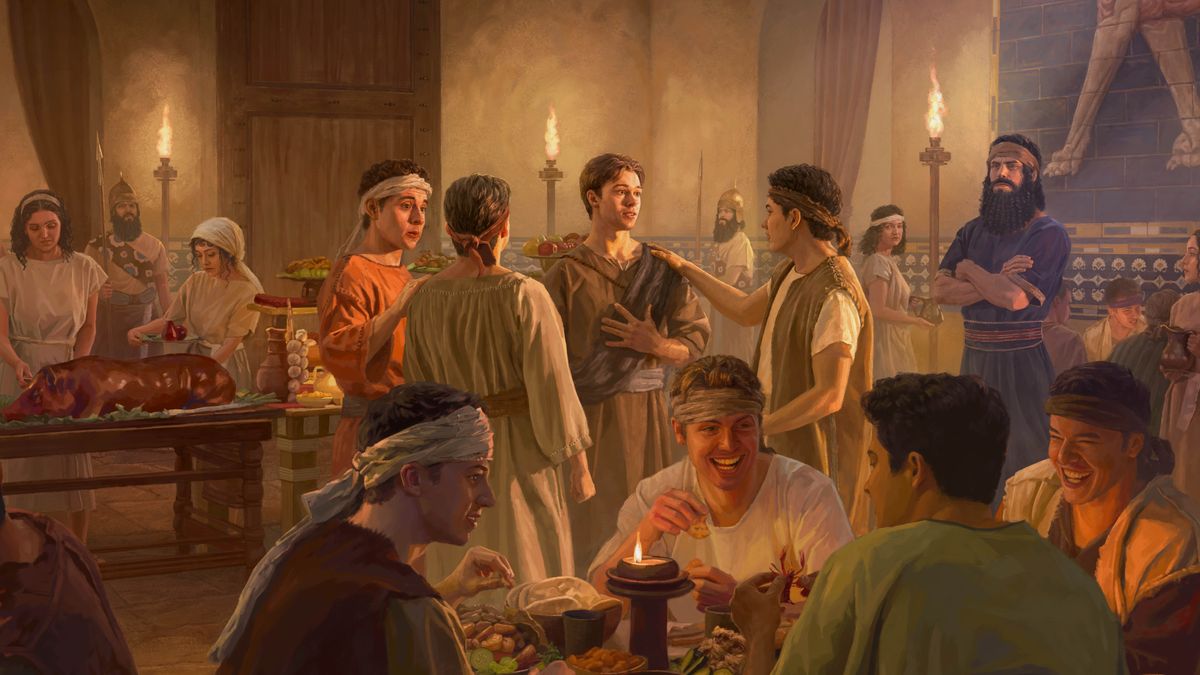
Daniel and his friends helped one another to resist temptation and to stay faithful (See paragraph 11)
12. What can help young ones today to fight temptations successfully?
12 As a young person, do you sometimes feel pressured to give in to a temptation? Daniel and his friends helped one another to make the right decision. Like those faithful young people, choose companions who are determined to remain loyal to Jehovah and to resist the pull of the world. (1 John 2:15-17) True friends can help you to stay faithful even in “what is least” and to experience Jehovah’s blessing and support. (Luke 16:10) And your faithfulness in these “little things” will help you to be faithful when you face bigger tests later in life.
TRUE FRIENDS HELP US TACKLE SEEMINGLY IMPOSSIBLE CHALLENGES
13. What seemingly impossible challenge did Daniel and his friends face?
13 True friends can help one another tackle seemingly impossible challenges. Consider the challenge that Daniel and his friends faced when King Nebuchadnezzar had a dream that troubled him. He wanted to know what it meant. So he sent for the magic-practicing priests and the sorcerers of Babylon. Instead of relating the dream to them and then asking for the interpretation, the king insisted that his advisers first tell him what his dream was about and then interpret it—an impossible task for any human! (Dan. 2:3, 9-11) If they failed to do so, they were to be put to death. Daniel and his friends were among the wise men who were in danger of being executed. Throughout this trial, Daniel and his three friends stood together.
14. How did the young Hebrews support one another? (See also pictures.)
14 Daniel approached the king tactfully, asking for some extra time to find the answer. Then Daniel turned to his friends. The account tells us what happened next: “He asked them to pray for mercy from the God of heaven concerning this secret, so that Daniel and his companions would not be destroyed.” (Dan. 2:18) Jehovah answered their heartfelt prayers, and he revealed the dream and its interpretation to Daniel. As a result, Daniel and his friends were spared, and the king gave them positions of honor.—Dan. 2:19, 47-49.
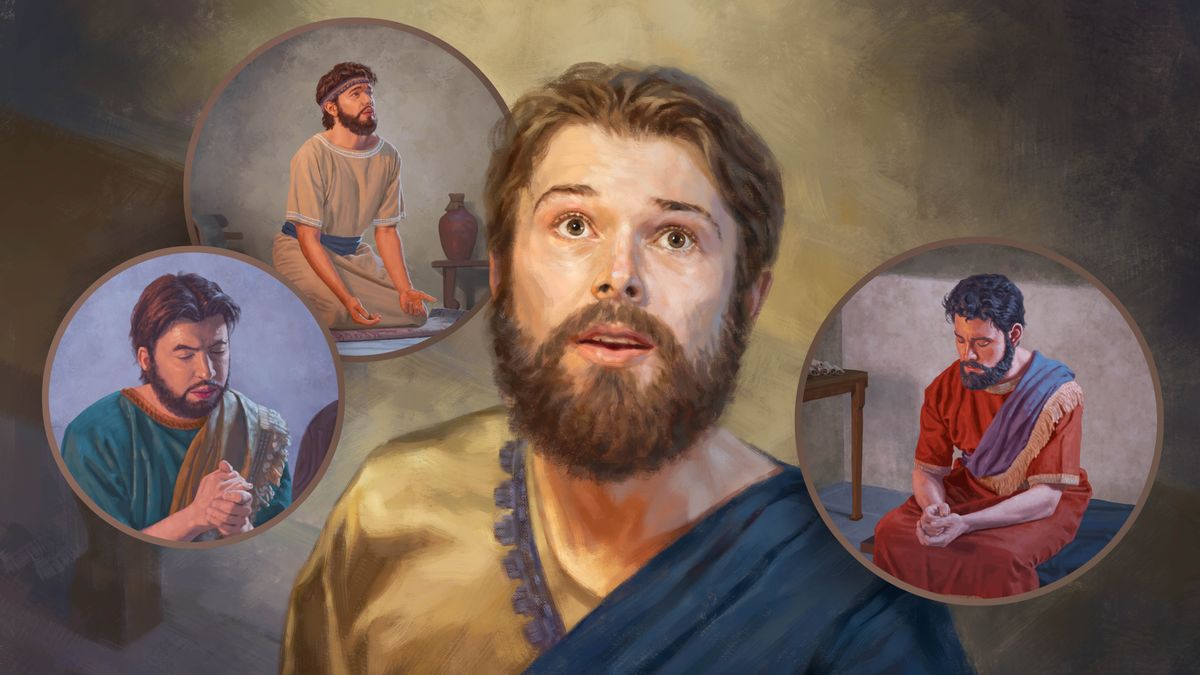
How did Daniel’s friends help him to tackle a seemingly impossible challenge? (See paragraph 14)
15. What lessons can we learn from this account? (Galatians 6:2)
15 This account offers valuable lessons. First, you do not need to face trials alone. Never let pride or embarrassment prevent you from seeking help. Second, do not hesitate to ask others to pray about a matter for you. (2 Cor. 1:11) Reflect on the power of earnest prayer. The “Hearer of prayer” can help us to overcome seemingly insurmountable challenges. (Ps. 65:2; Eph. 3:20) When we have friends who also serve Jehovah, we can rely on them for strength and support to endure life’s trials.—Read Galatians 6:2.
A TRUE FRIEND WHO CAN SUPPORT US IN ANY SITUATION
16. What trial did Daniel face in his old age?
16 Jehovah is a true Friend who can support us in any situation, even when we may be isolated from others. By the time Daniel was an old man—probably in his 90’s—Babylon had fallen to the Medes and the Persians and he was now serving King Darius. Some in the royal court, envious of Daniel’s position, plotted to have him killed. They manipulated the king into making a law that would forbid anyone from praying to any god except the king. Daniel refused to comply, so he was thrown into the lions’ pit. There he appeared to be alone—without human friends to help him face that trial. But was he truly alone?—Dan. 6:4-16.
17. According to Daniel 6:19-23, how did having a strong friendship with Jehovah help Daniel?
17 Daniel 6:19-23 explains the miraculous way in which Daniel was rescued. (Read.) In the lions’ pit, Daniel was supported by the most powerful Friend anyone could have, Jehovah God, who rescued him from the jaws of the lions. After the ordeal was over, Daniel told the king: “My God sent his angel and shut the mouth of the lions, . . . for I was found innocent before him.” (Dan. 6:22) Daniel’s unwavering faith in his best Friend, Jehovah, sustained him when his life hung in the balance.
18. Why is drawing close to Jehovah important, and how can we do this? (See also pictures and the box “Jehovah—Our Father, Our God and Friend.”)
18 You too may find yourself isolated from friends and family, perhaps because of an assignment in a remote territory, an unexpected move, limited health and strength, or even imprisonment. Circumstances in life might make you feel lonely or disconnected. In such moments, it is important to remember that God’s friends are never truly alone. Jehovah himself offers us protection and care wherever we may be. (Ps. 139:7-10) Trust that Jehovah sees you and will sustain you.

Are God’s friends ever really alone? (See paragraph 18)
FRIENDS FOR LIFE
19. Why do we need to strengthen our friendships now? (1 Thessalonians 5:2, 11)
19 Building strong friendships is crucial today. True friends help us make wise decisions as we approach “Jehovah’s day.” They encourage us and build us up. (Read 1 Thessalonians 5:2, 11.) Recognizing that “the end of all things has drawn close,” the apostle Peter wrote: “Above all things, have intense love for one another.”—1 Pet. 4:7, 8.
20. What should we look for in true friends, and what will be the outcome if we choose them wisely?
20 True friends are a gift from Jehovah, and we need them more than ever. So like Daniel, make friends with others. Seek out those in your congregation who, like Jeremiah, can inspire and guide you. Surround yourself with those who can strengthen your resolve to stay loyal to Jehovah. Humbly ask others to pray for you, when needed. Above all, remember who your best Friend is—Jehovah. He will never abandon you. (Heb. 13:5) With Jehovah’s help, together we can take our stand against anything that threatens us today and enjoy friendships that will last forever.
SONG 161 To Do Your Will Is My Delight
a Although we often apply these verses to marriage, this passage is primarily about the value of friendship.
Examine the Scriptures Daily
pp. 24–29
DECEMBER 28, 2026–JANUARY 3, 2027
SONG 162 My Spiritual Need
Examine the Scriptures Daily
“They accepted the word . . . , carefully examining the Scriptures daily.”—ACTS 17:11.
FOCUS
Encouragement to consider the day’s text and suggestions on how to do so.
1-2. What has Jehovah’s organization done to provide a scripture for daily consideration, and where are the day’s texts now published?
IN 1905, Jehovah’s organization published a book entitled Daily Heavenly Manna for the Household of Faith. That publication provided a scripture text along with comments from Zion’s Watch Tower that brothers and sisters could read each day of the year. Jehovah’s people used the same book until 1927 when the text and comments began to be published in the Year Book.a We were then able to consider a wider variety of Bible texts along with insightful comments from The Watch Tower.
2 In 1986 the organization began publishing daily texts in a booklet called Examining the Scriptures Daily. This publication is now available in over 300 languages. And where else can you find the day’s text? Right on the home page of the JW Library® app and Watchtower ONLINE LIBRARY™ (wol.jw.org) and in Watchtower Library.
3. What can make it challenging to consider the day’s text regularly, and what will we consider in this article?
3 Because we live busy lives, some of us struggle to consider the text each day. In this regard, we will answer three questions. What Bible example can motivate us to examine the Scriptures daily? Why is it good for us to consider each day’s text? How might we do so?
A MOTIVATING BIBLE EXAMPLE
4. With what attitude did the Beroeans listen to the apostle Paul’s preaching? (Acts 17:10, 11)
4 Our theme text describes the attitude of a group of Jewish listeners whom the apostle Paul preached to in the Macedonian city of Beroea. (Read Acts 17:10, 11.) Those Beroeans were not listening to Paul with a critical attitude. The Bible describes them as “noble-minded” people who “accepted the word” he was preaching. As they compared what Paul was saying with what they read in the Scriptures, they could discern that Paul was teaching the truth. We do something similar when we listen to a talk at a congregation meeting or at a convention or an assembly. We follow along as the speaker reads to us from God’s Word. Thus, we can be confident that the speaker is telling us the truth.
5. How did the Beroeans benefit from examining the Scriptures daily?
5 “Many of [the Beroeans] became believers.” (Acts 17:12) But trouble was brewing. Jews from Thessalonica came to Beroea “to incite and agitate the crowds” against this new teaching. (Acts 17:13) However, those new Christians were not intimidated. Their daily study of the Scriptures had convinced them that they had found the truth, and they no doubt stood firm in the faith. A daily consideration of God’s Word can strengthen us too as we face life’s challenges.
WHY CONSIDER EACH DAY’S TEXT?
6. Why should we consider the text each day? (See the box “Bible Examples of Daily Worship.”)
6 We consider the text each day because it helps us focus our attention on Jehovah and on our worship. As our God, Jehovah deserves our attention and our worship. He loves us and wants us to have everlasting life. (John 3:16) Bible examples show that Jehovah is pleased when we worship him every day. Many find it helpful to use the day’s text as a starting point for a daily spiritual routine that includes prayer, Bible reading, and meditation.
7-8. What additional reasons do we have for considering the text each day? (Ephesians 5:15, 16)
7 We consider the daily text because it is a good use of our time. (Read Ephesians 5:15, 16.) What better way could we use our time than to spend a few minutes each day absorbing the thoughts of our loving heavenly Father?
8 We consider the daily text because it strengthens us to face the day’s troubles. Jesus said that each day will have “its own troubles.” (Matt. 6:34) Just as he stated, we face challenges each day. But in this same Bible passage, Jesus assures us that Jehovah is fully aware of what we are going through and what we need. (Matt. 6:25-32) By considering the text, we turn our attention from our anxieties to the help that Jehovah provides. (Ps. 68:19; 1 Pet. 5:6, 7) For example, a teenage sister felt guilty because of a past mistake and wondered if Jehovah had forgiven her. In prayer, she asked Jehovah to help her feel convinced of his forgiveness. Then she read the day’s text. It was Psalm 86:5, which says: “You, O Jehovah, are good and ready to forgive; you abound in loyal love for all those who call on you.” She said: “I immediately felt at peace and was so grateful that Jehovah had provided me with the comfort I needed. That experience encourages me to consider the text every day.”
9. How did one day’s text help our brothers and sisters in Ukraine?
9 The day’s text often includes reminders that help us to “trust in Jehovah” when we face life’s troubles. (Prov. 3:5, 6) For example, the day that the war between Russia and Ukraine started, the text was taken from Isaiah 30:15, which says: “Your strength will be in keeping calm and showing trust.” That verse brought comfort to our brothers and sisters in Ukraine. For example, a brother named Eduard said: “That text was like a breath of fresh air. My wife and I read it together early that morning. And after we prayed, it gave us the strength we needed to cope with our emotions.” A sister named Svitlana related: “Isaiah 30:15 became truly special for us. We kept calling it to mind and meditating on its meaning as the heavy fighting continued around us.”
10. Why do we need courage, and how can we strengthen our courage? (Joshua 1:6-9) (See also pictures.)
10 We consider the day’s text because it strengthens our determination to remain faithful. We need courage to be different from our schoolmates and workmates, to share Bible truths with others, and to stay faithful when facing persecution. When Joshua was appointed as the overseer of the nation of Israel, Jehovah told him three times to be courageous and strong. To strengthen Joshua’s courage, Jehovah also directed him to read the book of the Law daily. (Read Joshua 1:6-9.) Reading the day’s text, in addition to our daily Bible reading, will help us to be strong and to remain faithful.

We strengthen our courage by reading the Scriptures daily (See paragraph 10)
11. How can considering the text help us to make spiritual progress?
11 We consider the day’s text because it helps us to make spiritual progress. Paul told the young man Timothy to keep making progress in such areas as speaking, conduct, love, faith, and chasteness. (1 Tim. 4:12, 15) When we consider the daily text, it gives us the opportunity to think about how we can grow as a spiritual person. A spiritual person is someone who imitates Jehovah’s way of thinking and who works hard to please Him and to live by His standards.—Rom. 8:5, 6.
12. In what roles are spiritually mature men and women needed, and what can help prepare us for those roles?
12 We consider the day’s text because it will help prepare us for future theocratic assignments. In Jehovah’s organization, we need spiritually mature men and women who can help with the ever-increasing work. We need brothers and sisters who can serve as pioneers and as missionaries as well as at Bethel, on construction projects, and in remote translation offices. We need capable and humble young men to serve as ministerial servants, elders, and circuit overseers. Jehovah wants trustworthy and dependable brothers, men who understand how to apply Bible principles, to take the lead in his organization. (Deut. 1:13-15) Considering the day’s text as part of your spiritual routine will teach you those principles and help prepare you for additional assignments.
HOW MIGHT YOU CONSIDER THE TEXT?
13. What is one way to consider the text?
13 How might you consider the daily text? Bethel families around the world begin their workday with a brief but earnest prayer to Jehovah, after which they consider the day’s text. You too may choose to start with a brief prayer, asking Jehovah to help you benefit from what you are about to read. (Jas. 1:5) Then read the scripture and the comments. Afterward, ask yourself such questions as: ‘How can this text strengthen my faith? How can meditating on it draw me closer to Jehovah? How might it help me face today’s challenges?’ If you are considering the text with family or friends, why not use it as the basis for an encouraging conversation? (Rom. 1:12) Some find it helpful to summarize the point of the text in three or four words so that they can recall it throughout the day.
14-15. What else might we consider, and what can help us remember the text?
14 What are some ways you can get more out of the day’s text? Try one or more of the following suggestions: (1) Highlight the main points in the Watchtower comments and meditate on them. (2) Read the cited scriptures in the comment. (3) Read the entire chapter of the Bible where the text is found. (4) Refer to the Research Guide for Jehovah’s Witnesses or to the study notes in the Bible to learn more. (5) Read portions of the study article from which the comment is taken. If you are using the digital publication, you can navigate to the study article by clicking on the reference at the end of the comments.b
15 Regarding her consideration of the day’s text, a 19-year-old sister named Mackenzie said, “If I take a little extra time, even just five more minutes, and slow down to read and think about the scripture text and comments, I am better able to remember the information.”
16. When should you consider the text?
16 When should you consider the text? Choose a time that works well with your family’s schedule. For example, some do it before or after breakfast or before taking their children to school. As a reminder to do so, they keep a copy of Examining the Scriptures Daily on the table. Of course, when unexpected circumstances come up, you may need to be flexible and adjust your schedule.
17-18. Why is it good to set a specific time for reading the text, and what can help us to be consistent? (See also pictures.)
17 Why is it good to set a specific time for reading the text? Because if you do not, you may not read the text at all. A 16-year-old brother named John said: “If you don’t make reading the text a priority, it might never get done.” Sierra, a 25-year-old sister, related: “I try to read the text first thing in the morning before the rush of the day takes over.” And Rogelio, a 21-year-old brother, commented: “Setting a reminder on my phone helps me to be consistent.”
18 Make the reading of the text part of your schedule, and stick to it as closely as you can. Avoid getting distracted. Isabelle, a 19-year-old sister, suggested: “Tell yourself that you cannot do anything or look at anything on your cellphone until you have read the text. If just looking at your phone is a distraction, get a printed copy of Examining the Scriptures Daily and read the text before you even pick up your phone.” A 19-year-old sister named Olivia commented: “One thing that helps is reading the text with others, like family or friends. When you have someone to remind you or to read it with, it is easier to stay consistent.”

What will help you to avoid distractions while reading the day’s text? (See paragraph 18)
HELP YOUNG ONES EXAMINE THE SCRIPTURES DAILY
19. Why is it important for young ones to establish the habit of reading the day’s text? Illustrate. (Philippians 1:9, 10)
19 Parents, if you develop the habit of reading the text with your family every day, the habit will likely stay with your children throughout their adulthood. Even if your children are young and cannot grasp the full meaning of a certain day’s text, the routine itself will benefit them in the long run. Just as small seedlings can grow to be huge trees by extracting moisture from the soil each day, our young ones can be helped to grow to be solid spiritual men and women by taking a few minutes each day to consider the scripture text and comments.—Read Philippians 1:9, 10.
20. How important is taking in spiritual food?
20 Jesus said: “Man must live, not on bread alone, but on every word that comes from Jehovah’s mouth.” (Matt. 4:4) We would not want to go a whole day without physical food. How much more important it is to take in life-sustaining spiritual food by examining the Scriptures daily!
SONG 94 Grateful for God’s Word
a For languages in which the Year Book was not available, The Watch Tower listed the scripture text along with a reference indicating where readers could find the related Watch Tower comments.
b The reference identifies the year and month of the Watchtower issue, the page number(s), and the paragraph number(s) from which the comments are taken.
Build Your Faith on a Solid Foundation
pp. 30–31

Build Your Faith on a Solid Foundation
WHEN you studied the Bible with Jehovah’s Witnesses, what convinced you that you had found the “one faith”—the one acceptable way of worship that God approves? (Eph. 4:4-6) Were you drawn to Jehovah’s people because of the love you observed among them? Did their upright conduct make a favorable impression on you? Many are attracted to the truth because God’s organization makes them feel safe and genuinely loved, and that is understandable. Love and good conduct are identifying marks of true worship.—John 13:35; 1 Pet. 2:12.
But what if a fellow believer offends you or in some other way fails to show you love? Or what if a fellow believer gets involved in serious sin—even scandalous conduct, as occurred with an individual in the first-century congregation in Corinth? (1 Cor. 5:1) If your faith depends solely on how the actions of others make you feel, it is resting on a shaky foundation. Is there a more stable foundation for your faith?
A STABLE FOUNDATION FOR FAITH
You can build a strong foundation for your faith by deepening your conviction in the basic truths you have learned from the Bible. How can that help? Consider an example.
On one occasion, many of Jesus’ disciples left him. They had stumbled over his statement about eating his flesh and drinking his blood. They said: “This speech is shocking.” What Jesus said disturbed them so much that they stopped following him.—John 6:56-60, 66.
Afterward, Jesus asked his apostles: “You do not want to go also, do you?” Peter replied: “Lord, whom shall we go away to? You have sayings of everlasting life. We have believed and have come to know that you are the Holy One of God.”—John 6:67-69.
What made Peter and the other apostles different from those who had stumbled? Their faith was founded on something more solid than their feelings. Peter said: “We have believed and have come to know that you are the Holy One of God.” These faithful ones knew what they believed and why they believed it. Having compared Jesus’ words and actions with what they knew of the Scriptures, they were convinced that Jesus was the Messiah. Their strong conviction in this basic truth stabilized their faith when others were stumbled by what Jesus said.
What does that account teach us? What we know can be more powerful than how we feel. Why? Because Bible doctrines—including the truths we have learned about God’s name, his purpose, and the ransom—remain constant. Unlike our feelings, Bible truths are not affected by what people do or say. Therefore, if we are convinced of Bible truths and we connect these truths with the channel Jehovah is using, we can avoid being stumbled by the behavior of others.

If our faith depends solely on how the actions of others make us feel, it is resting on a shaky foundation
Granted, we feel encouraged by the love of the brotherhood. And we feel uplifted by the good conduct of our fellow believers. But if those feelings should ever start to waver because of the actions of others, then our conviction in Bible truths can stabilize our faith. It will help us recognize that we are in the right organization—regardless of the actions of a few individuals.
When we have a good routine of personal Bible study, we strengthen our conviction in the truths we have learned from God’s Word. That conviction, in turn, will help us remain convinced that we have found the one way of worship that God approves. Then our faith will rest on a solid foundation and will not be shaken by the words or actions of others.—Ps. 16:8; see the box “Stay on the Right Road.”
Jehovah Rewards Faith
p. 32
EXPERIENCE
Jehovah Rewards Faith
Emma worked at a hotel three days a week, nine hours a day. She asked her supervisor for a day off so that she could attend her regional convention. Instead of granting her request, the supervisor changed her schedule to five days a week and gave her an ultimatum: Accept the new schedule or resign. Trusting in Jehovah, Emma chose to resign and attend the convention.
When Emma went to submit her resignation, the general manager of the hotel happened to be there. When he learned about the situation, he promised to take care of the matter. However, two weeks later, Emma was told that she was fired. She came across the general manager again, who was upset that his instructions were ignored. He resolved the issue, and Emma was offered a new schedule: five days a week, four hours a day. It turned out to be even better than her original schedule; it accommodated her theocratic activities! Jehovah took care of her needs in a way that exceeded her expectations.