The Watchtower — Study Edition · November, 2026
Study Edition
pp. 1–32

Study Edition
NOVEMBER 2026
STUDY ARTICLES FOR: JANUARY 4-31, 2027
© 2026 Watch Tower Bible and Tract Society of Pennsylvania
This publication is not for sale. It is provided as part of a worldwide Bible educational work supported by voluntary donations. To make a donation, please visit donate.jw.org.
Unless otherwise indicated, Scripture quotations are from the modern-language New World Translation of the Holy Scriptures.
Table of Contents
p. 32
Table of Contents
IN THIS ISSUE
Study article for January 4-10, 2027
2 To Please Jehovah, Keep Training Your Conscience
Study article for January 11-17, 2027
8 “Shepherds Who Will Really Shepherd”
Study article for January 18-24, 2027
14 Cultivate a Friendship With Jehovah and With Jesus
Study article for January 25-31, 2027
20 Cultivate Meaningful Friendships With Your Brothers and Sisters
26 How to Be Content During Economic Hardship
29 Did You Know?—How did soldiers of the Praetorian Guard dress?
To Please Jehovah, Keep Training Your Conscience
pp. 2–7
JANUARY 4-10, 2027
SONG 36 We Guard Our Hearts
To Please Jehovah, Keep Training Your Conscience
“Keep perceiving what the will of Jehovah is.”—EPH. 5:17.
FOCUS
How to train and protect our conscience in order to discern the will of Jehovah and to please him by means of our decisions and actions.
1. What is the conscience, and how can it help us to please Jehovah?
JEHOVAH has given us the ability to examine our actions and our attitude and to judge whether they are right or wrong. That ability is called the conscience, and it is a wonderful gift from God. (Rom. 2:14, 15) When our conscience is molded by good influences, it can help us to make wise decisions that please Jehovah. But we do well to remember that our conscience is susceptible to harmful influences.
2. What can our conscience move us to do?
2 A well-trained conscience can do more than merely let us know whether the actions we have taken are good or bad. It can also move us to avoid what is bad and to “cling to what is good.” (Rom. 12:9) In this article, we will consider how our conscience can protect us. We will also discuss factors that can influence our conscience.
YOUR CONSCIENCE CAN PROTECT YOU
3-4. (a) How is the conscience similar to a smoke detector, and how is it different? (See also picture.) (b) Illustrate how a Bible-trained conscience can protect us.
3 The conscience can be compared to a smoke detector—but with a significant difference. Like the conscience, a smoke detector can alert you to danger. But it is activated only after smoke is detected. By that time, fire may already have caused damage. A Bible-trained conscience works far better because it can sound an alarm before we do something wrong and damage our relationship with Jehovah. The conscience can alert us to potential dangers, thus protecting us from taking wrong steps that could even lead to serious sin.
4 To illustrate, imagine the following scenario. A young brother moves to a new area. Naturally, he wants to make friends. There are some young people his age in the congregation. They invite him to a gathering, and he gladly accepts. He notices, though, that a few who are there have little respect for Jehovah’s standards regarding morals and the use of alcohol. Will he pursue a friendship with those troubled youths? Of course not! His conscience has sounded the alarm, and he will heed the warning. Those early warnings from his conscience will protect him from going down a road that might lead to serious sin.—Jas. 1:14, 15.

Our conscience can work like a smoke detector—but far better (See paragraph 3)
5-6. How did Adam and Eve fail to please Jehovah?
5 In some situations, Jehovah clearly tells us what is right and what is wrong. (Isa. 33:22) That was the case with Adam and Eve. God told them that it would be wrong for them to eat from the tree of the knowledge of good and bad. (Gen. 2:17) In fact, God commanded them not even to touch the tree. (Gen. 3:3) So when a lowly serpent told Eve that she would be better-off if she disobeyed Jehovah, she evidently chose to ignore her conscience. She knew that it was wrong to eat the fruit. She should have rejected the serpent’s prodding! Instead, Eve gave in to that harmful influence and sinned against God.
6 What about Adam? “Adam was not deceived” by the serpent. (1 Tim. 2:14) Adam’s conscience should have moved him to obey Jehovah regardless of what Eve did. Instead, he went against what he knew to be right and ate the fruit. As a result of the disobedience of our first human parents, “sin entered into the world . . . and so death spread to all men because they had all sinned.” (Rom. 5:12) We can learn from their bad example. To avoid giving in to sin, we must listen to our conscience.
DISCERN JEHOVAH’S WILL
7. What can we learn from the advice found at Ephesians 5:15-17?
7 As was the case with Adam and Eve, in some aspects of life Jehovah tells us specifically what is right and what is wrong. In other areas, there is no precise Bible law that tells us what to do. So we need to “keep perceiving what the will of Jehovah is.” (Read Ephesians 5:15-17.) The choices we make will either please or displease Jehovah. Our conscience can help us to perceive what Jehovah’s will is and act in harmony with it.
8. What factors could explain why two Christians can make different choices when facing a similar situation and still act with a clean conscience?
8 How can we make a decision when a situation is not covered by a specific Bible law? In such a case, Christians must use their Bible-trained conscience. Often there are many factors to consider when deciding what to do, such as our motives, our intentions, and the local culture. Two Christians who are in a similar situation may make different decisions. Yet, if their choices are in harmony with Bible principles, both individuals can act with a clean conscience and please Jehovah.
9. In two different scenarios involving toasting and clinking glasses, how can the words found at Galatians 6:4 be applied? (See also pictures.)
9 Consider the following situations. Two mature Christians, each attending a separate work-related event, are invited by their respective employers to raise or clink their glasses at a dinner. Each of them lives in a land where toasting is widely viewed as an expression of courtesy and good etiquette. In one scenario, the brother joins in the toast because he realizes that the reason for the toast is simply to celebrate a milestone that the company has reached. In the other scenario, the Christian declines to join in. He wonders, ‘Could my employer’s words be considered nationalistic?’ The brother fears that his neutrality might be compromised. But the goal of both brothers is to please Jehovah by acting in harmony with his will.—Read Galatians 6:4.

When we have to decide what is the right course to take, our trained conscience can help us to act wisely (See paragraph 9)a
TRAIN YOUR POWERS OF DISCERNMENT
10-11. According to Hebrews 5:13, 14, how will “solid food” help a Christian to train his conscience?
10 At Hebrews 5:13, 14, we find expressions that relate to training the conscience. (Read.) Although the word “conscience” is not used in those verses, we understand that the goal is for us to be trained “to distinguish both right and wrong.” That is what the conscience does. In order to train the conscience, we need “solid food.” What does that mean?
11 “Solid food” represents substantial or deeper truths that spiritually “mature people” can understand. (1 Cor. 2:14, 15) Such “solid food” includes Bible principles. When there is no specific Bible law to govern a certain situation, a Christian may consider the principles involved and come to a conclusion that will please Jehovah.—Prov. 2:4, 5.
12. What do the expressions “mature people” and “through use” found at Hebrews 5:14 mean?
12 Because they understand Jehovah’s personality and his thinking, “mature people”—that is, those who have trained their conscience according to Bible principles—can actually anticipate how their actions might affect Jehovah. They make it a habit to consider godly principles whenever they have a decision to make. Thus, they train their powers of discernment “through use” to distinguish both right and wrong.
BEWARE OF INFLUENCES THAT COULD AFFECT YOUR CONSCIENCE
13. What could happen if the conscience is not trained?
13 The conscience is not an infallible guide. If we do not train our conscience by considering Bible principles, something else will influence it. (1 Tim. 4:1, 2) The conscience can be influenced by such things as false religious beliefs, prejudices, and wrong desires. (Isa. 5:20) It can also be affected by inherited or acquired negative traits—such as greed, pride, and selfishness. Further, if we use the wrong standards to judge what is right and what is wrong, our conscience will be a poor guide.
14. (a) What could have influenced Adam and Eve to act contrary to their conscience? (b) Give examples of individuals who failed to train their conscience to please Jehovah. (See the box “They Failed to Train Their Conscience.”)
14 In Eve’s case, it seems that she allowed greed and pride to blur her view of who has the right to set the standard of good and bad. She became dissatisfied with all that Jehovah had given her. She wanted to be like God. As for Adam, he selfishly placed his desire to be with Eve above pleasing Jehovah. The Bible record provides other examples of individuals who had accurate knowledge of Jehovah but allowed their conscience to be influenced by greed, pride, or selfishness.
15. What else could damage our conscience, and what are we urged to do?
15 Our conscience can also be damaged by bad associations. (1 Cor. 15:33) People who are alienated from God and have an insensitive heart can pose a great danger to those who want to do what is right. Appropriately, the Bible urges us to avoid those who walk “in the futility of their minds” and who are “in darkness mentally.” (Eph. 4:17-19) For that reason, we do well to “turn away” from them.—2 Tim. 3:1-5.
ALLOW JEHOVAH TO MOLD YOUR CONSCIENCE
16. When can the conscience be especially helpful in pleasing Jehovah? (See the box “Understanding the Boundaries of Your Conscience.”)
16 Although imperfect, the conscience can help us to please Jehovah. It can be especially helpful in areas that are not covered by specific commands in God’s Word. (1 Cor. 10:31) But only a conscience that is trained by Scriptural principles will function properly. Such a conscience will help us to remain balanced and will please Jehovah.
17. In harmony with Romans 12:2, how does Jehovah train us?
17 Jehovah can teach us his way of thinking. He can help us to mold or transform our mind if we submit to his training. (Isa. 64:8; read Romans 12:2.) The entire Bible record provides this training by teaching us about Jehovah’s dealings with his people through the ages. (2 Tim. 3:16) Best of all, we can learn Jehovah’s way of thinking by studying Jesus’ teachings and example.—1 Cor. 2:16.
18. What can lead to a happy, successful life and “a clean conscience”?
18 We can strengthen our conscience by avoiding harmful influences. We can train our perceptive powers to distinguish right from wrong by immersing ourselves in God’s Word. (Ps. 1:1-3) As a result, we will lead a happy, successful life as we serve Jehovah “with a clean conscience.”—2 Tim. 1:3.
SONG 159 Give Jehovah Glory
a PICTURE DESCRIPTION: In the first picture, a brother feels comfortable with toasting in a social setting. In the second picture, a brother chooses not to take part in a toast that might appear to be nationalistic.
“Shepherds Who Will Really Shepherd”
pp. 8–13
JANUARY 11-17, 2027
SONG 103 Shepherds—Gifts in Men
“Shepherds Who Will Really Shepherd”
“I will raise up over them shepherds who will really shepherd them.”—JER. 23:4.
FOCUS
What elders can learn from Jesus and how they can care effectively for Jehovah’s sheep.
1-2. (a) How do elders help us? (b) How has Jehovah made sure that we receive spiritual support? (See also the box “Shepherds in Bible Times.”)
CAN you recall a time in your life when a loving elder helped you? Perhaps he gave you Scriptural advice when you were heading in a wrong direction. He may have comforted you after a loved one died. Or maybe he reminded you of how much Jehovah loves you, even though you felt unworthy at the time. A sister from Spain named Maríaa says: “Shepherding is proof that the elders really care about me. Their visits show that they really want to get to know me and to understand how best to help me.”
2 Jehovah knows that we need the support of the elders. That is why he promised to raise up “shepherds who will really shepherd.” He had in mind men “after [his] own heart,” men who would care for people with knowledge and insight. (Jer. 3:15; 23:4) God fulfilled that promise in the greatest way possible when he sent Jesus to the earth. Later, Jesus arranged for appointed elders to shepherd the Christian congregation. (Eph. 4:7, 8, 11) In this article, we will first consider the example Jesus set as a shepherd. Next, we will identify some skills and qualities that will help elders become more effective shepherds. Finally, we will discuss the rewards that a spiritual shepherd receives when he genuinely cares for the flock.
LEARNING FROM “THE FINE SHEPHERD”
3. Why could Jesus call himself “the fine shepherd”? (John 10:11, 14)
3 Jesus described himself as “the fine shepherd.” (Read John 10:11, 14.) Why? He loved his disciples so much that he surrendered “his life in behalf of the sheep.” Jesus said: “I know my sheep and my sheep know me.” He understood the individual needs of his disciples, and he offered to refresh them. (Matt. 11:28, 29) As a result, they came to know and trust him.
4-5. (a) Why did Martha and Mary turn to Jesus for help? (b) What efforts did Jesus make in order to help them?
4 In John chapter 11, the qualities of the fine shepherd are seen at work during Jesus’ visit to Martha and her sister, Mary, in Bethany. These women needed his support because their brother, Lazarus, had died just a few days earlier. Jesus loved that close-knit family. (John 11:5) He often stayed in their home; he knew them well, and they were close friends. Though Martha and Mary were disappointed that Jesus had not prevented Lazarus’ death, they surely trusted that Jesus would comfort them in their time of grief. When elders today forge a close friendship with their brothers and sisters, they are in a good position to offer spiritual help.
5 It would have taken Jesus about two days to travel to Bethany. And there was an element of danger. The people of that region had tried to put him to death. (John 11:8) But a good spiritual shepherd is willing to make sacrifices to help his brothers and sisters who are in need.
6. How did Jesus comfort Martha?
6 When Jesus arrived near Bethany, Lazarus had been dead four days. Given the circumstances, Martha could not help but think about what could have been done to save her brother. (John 11:21) So Jesus kindly helped her to look, not to the past, but to the future. Jesus assured her: “Your brother will rise.” (John 11:23) Jesus then listened to Martha’s heartfelt words, after which he once more strengthened her faith by reminding her that he has God-given power over death. (John 11:24, 25) Elders today encourage others by listening to them patiently and by building their confidence in God’s promises.
7. How did Jesus react to the grief of Lazarus’ relatives and friends? (See also picture.)
7 Before resurrecting Lazarus, Jesus observed the scene near the tomb. Lazarus’ sister Mary and others were weeping. How did their anguish affect Jesus? “He groaned within himself and became troubled.” Then he “gave way to tears.” (John 11:33, 35) What a heartwarming example of Jesus’ empathy! He felt their pain in his heart. That touched people. (John 11:36) Yes, a good shepherd can empathize with his brothers and sisters.—Rom. 12:15.
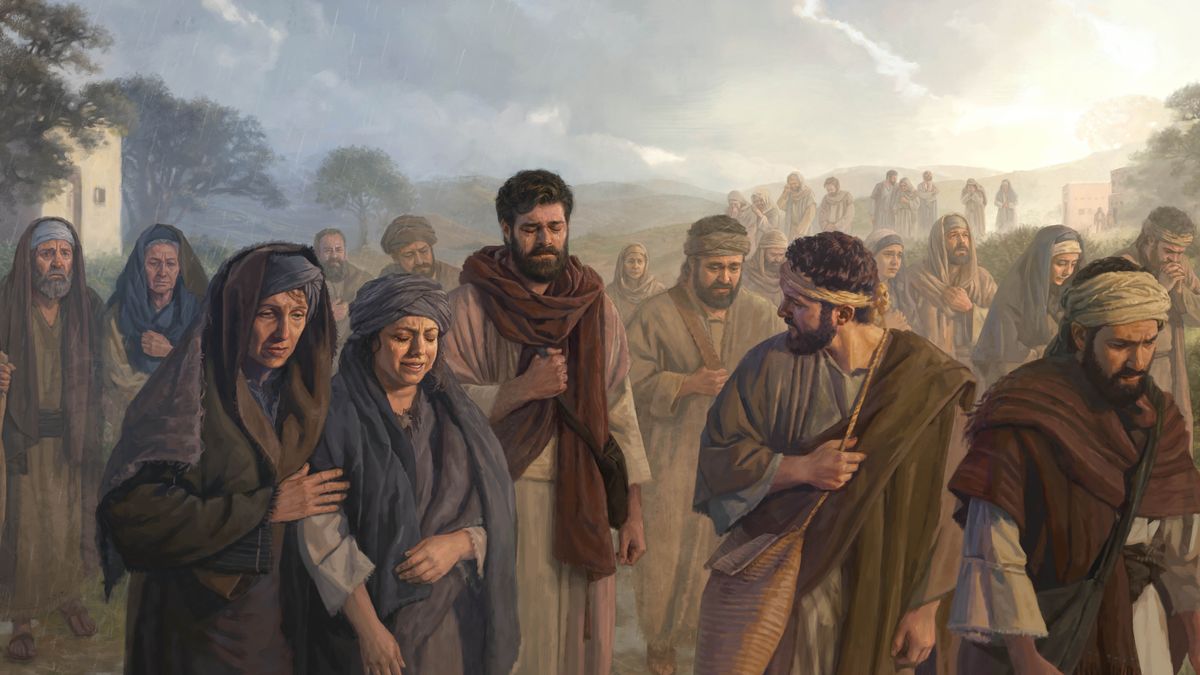
Jesus, Martha, Mary, and others grieve the loss of their beloved Lazarus (See paragraph 7)
8. How did Jesus make sure that the work of shepherding would continue after his return to heaven?
8 Jesus set the example in being a loving spiritual shepherd and encouraged his followers to do the same. After his resurrection, he entrusted the apostle Peter and, by extension, the other apostles with the task of spearheading this work. Jesus emphasized that his “lambs,” his “little sheep,” would need shepherding.b (John 21:15-17) Peter never forgot that encouragement. Years later, he entreated his fellow elders to continue to care for those little sheep, who were precious to Jesus.—1 Pet. 5:1, 2.
DEVELOP THE NEEDED SKILLS AND QUALITIES
9. Why can it be said that shepherds have a weighty responsibility? (Acts 20:28)
9 The apostle Paul urged the elders in Ephesus to take their shepherding work very seriously. (Read Acts 20:28.) Overseers today have been entrusted with the same sacred work. An elder named David puts it this way: “It is as if Jesus were saying to me personally: ‘Do you see those little sheep? They are mine, but I want you to help me take care of them.’” That is a huge responsibility. At times, an elder may doubt his ability to give comfort to the bereaved, strength to the weak, or encouragement to the depressed. (1 Thess. 5:14) Clearly, Jehovah is the one who supplies elders with the strength to carry out their assignment. (Phil. 4:13) But each elder can develop skills and qualities that will help him to be a more effective shepherd. Let us consider a few of these skills and qualities.
10. What should an elder do to become an effective shepherd, and why? (Proverbs 27:23 and footnote)
10 Getting to know the sheep. (Read Proverbs 27:23 and footnote.) One translation renders this verse: “Learn all you can about your sheep.”c No doubt, we respect the privacy of our brothers and sisters. (1 Pet. 4:15) Still, as David, quoted earlier, puts it, “Only when we understand the challenges that the brothers and sisters are facing can we use the Bible effectively to help them.”
11. How do brothers and sisters benefit when an elder is an empathetic listener?
11 Listening empathetically. Shepherds can become attuned to their brothers’ and sisters’ needs by listening. (Jas. 1:19) Consider the experience of a sister named Catherine, whose husband abandoned her and her children. She says: “The elders asked me thoughtful questions and listened to every word I said. In doing so, they made me feel precious, valued, and loved. I sensed that they really wanted to understand what I was going through, almost as though they were trying to feel my pain. That conversation reminded me that Jehovah had not abandoned us.”
12. How can elders use the Bible effectively during a shepherding visit?
12 Using scriptures that fit the needs of the sheep. (Titus 1:7, 9) Once an elder knows what challenges his brothers and sisters are facing, he can address their concerns.d An elder named Andrew explains: “I try to point my brothers and sisters to Bible principles and accounts that fit their specific needs. I often consult the publication Scriptures for Christian Living to help me.” An experienced elder named Elihú uses the same publication. He says: “I frequently go to the sections ‘Anxiety,’ ‘Disappointment,’ and ‘Discouragement’ to prepare for my shepherding calls. These are some of the feelings our brothers and sisters struggle with every day, and I’ve found encouraging verses that they can relate to.” Catherine, mentioned in the preceding paragraph, recalls: “An elder shared Isaiah 26:3 with me. My daughters and I read those words over and over again. That comforting scripture helped us get through the toughest days.”
13. What makes a shepherd approachable? (See also pictures and the box “All of You Are Brothers.”)
13 Being approachable. Even though he was very busy, Jesus always made time for people, including children. (Luke 18:15, 16) The lesson? A good shepherd makes himself available to everyone, young and old. Even brief conversations before and after the meetings can build trust and friendship. “It is easier for me to approach an elder who regularly asks me how I am and who has already offered me support,” explains a sister named Lauren. “Then when something serious comes up, I feel comfortable approaching him because I know that he cares and that he is there for me.”

A good shepherd earns the trust and friendship of his brothers and sisters (See paragraph 13)
14. What do you learn from Juan’s experience?
14 Showing love. Jesus said that his disciples would be identified by their love. (John 13:35) And nothing identifies a true shepherd more than his love for Jehovah’s sheep. Juan, who himself now serves as an elder, benefited from the support of a loving shepherd. “When I began studying the Bible, I had my ups and downs, both emotionally and spiritually,” he admits. “But the love of one elder was instrumental in my continuing to study and attend meetings. His love helped me to avoid the terrible mistake of leaving Jehovah. Thanks to that elder’s patience and love, I came to see how Jehovah really sees me, and that encouraged me never to give up.”
WHY IS SHEPHERDING SO REWARDING?
15. What makes the shepherding work rewarding? (Acts 20:31, 35)
15 The work of a shepherd is not always easy. Paul admitted that his love and concern for Jehovah’s sheep caused him anxiety and even sleepless nights. (2 Cor. 11:27, 28) Yet, when he recalled his efforts to shepherd the congregation, he echoed the words of the fine shepherd, Jesus Christ, who said: “There is more happiness in giving than there is in receiving.” (Read Acts 20:31, 35.) Javier, who has been an elder for over 30 years, feels similarly. He says: “Shepherding my brothers and sisters has deepened my own faith and love for Jehovah. My visits with them remind me that Jehovah is interested in all who love and serve him wholeheartedly.”
16. Why did Paul compare his shepherding work to the role of a mother?
16 In many ways, a good shepherd reflects the unselfish love of a caring mother. Paul made that comparison when he remembered his work among the brothers and sisters in Thessalonica. (1 Thess. 2:7, 8) A mother sacrifices a lot for her baby, but she also gets a lot of joy. Just as a mother takes pride in her child’s progress, Paul took pride in the Thessalonians’ progress. (2 Thess. 1:3, 4) Today, self-sacrificing elders derive much satisfaction from helping others and from observing their progress. Miguel, the elder who helped Juan, mentioned earlier, explains: “It was a great pleasure to help Juan develop Christian qualities. And now, I am so proud to see that he himself has become an elder.”
17. What do you appreciate about the shepherds Jehovah has raised up?
17 How grateful we are that Jehovah has raised up faithful shepherds in these last days! We observe them working hard to imitate the example of Jesus, the fine shepherd. And we appreciate their efforts to develop the qualities and skills they need to advise, strengthen, and comfort us. They are precious to us and to Jehovah!—1 Thess. 5:12, 13.
SONG 109 Love Intensely From the Heart
a Names have been changed.
b Jesus used the expression “little sheep” to indicate his warm affection for his disciples.
c Although Proverbs 27:23 refers to the diligent way literal shepherds should look after their sheep, spiritual shepherds may apply this admonition as they care for Jehovah’s flock.
d When shepherding, elders remember that they are not authorized to tell others what to do. (2 Cor. 1:24) Each Christian has the responsibility to make his own decisions. (Gal. 6:5, see study note.) See also The Watchtower of January 15, 2013, pp. 27-28, pars. 2-4.
Cultivate a Friendship With Jehovah and With Jesus
pp. 14–19
JANUARY 18-24, 2027
SONG 28 Gaining Jehovah’s Friendship
Cultivate a Friendship With Jehovah and With Jesus
“Draw close to God, and he will draw close to you.”—JAS. 4:8.
FOCUS
How we can cultivate and maintain our friendship with Jehovah God and with Jesus Christ.
1. What shows that Jehovah wants people to know him and love him?
JEHOVAH created us with the capacity to become his friends.a He wants people to know him and to love him. In fact, he knows and loves all those who truly want to be his friends. He listens to their prayers, and he provides the help and guidance that each of them needs. (Ps. 139:1-4) What a delight to have a relationship with our Creator and to know that he wants to have a friendship with each one of us!
2. Why can we be sure that it is possible for imperfect humans to be friends of Jehovah?
2 When Adam and Eve sinned, they lost their friendship with Jehovah. As a result, all of us were born alienated from God. (Rom. 5:10) So we might assume that it is impossible for us to have a friendship with him. Remember, though, that Jesus said: “All things are possible with God.” (Mark 10:27) Because he wants to be our Friend, he has gone to extraordinary lengths to make that possible, even at great cost to himself. (1 John 4:9, 10) Thanks to what Jehovah and Jesus have done, we are able to draw close to God by cultivating a friendship with him and with Jesus.—John 15:9, 10.
3. How is being a friend of Jehovah different from being a friend of a fellow human?
3 Our relationship with the almighty God is different from our friendship with a fellow human. As the Creator, Jehovah is far superior to us. It is a grand and undeserved privilege to build a friendship with him. (Ps. 15:1) In this article, we will first consider why we can be sure that Jehovah wants us as his friends. Then, we will discuss why he is by far the best Friend anyone could ever have. And finally, we will examine how we can cultivate a friendship with Jehovah and with Jesus.
JEHOVAH WANTS US TO BE HIS FRIENDS
4. What might we sometimes wonder?
4 Because we are imperfect and make many mistakes, we might at times wonder if Jehovah really wants to be our Friend. We know that Jehovah offers us everlasting life. (Rom. 6:23) But does he really want a personal friendship with us?
5. Why can we be confident that Jehovah wants to be our Friend? (See also picture.)
5 We can be confident that Jehovah wants to be our Friend because he paid the highest price—the life of his only begotten Son—to save us. (John 3:16) Jehovah arranged to do this right after Adam and Eve rebelled. (Gen. 3:15) Their rebellion and our inherited sin have not kept Jehovah from being a loving Father. (Jer. 31:3) Although we are sinners, Jehovah’s actions clearly show that he wants to be our Friend.

Jehovah allowed his beloved Son to die so that we could become His friends (See paragraph 5)
6. How does Jehovah help us draw close to him? (James 4:8)
6 Jehovah does not simply offer his friendship; he encourages us to build a close relationship with him. (Read James 4:8.) He knows that we are imperfect. Yet, he lovingly draws each one of us to him. (John 6:44) He encourages us to speak to him regularly, to confide in him, and to open our heart to him. (Lam. 2:19; Phil. 4:6, 7) He not only listens to our prayers but also responds to them. (Matt. 7:7, 8) Thus, we have every reason to believe that Jehovah wants us to be his friends. Let us now consider why Jehovah is the best Friend we could ever have.
WHY JEHOVAH IS THE BEST FRIEND ANYONE COULD EVER HAVE
7. What quality does Jehovah show toward his friends, and what does it mean for us? (Exodus 34:6)
7 Jehovah shows loyal love. Jehovah loves all people, but he treats his friends in a special way—he shows them loyal love. (Ps. 4:3) Why is that significant? Because loyal love is motivated by commitment and deep attachment. (See Glossary, “Loyal love.”) The Bible tells us more than 20 times that Jehovah’s loyal love is abundant, or great. (Read Exodus 34:6.) What does that mean? When Jehovah becomes our Friend, he sticks to us. He does not abandon us because of our imperfections and mistakes. Instead, Jehovah’s loyal love moves him to forgive us and help us.—Ps. 103:11, 12.
8. How did Jehovah show that he never forgot his friends Abraham and David? (See also picture.)
8 Jehovah never forgets his friends. For example, hundreds of years after Abraham died, Jehovah still called him “my friend.” (Isa. 41:8) And think of King David. Jehovah promised him that his throne would be firmly established forever. (1 Chron. 17:11-17) Jehovah never forgot that promise. Hundreds of years after making it, Jehovah confirmed that he would give Jesus “the throne of David his father.” (Luke 1:32, 33) Then in 1914, Jehovah fulfilled his promise when he placed Jesus on the throne of David as the Messianic King.

Jehovah remembers his friends (See paragraphs 8-9)c
9. What can you learn from Hannah’s experience? (See also picture.)
9 At this point, you might be thinking: ‘Abraham and David were special. I’m just an ordinary servant of Jehovah.’ If that is how you feel, consider the way that Jehovah dealt with Hannah, whose husband had two wives. Hannah was not able to have children, and her rival wife, Peninnah, tormented her about that. (1 Sam. 1:4-7) Hannah may have wondered if Jehovah had forgotten her. However, she poured out her heart to Jehovah in prayer. (1 Sam. 1:11, 15) In response, Jehovah proved to be a good Friend to Hannah. He not only listened to her prayer but also acted in her behalf by giving her the ability to have children.b Hannah became pregnant and gave birth to a son whom she named Samuel. (1 Sam. 1:20) Later, Jehovah blessed her with three more sons and two daughters. (1 Sam. 2:21) Truly, Jehovah shows loyal love to all his friends—even those who feel insignificant or worthless.—Jer. 31:3.
10. What makes Jehovah’s guidance far superior to that of humans? (Psalm 119:98-100)
10 Jehovah’s guidance is perfect. Jehovah gives us direction, counsel, and wisdom. He is the best Adviser anyone could ever have! (Read Psalm 119:98-100.) He knows everything and wants what is best for us. (Isa. 48:17, 18) People will pay imperfect humans for “expert” advice on how to be successful in life. We have something far better. We can turn to the almighty God of the universe, Jehovah. His guidance is perfect, always available, and free. He never sleeps, he never gets tired, and he always listens when we pray. (Ps. 121:1-4) And we always benefit when we listen to his advice.—Ps. 1:2, 3.
11. What shows that Jehovah is a generous Friend?
11 Jehovah is generous. He shows this quality in everything he does. He gives us life and all we need to enjoy it. (Ps. 145:16; Acts 14:17) He generously gives us wisdom to cope with the challenges we face. (Jas. 1:5) And he freely forgives us when we sin. He even goes beyond that. Despite our imperfection, he dignifies us, helping us to feel loved and respected. His greatest gift—the life of his beloved Son—opens the way for us to live forever. What a generous Friend Jehovah is! How can we become—and remain—his friend?
HOW WE CAN CULTIVATE A FRIENDSHIP WITH JEHOVAH
12. What do you learn from Hebrews 11:6 about how to cultivate a friendship with Jehovah?
12 Jehovah expects us to do our part to cultivate and maintain our friendship with him. (Read Hebrews 11:6.) In addition to believing that Jehovah wants to reward us, three things are required of those who want to remain Jehovah’s friend.
13. What does it mean to fear God?
13 We must fear Jehovah. Psalm 25:14 says: “Close friendship with Jehovah belongs to those who fear him.” What does it mean to fear God? It means that we love him so much that we would never want to displease him. Therefore, when making decisions, we consult his Word. (Prov. 3:5, 6) When we follow the guidance of our loyal Friend, we will make wise decisions and be successful. That is why Proverbs 9:10 says that the fear of God is “the beginning of wisdom.”
14. What are some ways that we show our loyalty to Jehovah?
14 We must be loyal to Jehovah. Just as Jehovah is loyal to his friends, he expects us to be loyal to him. (2 Sam. 22:26; Prov. 3:32) We prove that we are loyal to Jehovah in the following ways: We put him first in our life. We imitate Jesus’ example by telling others about Jehovah and His wonderful qualities. (Matt. 28:19, 20) And we remain faithful to Jehovah, no matter how much our enemies might oppose us. We do not allow anything to hinder our friendship with our loyal heavenly Father.
15. How can we show loyal love to others?
15 We must show loyal love to others. Jehovah wants his friends to imitate him in showing loyal love. Thus, we show loyal love to our friends—his friends. We do not forget the kind deeds that others have done for us. We stick to our friends. We look for ways to be kind and generous to them. Jehovah wants us “to love loyal love.” (Mic. 6:8, ftn.) The next article will explore specific ways we can show love to others. But now, let us consider how we can cultivate a close friendship with Jesus.
HOW WE CAN CULTIVATE A FRIENDSHIP WITH JESUS
16-17. (a) How do we know that Jesus wants to be our friend? (b) In what ways is our friendship with Jesus different from our friendship with Jehovah?
16 Jesus has shown that he wants to be our friend. How? Before we were even born, Jesus gave his life for us. He said: “No one has love greater than this, that someone should surrender his life in behalf of his friends.” (John 15:13) What a powerful act of friendship!
17 Jesus invites each of us to become his close friend. (Matt. 11:28-30; John 15:15) Our relationship with Jesus, however, is different from our relationship with Jehovah. For example, we do not pray to Jesus or worship him. (Matt. 4:10; 6:9) But our gratitude for everything he does for us moves us to want to enjoy a close and meaningful friendship with him.
18. What does Jesus do for us?
18 As our friend, Jesus does so much for us. For example, as foretold by the prophet Isaiah, he has become a “Wonderful Counselor,” an “Eternal Father,” and the “Prince of Peace.” (Isa. 9:6) As our “Wonderful Counselor,” he gives us practical, lifesaving advice. Jehovah has granted Jesus the opportunity to be an “Eternal Father” to those who are given the prospect of living on earth forever. (John 11:25, 26) He can sympathize with us because he was “tested in all respects.” (Heb. 4:15) And as the “Prince of Peace,” he helps us to enjoy a peaceful relationship with our Father, Jehovah. Jesus is truly a wonderful friend!
19. How do we cultivate a friendship with Jesus? (John 15:14) (See also picture.)
19 What is our part in cultivating a friendship with Jesus? (1 Pet. 1:8) We carefully study his words and actions, which are recorded in the Gospels. Then when making decisions, we follow his advice and example. We also respect his loving authority and obey his direction. (Read John 15:14.) This means that we gladly support congregation arrangements. We cooperate with those whom Jesus has provided to care for us. (Eph. 4:8; Heb. 13:17) And we faithfully carry out any assignments he gives us through the congregation. Jesus notices and values our efforts to be his friends.

We strengthen our friendship with Jesus by supporting the Christian congregation in any way we can (See paragraph 19)
20. How do you feel about being a friend of Jehovah God and a friend of Jesus Christ?
20 What an amazing privilege it is to have a friendship with the almighty God and with his Son, Jesus Christ! As our best Friend, Jehovah listens to our prayers and lovingly responds. He and his Son continually provide for our spiritual needs. (Matt. 5:3) How we treasure their friendships! May we always be their loyal friends.
SONG 31 Oh, Walk With God!
a Jehovah did not create angels or humans because he needed friends. Instead, he has offered friendship to his intelligent creatures because he loves them.—1 John 4:8.
b Today we do not expect Jehovah to answer our prayers miraculously, such as by healing our physical ailments.
c PICTURE DESCRIPTION: Servants of Jehovah with the hope of an earthly resurrection, such as Abraham, Hannah, and King David along with some in modern times.
Cultivate Meaningful Friendships With Your Brothers and Sisters
pp. 20–25
JANUARY 25-31, 2027
SONG 107 The Divine Pattern of Love
Cultivate Meaningful Friendships With Your Brothers and Sisters
“A true friend shows love at all times.”—PROV. 17:17.
FOCUS
Why we need to cultivate meaningful friendships and how we can make and keep friends.
1-2. What challenge do many face regarding friendships?
ALL of us need good friends—people who will love and support us in good times and in bad times. And don’t you feel a sense of fulfillment when you prove to be a true friend to others? (Acts 20:35) To remain spiritually and emotionally healthy, we need to make friends with those who are friends with Jehovah God and with Jesus Christ. (Ps. 119:63) Sadly, though, we live in a world where many people struggle to make or to maintain meaningful friendships. Some of us may have the same struggle.
2 How can we cultivate meaningful friendships within the congregation? For one thing, we can apply some of the principles we learned in the preceding article about friendship with Jehovah God and with Jesus Christ. In this article, we will discuss five keys to making and keeping friends. First, though, let us consider barriers that can prevent us from cultivating strong friendships and how we can overcome them.
BARRIERS TO FRIENDSHIP
3. What attitude can prevent us from forming strong friendships, and how can we overcome it?
3 Being self-absorbed. Many people today have a me-first attitude. (2 Tim. 3:1, 2) But that attitude is not an appealing quality in a friend. To make good friends, we must reject any tendency to be self-absorbed. Instead, we should learn to be sincerely interested in the welfare of our brothers and sisters. The apostle Paul was inspired to encourage us to “look out not only for [our] own interests, but also for the interests of others.”—Phil. 2:3, 4.
4. Why should we avoid isolating ourselves? (2 John 12) (See also pictures.)
4 Isolating ourselves. When we isolate ourselves, we can become anxious and discouraged. Over time, isolation can weaken us emotionally and spiritually. (Prov. 18:1) While it can be beneficial to have some time alone, we should avoid developing habits that can lead to isolation. For example, we could rely too much on social media. Why is that a concern? Because although we may connect with many people online, we might have few true friends. What is the solution? Make time for in-person association. (Read 2 John 12.) It will benefit you and others.—Heb. 10:24, 25.

Make time for in-person association (See paragraph 4)
5. Why is it important to express our feelings to others?
5 Some isolate themselves emotionally. They keep their feelings all bottled up, hesitating to express their personal thoughts and emotions. The Bible does not suggest that you must reveal your every inner emotion. (Prov. 13:3; Eccl. 3:7) But Jehovah has created us with the need to express our feelings. Thus, if we are unwilling to share our feelings, we may struggle to make good friends. If you do choose to open up to a friend, you may find that he appreciates the trust you place in him. Your friendship may grow stronger. Jesus did not hesitate to share his emotions with his disciples. (Luke 19:41; John 11:35) This helped him to enjoy many close friendships.—John 15:15.
6. How can we overcome shyness? (See also the box “Suggestions for Coping With Shyness.”)
6 Being shy. Some of us are shy or self-conscious around others. If you struggle with shyness, ask Jehovah to help you face that challenge and then work in harmony with your prayers. (Phil. 2:13) Focus on the reasons why you love your brothers and sisters. (John 15:12) At a congregation meeting, you might begin by making it a point to smile and say hello to someone whom you do not know very well. You could ask a simple question, such as, “How was your day?” Then be sure to listen carefully.
7. How might we feel at times, and what can we do about it?
7 Feeling emotionally exhausted. If we are in such a state, just keeping up with daily obligations can tire us out. We may feel that we have no time or energy to cultivate a friendship. Rest and solitude are important. (Eccl. 4:6) However, we do need friends, and it takes some time for friendships to form. So even if socializing is a challenge, it can also be a step toward developing friendships that will recharge you emotionally and spiritually. (Prov. 11:25) You may be surprised to find that those friends will refresh you.
8. (a) Why should we widen out in our choice of friends? (b) What do we learn from the apostle Paul’s words about his friend Timothy? (Philippians 2:19-22)
8 Thinking we have limited options. Some may feel that they have few options when it comes to making friends. Perhaps there is no one in the congregation who is close to your age or who has your interests. But just as a plant can become root-bound when placed in a very small pot, we can restrict our personal growth as Christians when we limit our friendships to those who share our age, background, or interests. The apostle Paul and his friend Timothy certainly came from different backgrounds, but they were close friends. Our life is enriched when we widen out in our choice of friends. (Read Philippians 2:19-22.) With Jehovah’s help, we can overcome barriers to friendship.
KEYS TO MAKING AND KEEPING FRIENDS
9. Why does friendship require effort?
9 It has often been said that to have a friend, we need to be a friend. That requires effort on our part. Let us discuss five keys that can help us to make and to keep good friends: (1) be loyal, (2) show gratitude, (3) express love, (4) be forgiving, and (5) be generous.
10. Why should we show loyal love to our friends, and how can we do so?
10 Be loyal. Jehovah is “abundant in loyal love.” (Ex. 34:6) He is willing to stick to his friends, even though they are imperfect. To please Jehovah, we need to be loyal to our friends. (Mic. 6:8, ftns.) This means sticking close to our friends through good times and bad times. (Prov. 18:24; Rom. 12:15) We speak well of our friends and defend their good reputation. (Ps. 15:3) When we are loyal to our friends, they are more likely to be loyal to us. One day, some of them may even risk “their own necks” for us!—Rom. 16:3, 4.
11. (a) Why is gratitude important in friendships? (b) How did Jesus teach the importance of gratitude? (Luke 17:11-18) (See also pictures.)
11 Show gratitude. Being grateful is essential to making and keeping friends. Why? Because few things stifle a friendship more than ingratitude. A grateful person recognizes and acknowledges the kindnesses of others. He does not take their loving acts for granted. He is quick to say thank you. (Read Luke 17:11-18; Col. 3:15) As a result, a bond of love is formed between the giver and the receiver. When we develop the habit of showing gratitude, we will form strong and lasting friendships.

Like the former leper who went back to thank Jesus, express gratitude when others are kind to you (See paragraph 11)a
12. How do Jehovah and Jesus set the example in expressing love? (John 11:3, 5, 33-36; 13:1)
12 Express love. To build meaningful friendships, we must express love for our friends. (2 Cor. 6:12, 13 and study note on verse 13; 1 Pet. 4:8) Jehovah and Jesus set the perfect example. Although Jesus knew that his Father loved him, it must have delighted him to hear Jehovah call him “the beloved.” (Luke 3:22) Jehovah also expresses his love for us, and we, in turn, are drawn to him. (Jer. 31:3) Jesus expressed affection for his friends. He “loved them to the end.” (Read John 11:3, 5, 33-36; 13:1.) And they were moved to imitate him. For example, the apostle Peter expressed his affection for Jesus.—John 21:15-17.
13. How can we express love to our friends?
13 We can imitate Jehovah God and Jesus Christ by expressing our love to our friends. (Rom. 12:10; 1 Pet. 1:22) We are not afraid to tell them that we love them. We commend them for their fine qualities. We are ready to help them. We even love them enough to offer them counsel when necessary. (Prov. 27:9) Yes, expressing love is a key to making and keeping friends.
14. How does being forgiving help preserve friendships?
14 Be forgiving. Unless we are willing to forgive, we will not be able to keep friends. Jehovah does not expect perfection from us, so we should not expect perfection from others. Even close friends will sometimes hurt our feelings. (Eccl. 7:21, 22) When that happens, will we imitate Jehovah by being willing to forgive? If we fail to “pursue the things making for peace,” we may lose a friendship that we worked hard to build. (Rom. 14:19) When we are unforgiving, we will likely end up angry, resentful, and lonely. On the other hand, when we freely forgive, we will be blessed with close friendships.—Prov. 17:9.
15. How does being generous affect friendships?
15 Be generous. To enjoy meaningful friendships, be generous with your time, attention, and resources. (Prov. 11:25; Luke 6:38) Even small acts—such as sharing a simple meal, offering a ride, or patiently listening—can strengthen bonds of friendship. If you are willing to give of yourself in the ways we have just discussed, you will always have good friends.
KEEP WORKING AT BUILDING FRIENDSHIPS
16. Why are good friends so valuable?
16 We need good friends. They bring us joy, help us to stay strong in our service to Jehovah, and comfort us “at all times,” including “times of distress.”—Prov. 17:17; 2 Cor. 7:5-7.
17. Why may we be confident that we can build friendships that will last forever? (See the box “They Formed Lasting Friendships.”)
17 Keep working to overcome the barriers to friendship. Remember the keys to making true friends. And be sure to treasure the friends you have already made. The ability to make and keep friends is a beautiful gift from Jehovah. The joy that results from friendships rooted in loyal love will last forever!
SONG 154 Unfailing Love
a PICTURE DESCRIPTION: The former leper thanks Jesus for curing him. Similarly, an elderly sister takes time to thank a couple who came to her aid.
How to Be Content During Economic Hardship
pp. 26–28

How to Be Content During Economic Hardship
“BECAUSE of the high cost of living and the uncertainty about the future, my wife and I decided to move abroad to find better work. We intended to bring our children later. However, our new life was more difficult than we expected, and we couldn’t send for our children as we had planned. I was told by the brothers back home that our children were rarely seen at Christian meetings or in the field ministry.”—Samuel.a
Many of God’s servants live in areas where there are limited job opportunities or where there is widespread poverty. Because of these circumstances, some have made decisions that they thought would improve their situation without considering all the consequences. Some have left behind their spouse or minor children and have moved abroad in search of a better life. Others have invested in get-rich-quick schemes that left them worse off financially. If you face financial anxiety, how can you avoid making unwise decisions?
THE SECRET OF CONTENTMENT
The apostle Paul learned what he called “the secret”—how to be content despite his circumstances. He wrote: “I know how to be low on provisions and how to have an abundance. In everything and in all circumstances I have learned the secret of both how to be full and how to hunger, both how to have an abundance and how to do without.”—Phil. 4:11, 12.
Note that Paul had to learn to be content. Let us consider four Bible principles that can help us to do the same.
Bible principle #1: “Let your way of life be free of the love of money, while you are content with the present things. For he has said: ‘I will never leave you, and I will never abandon you.’”—Heb. 13:5.
How this principle helps. Love of money may drive you to compare your financial situation with that of others. Such love robs people of peace and contentment. If we fight against that love and learn to appreciate what we have, we will find contentment and peace of mind.
What you can do. Focus on what you have and on what you can realistically afford rather than on the lifestyle that others seem to enjoy. Remember, Jehovah promises to provide necessities for those who put spiritual matters first. (Matt. 6:24, 33) He makes no such guarantee to those who put the pursuit of money first in their life. Always appreciate Jehovah’s provision of the basic necessities. Paul wrote: “Having food and clothing, we will be content with these things.”—1 Tim. 6:8.

Give priority to your service to Jehovah
Bible principle #2: “Never be anxious and say, ‘What are we to eat?’ or, ‘What are we to drink?’ or, ‘What are we to wear?’ For all these are the things the nations are eagerly pursuing. Your heavenly Father knows that you need all these things.”—Matt. 6:31, 32.
How this principle helps. When we have confidence in Jehovah’s care and support, we may worry less about the what-ifs, such as “What if things get worse?” or “What if I cannot provide for my family?” Eric, from Ghana, admits that he had such thoughts. Now, though, he has adjusted his view. “Contentment doesn’t mean that we deny the reality of our struggles,” he says. “Rather, it means that we choose to focus on what we can control and that we are grateful for what we have, even during hard times.”
What you can do. Pray to Jehovah about your specific needs, and ask him for wisdom. (Jas. 1:5) Talk to mature Christians about your situation, and consider how they have dealt with similar hardships. (Prov. 20:18) Take note of how Jehovah provides for you each day. This will help reduce your anxiety about the future and help you to focus on your present needs. (Matt. 6:25-30, 34) Never forget the words of the psalmist David, who said: “Many are the hardships of the righteous one, but Jehovah rescues him from them all.”—Ps. 34:19.
Bible principle #3: “The shrewd person sees the danger and conceals himself, but the inexperienced keep right on going and suffer the consequences.”—Prov. 27:12.
How this principle helps. Advertisements and social media posts may present opportunities to get rich quick that can be enticing when you are struggling financially. However, many who have invested in such schemes have ended up disappointed. (Prov. 18:11; 1 Tim. 6:9) Shrewdness will help you to avoid such traps.
What you can do. The Bible says: “The naive person believes every word, but the shrewd one ponders each step.” (Prov. 14:15) So if someone promises that you can make a lot of money very easily, be extremely cautious. Do thorough research before making any decision. And by all means, do not allow your heart to be seduced by get-rich-quick schemes or offers that would require you to engage in dishonest practices.—Prov. 28:6, 20; Jer. 17:9.

Do not shy away from humble work
Bible principle #4: “Who of you wanting to build a tower does not first sit down and calculate the expense to see if he has enough to complete it?”—Luke 14:28.
How this principle helps. A job opportunity might solve some problems but create others. When you count the cost of any offer you receive—weighing both the pros and the cons—you can make a wise decision and spare yourself the harmful consequences of making a hasty one.
What you can do. Carefully think through any opportunity that comes your way. For example, moving abroad might increase your income, but it might increase your cost of living as well. Also, consider the emotional and spiritual cost if you were to leave behind your spouse or children. Further, take into account how your Christian activity might be affected. Will you still be able to serve Jehovah “with your whole soul”?—Luke 10:27.

Protect your family by staying together
THE BENEFITS OF CONTENTMENT
If we learn the secret of contentment, we will grow ever more convinced that Jehovah loves and cares for us all. (Ps. 34:8) We will gain ever greater appreciation for his daily provisions and for his loving care.
Samuel, quoted at the outset of this article, found that to be true. He says: “After praying to Jehovah for wisdom, my wife and I decided to return home, resume our previous jobs, and take care of our children. We now have a routine of studying the Bible with each of them and taking them to meetings and in the field ministry. Being focused on spiritual things has reduced my anxiety. We do not regret our decision to return home.”
Never forget that we serve “the happy God” and that his holy spirit can produce joy in us—regardless of our circumstances. (1 Tim. 1:11; Gal. 5:22, 23) Soon, he will bring about a world in which there will be an abundance of good things for everyone.—Ps. 72:16; 145:16.
a Some names have been changed.
Did You Know?
p. 29
Did You Know?
How did soldiers of the Praetorian Guard dress?
THE Praetorian Guard was an elite group of soldiers that became the imperial bodyguard under Caesar Augustus in 27 B.C.E. This force provided security for the emperor and his family.

A member of the Praetorian Guard dressed in a tunic
When in Rome, the Praetorian Guard usually dressed in civilian clothing. Such garb often included tunics and cloaks, which were common and allowed for freedom of movement. When guarding the emperor inside Rome’s city limits, members of the guard may have worn togas, which were standard formal wear.
Members of the Praetorian Guard could be recognized by their weapons. According to Brill’s New Pauly: Encyclopaedia of the Ancient World: “While serving in Rome, these troops wore civilian dress with side arms and shields.” These side arms likely included a sword and a knife. Each hung from its own belt—one on the right side and the other on the left side.

On formal occasions, such as when protecting a dignitary, members of the Praetorian Guard may have dressed in togas
It is likely that members of the Praetorian Guard were assigned to guard the apostle Paul while he spent two years awaiting trial in Rome. During that time, Paul was under house arrest. He rented his own home and was able to receive visitors there. Paul preached to his visitors, using the Scriptures to explain that Jesus was the Messiah and that God’s Kingdom was mankind’s hope.—Acts 28:16, 23, 30, 31.
Paul said: “My prison bonds for the sake of Christ have become public knowledge among all the Praetorian Guard.” (Phil. 1:12, 13) That statement is remarkable because the Praetorian Guard was made up of thousands of soldiers. Jehovah opened the way for the apostle to give a witness while in custody, and he used this opportunity to advance the good news.
Appreciate the Variety in Your Congregation
pp. 30–31

Appreciate the Variety in Your Congregation
IMAGINE attending a meeting for field service. The conductor assigns two brothers to work together. One has earned a reputation as a zealous evangelizer and the other as a compassionate shepherd. After the closing prayer, the brother known for being zealous checks his watch and heads straight for the door. The brother known for being compassionate settles back into his chair and begins to chat with an elderly sister.
What happens next? Much will depend on how these brothers view each other. Will the first brother see his partner as inefficient, wasting time that should be spent preaching? Will the second brother view his partner as cold, insensitive to the needs of others? In either case, a pleasant morning in the ministry could be ruined.
We all have different personalities and preferences. Jessica, who got baptized more than 20 years ago, admits, “We can get so used to thinking or behaving in a certain way that we unwittingly come to believe that our way is the only way.”
How can we broaden our perspective and deepen our appreciation for the different traits of our brothers and sisters? We can start by considering Jehovah’s view of variety.
JEHOVAH APPRECIATES VARIETY
Jehovah undoubtedly appreciates unity. He wants us to “be completely united in the same mind and in the same line of thought.” (1 Cor. 1:10) He wants all of us to follow the “one shepherd” he appointed and to live by the same book—his Word, the Bible.—John 10:16.
At the same time, Jehovah also loves variety. We can see this in his creation. Some animals run, while others crawl, fly, or swim. Some plants grow tall and sturdy, while others stay short and delicate. Jehovah called this stunning variety “very good.”—Gen. 1:30, 31.
Jehovah also takes delight in the variety found among his worshippers. Consider one of Isaiah’s prophecies. The prophet describes different animals residing together in peace. (Isa. 11:6) Today, Jehovah’s people fulfill that prophecy because they are at peace with one another. Is that peace a result of all his worshippers being identical? No. As is the case with the animals in the prophecy, Jehovah’s people are quite diverse. They come from different backgrounds and have different personalities and temperaments. Some are bold and confident; others are gentle and reserved. Nevertheless, they live in peace because they share the most important thing—“the knowledge of Jehovah.”—Isa. 11:9.
Because Jehovah allows room for variety among his people, we should not let such differences divide us. Instead, we can view those differences as gifts that reflect Jehovah’s wisdom, creativity, and generosity.
HOW TO DEEPEN YOUR APPRECIATION
We might easily say that we appreciate the variety among our brothers and sisters. But when someone frustrates us, we may struggle to appreciate that person’s different way of thinking or acting. What can help?
Attribute good motives to your brothers and sisters. (1 Cor. 13:4, 7) To Jehovah, they are treasures; that is why he has invited them to be guests in his tent. (Ps. 15:1, 2) When we remember that our brothers and sisters are working hard to keep themselves in God’s love, it is easier to put up with personal differences and to treat one another with tender compassion.—Eph. 4:32; Col. 3:13.
Broaden your perspective. It is natural to like the way we do things. But this does not mean that our way is the only way. All of us were raised in different environments that shaped our way of communicating, our values, and even our preferences in food. So when we are frustrated by someone who thinks differently from the way we do, we can ask ourselves, ‘What would my perspective have been if I had grown up in a different place, at a different time, or in a different family?’
Look for godly traits in others. Think back to the scenario described at the outset. What if those two brothers appreciated each other’s gifts? Suppose the zealous brother saw kindness in his partner instead of idleness. Suppose the compassionate brother saw devotion in his partner instead of impatience. By looking for these godly traits, they would avoid the mistake of trying to change each other’s behavior. Rather, they would put aside any tension they might feel and work together peacefully as a team.—Rom. 12:10.
May we all strive to appreciate the variety among our brothers and sisters. (Phil. 2:2-4) When we do, we will enjoy inner peace. (Ps. 119:165) We will draw closer to them. And above all, we will deepen our bond with Jehovah—the one who has lovingly brought “the whole association of brothers” together.—1 Pet. 2:17.
Get the Most Out of Our Videos
p. 32
STUDY TIP
Get the Most Out of Our Videos
We love the videos on jw.org because they teach us important lessons that help us draw closer to Jehovah. Many watch these videos as part of their family worship or personal study. How can you get the most benefit from them? Consider a few suggestions.
Pause and reflect. Do not feel that you have to watch the whole video straight through. Pause, if necessary, to reflect on important points or scriptures. Ask yourself, ‘How can I apply this in my life or use it to help others?’ If you are watching the video with others, you could discuss such questions together.
Take notes. Write down key scriptures, points, or practical applications that you want to remember. This makes it easier for you to review later what you learned from the video.
Watch again. Do not hesitate to watch a video more than once. Each time, you might notice something that you missed earlier or remember a detail that you forgot.