The Watchtower — Study Edition · July, 2026
Study Edition
pp. 1–32

Study Edition
JULY 2026
STUDY ARTICLES FOR: SEPTEMBER 7–OCTOBER 4, 2026
© 2026 Watch Tower Bible and Tract Society of Pennsylvania
This publication is not for sale. It is provided as part of a worldwide Bible educational work supported by voluntary donations. To make a donation, please visit donate.jw.org.
Unless otherwise indicated, Scripture quotations are from the modern-language New World Translation of the Holy Scriptures.
Table of Contents
p. 32
Table of Contents
IN THIS ISSUE
Study article for September 7-13, 2026
Study article for September 14-20, 2026
8 Find Comfort in the Book of Isaiah
Study article for September 21-27, 2026
14 Are You Getting to Know Jehovah Better?
Study article for September 28, 2026–October 4, 2026
20 Help Others Come to Know Jehovah
Learn From the Gibeonites
pp. 2–7
SEPTEMBER 7-13, 2026
SONG 88 Make Me Know Your Ways
Learn From the Gibeonites
“The inhabitants of Gibeon had made peace with Israel and remained among them.”—JOSH. 10:1.
FOCUS
Identify lessons we can learn from the Gibeonites and from the way Jehovah dealt with them.
1-2. Why should we be interested in what the Bible says about the Gibeonites?
THE year is 1473 B.C.E. The nation of Israel has just begun its conquest of the Promised Land. The Israelites have won extraordinary victories over the cities of Jericho and Ai. But later, something unexpected happens. A group of travelers comes to them, claiming to be from a distant land and seeking to establish a peace agreement with God’s people.
2 Those travelers are the Gibeonites. This is the first time that the Gibeonites are mentioned in the Bible record, but it is not the last. A number of Bible accounts reveal that the Gibeonites were closely associated with the Israelites throughout the following centuries. These accounts contain valuable lessons for us, and they reveal much about Jehovah God.
ACT WITH FAITH AND HUMILITY
3. (a) Who were the Gibeonites? (b) Why did they seek peace with Israel?
3 When the Israelites began their conquest of the land of Canaan, the Gibeonites lived in the fortified city of Gibeon. They were part of the Hivite nation, one of the seven Canaanite nations that were “more populous and mightier” than the Israelites. (Deut. 7:1) So the Gibeonites were a militarily strong people. (Josh. 10:2) Unlike the other Canaanites, however, they realized that resisting Israel would be pointless. They could see that Jehovah was fighting for his people, and they knew that he had promised to drive the Canaanites out of the land. (Ex. 34:11; Josh. 9:24) So after the Israelites conquered Jericho and Ai, the Gibeonites sent a delegationa to Joshua at Gilgal in an effort to seek peace.
4. (a) As shown at Joshua 9:8-13, how did the Gibeonites trick Israel into making a covenant of peace? (See also picture.) (b) What happened when their deception was discovered?
4 Read Joshua 9:8-13. The Gibeonites pretended to be from a distant land. They acknowledged that Jehovah had a hand in Israel’s military success against Egypt and the Amorite Kings Sihon and Og. But wisely, they did not mention what had happened to Jericho and Ai, since such recent news could not yet have reached their so-called “very distant land.” Without consulting Jehovah, Israel’s representatives accepted the evidence that the Gibeonites presented and made a covenant of peace with them. (Josh. 9:14, 15) Shortly thereafter, the Gibeonites’ deception was discovered, but the Israelites stuck to their peace agreement with the Gibeonites because they had “sworn an oath to them by Jehovah.” (Josh. 9:16-19) The Gibeonites were given the humble assignment to serve indefinitely as “gatherers of wood and drawers of water for the assembly and for Jehovah’s altar.”—Josh. 9:27.
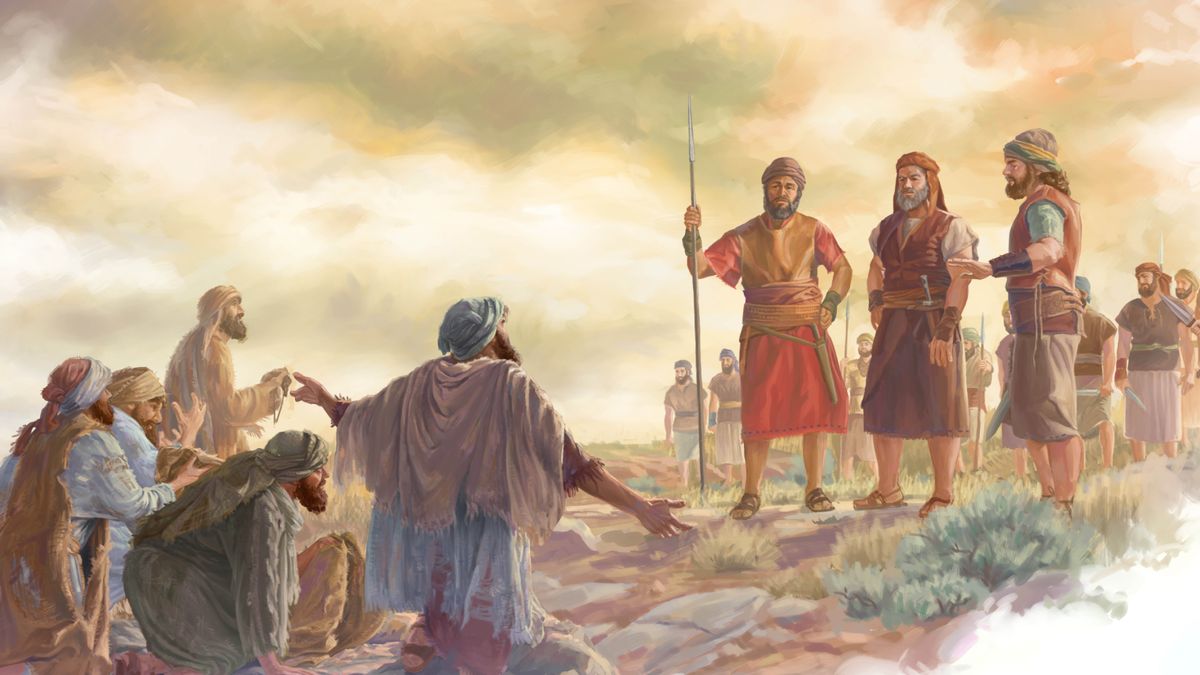
The Gibeonites tricked Joshua into making peace with them (See paragraph 4)
5. In what ways did the Gibeonites show faith in Jehovah?
5 On hearing that the Gibeonites had made peace with Israel, five Amorite kings banded together to attack Gibeon. The Gibeonites appealed to Joshua for help. (Josh. 10:3-7) Joshua led Israel in a rescue operation, and their efforts were blessed. Jehovah even hurled down great hailstones on the enemy Amorite forces and miraculously extended the daylight for battle. (Josh. 10:9-14) By seeking a covenant of peace with Israel and by appealing to Joshua for help when threatened, the Gibeonites showed faith in Jehovah—faith in his ability to fulfill his word and to rescue them.
6. What do we learn about Jehovah from the way he treated the Gibeonites during Israel’s conquest of the Promised Land?
6 What does this account teach us about Jehovah? Jehovah is humble and merciful. He had previously instructed Israel to “drive away all the inhabitants of the land,” which included the Gibeonites. (Num. 33:51, 52) Yet, in support of the covenant of peace Israel made with them, Jehovah mercifully permitted the Gibeonites to live. Jehovah did so even though the Israelites failed to consult him before entering into that covenant. He then helped Israel to stick to their agreement and miraculously rescued the Gibeonites.—Josh. 9:26; 11:19.
7. How can we imitate the Gibeonites’ faith and humility? (See also picture.)
7 How can we imitate the Gibeonites? By cultivating strong faith in Jehovah. Since we know so much more about Jehovah than did the Gibeonites at that time, we have even more reasons to trust in Jehovah completely. (Ps. 40:4, 5) We can also imitate the Gibeonites by being willing to do humble tasks in Jehovah’s service. (Josh. 9:23, 27) A young brother named Luke will never forget the time when he saw an older brother of the Bethel family do just that. Although that Bethelite cared for a weighty and somewhat prominent assignment, he quietly volunteered for a night shift to watch the local Kingdom Hall site while it was under construction. Luke says: “I learned that humility is not simply a feeling. It is expressed by what we choose to do or not do.” May we express our faith in Jehovah daily by relying on him when we face difficult situations and by humbly caring for any theocratic assignment.
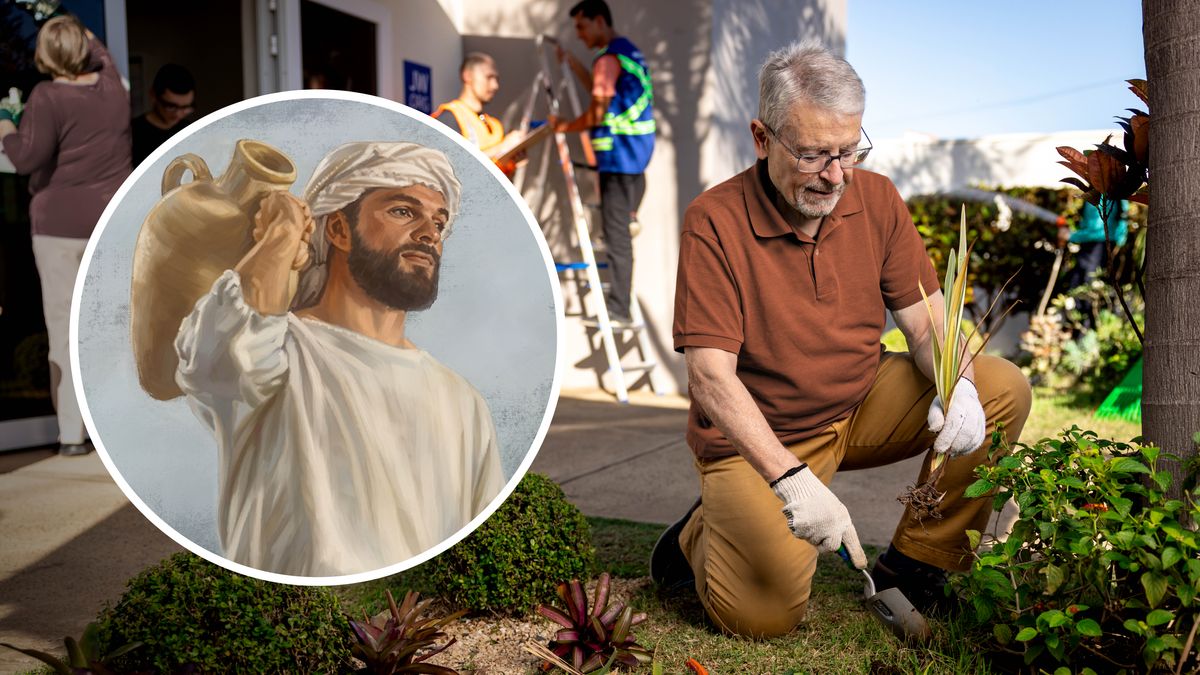
Imitate the Gibeonites by being willing to do humble work (See paragraph 7)
WAIT ON JEHOVAH TO CORRECT INJUSTICE
8. What crime did King Saul commit against the Gibeonites?
8 The Gibeonites are mentioned again in the Bible record centuries later. King Saul turned against the Gibeonites living in Israel. “In his zeal for the people of Israel and Judah,” he attempted to wipe the Gibeonites out.b As a result, a number of them were murdered. (2 Sam. 21:2, 5, 6) What an injustice! Saul broke the long-standing covenant of peace that existed between Israel and the Gibeonites.
9. When was the injustice against the Gibeonites finally addressed?
9 This terrible injustice against the Gibeonites was not immediately addressed. In fact, it was not until the reign of Saul’s successor, King David, that Jehovah brought the matter to the attention of the nation by means of a three-year famine. When David asked about the reason for the famine, Jehovah told him that Saul and his household were bloodguilty because of the way they had mistreated the Gibeonites years earlier.—2 Sam. 21:1.
10. As recorded at 2 Samuel 21:3-6, how did the Gibeonites show respect for God’s Law in what they said to David?
10 Read 2 Samuel 21:3-6. David spoke to the Gibeonites to try to determine what could be done to atone for Saul’s crime against them. Would they try to get rich by making David pay for not acting earlier in their behalf? The Gibeonites rightly answered that it was “not a matter of silver or gold” because, according to the Law, no ransom could be accepted for a murderer. (Num. 35:30, 31) They also recognized that they could not put a man to death without legal authorization. In the end, David authorized the execution of seven of Saul’s male descendants who may have had some share in Saul’s attempted genocide. Sometime later, the rains came, ending the famine and signaling that the injustice had been avenged to Jehovah’s satisfaction.—2 Sam. 21:9, 10, 14.
11. What can we learn about Jehovah from this account?
11 What does this account teach us about Jehovah? We see clear evidence that Jehovah is a just God. (Ps. 37:28) He wants all people to be treated fairly. That includes even those who may be discriminated against, as is often the case with foreigners and minorities. In his due time, Jehovah will correct any injustices that his worshippers may have experienced. We also learn that Jehovah expects us to keep our promises, just as he expected the Israelites to keep their promise of peace with the Gibeonites.—Compare Amos 1:9.
12. How can we imitate the Gibeonites when dealing with an injustice?
12 How can we imitate the Gibeonites? Even when mistreated by our brothers and sisters, we can wait patiently on Jehovah. By doing so, we show that we trust that Jehovah will correct matters in his due time. Consider the example of Sister Laura French. She began serving at Canada Bethel in 1926. About ten years later, she became the victim of a terrible injustice. She was wrongly accused of being involved with a group of apostates, and she was dismissed from Bethel. What would she do? Although she felt hurt, she never complained. She spent the next four years zealously serving as a pioneer. To her surprise and delight, in 1940 she was invited to return to Bethel, where she continued to serve faithfully until she finished her earthly course some 50 years later. Like Sister French, we can overcome an injustice by persevering in doing what is right and by waiting on Jehovah to correct matters in his due time.—Isa. 26:3, 4.
LOYALLY SUPPORT TRUE WORSHIP
13. Who were “the Nethinim,” and what did they do after the Babylonian exile?
13 About 500 years after the time of King David, the Gibeonites appear again in the Bible record. The 70-year Babylonian exile had come to an end, and in 537 B.C.E., the first group of Jewish exiles returned to Jerusalem with Governor Zerubbabel. (Ezra 2:1, 2, 58) In 468 B.C.E., another group returned but with Ezra the copyist. (Ezra 7:1-7) Both of those relatively small groups of returning exiles included families of “the Nethinim.” (See footnotes on Ezra 2:58 and 7:7.) Who were the Nethinim? They were “non-Israelite temple servants, or ministers,” and many of them were likely descendants of the Gibeonites.—See Glossary, “Nethinim.”
14. How did the Gibeonites show loyalty to Jehovah? (1 Chronicles 9:2 and footnote)
14 Read 1 Chronicles 9:2 and footnote. “The temple servants” were among the first exiles to return to Israel. That is significant because not all of the Jews in exile returned. Many Jews no doubt had found a measure of prosperity in Babylon, and they were unwilling to make the sacrifices required to return and help rebuild their devastated homeland. But faithful exiles, including some who were likely descendants of the Gibeonites, longed to see true worship reestablished at the temple in Jerusalem, and they made every effort to return. Unlike the Jews, the descendants of the Gibeonites did not have an inheritance of land in Israel. Yet, they returned to care for their temple duties and even to help repair Jerusalem’s walls.—Neh. 3:26.
15. What does the account of the Gibeonites teach us about Jehovah?
15 What does this account teach us about Jehovah? We learn that our God greatly appreciates his loyal worshippers and always takes care of them. By the time the Babylonian exile ended, almost 1,000 years had passed since Jehovah saved the Gibeonites during Israel’s conquest of the Promised Land. Yet, he continued to bless them. Descendants of the Gibeonites survived the destruction of Judah and Jerusalem in 607 B.C.E. After the exile, they continued to be closely involved with true worship, ministering with the Levites at the temple. Some apparently lived near the temple. (Ezra 2:70; Neh. 11:21) And they received an exemption from paying tax, tribute, and toll on account of their temple work.—Ezra 7:24.
16. How can we imitate the Gibeonites when it comes to our worship?
16 How can we imitate the Gibeonites? We too want to do all we can to support true worship. We willingly make sacrifices to serve Jehovah because we love him and want to please him. That was true of Alwin, a brother in the Philippines. He had a high-paying job working for an oil company. But he wanted to do more in his service to Jehovah. Whenever the circuit overseer visited his congregation, Alwin took time off from work to support the visit and enjoyed having a greater share in the ministry. After some time and many prayers, Alwin decided to quit his job and find one that would allow him to serve as a regular pioneer. Doing so would involve making financial sacrifices. Still, he reached his goal. His wife joined him in the pioneer ministry, and as a couple they have been able to help 21 people learn the truth. No doubt, Jehovah values this couple’s efforts. We too can be confident that Jehovah appreciates any sacrifices we make in his service, and as a result, he will always care for our needs.—Matt. 6:33.
17. What have we learned by reviewing Bible accounts about the Gibeonites?
17 The Bible accounts about the Gibeonites shed light on Jehovah’s endearing personality. He is humble, merciful, just, and loyal. He always rewards his faithful worshippers. These Bible accounts also contain a number of practical lessons. Like the Gibeonites, we want to have strong faith in Jehovah, relying on him when faced with frightening events. Such faith will also move us to care humbly for any theocratic assignment we may receive. We want to wait patiently on Jehovah, confident that he will ultimately correct all injustices. And we support true worship with zeal and loyalty. As we do, we will show that we have learned valuable lessons from the Gibeonites.
SONG 148 Jehovah Provides Escape
a The Gibeonite delegation apparently also represented the people of three other Hivite cities: Chephirah, Beeroth, and Kiriath-jearim.—Josh. 9:17.
b The Bible does not specifically say why Saul committed this crime. Some scholars have suggested that Saul was motivated by nationalistic fervor.
Find Comfort in the Book of Isaiah
pp. 8–13
SEPTEMBER 14-20, 2026
SONG 41 Please Hear My Prayer
Find Comfort in the Book of Isaiah
“This is what Jehovah says: . . . ‘As a mother comforts her son, so I will keep comforting you.’”—ISA. 66:12, 13.
FOCUS
How meditating on the book of Isaiah can lift our spirits when we feel sad or downhearted.
1-2. How does Jehovah respond when we face situations that make us feel sad?
IMAGINE a heartbroken child weeping uncontrollably. Perhaps his family is moving to a new home and this means that he has to leave his friends behind. Or maybe he is devastated about a mistake he made. In such moments, what would a loving mother do? She would gently embrace her child, listen to his tearful concerns, and assure him of her love.
2 In the Bible, Jehovah compares himself to a caring and loving mother who comforts her child. He says: “As a mother comforts her son, so I will keep comforting you.” (Isa. 66:13) Jehovah’s love for us is greater than that of any parent. (Isa. 49:15) Through His Word, the Bible, Jehovah provides us with the comfort and strength we need when we are downhearted or are in distress.—Rom. 15:4.
3. What will we consider in this article?
3 The book of Isaiah is filled with comforting expressions from Jehovah. (Isa. 40:1) Our loving Father inspired the writing of the book to assure his people during a turbulent period in Judah’s history. We too live in “critical times hard to deal with” and therefore need comfort. (2 Tim. 3:1) Let us consider some verses in the book of Isaiah that can soothe and fortify us when we are (1) faced with an unexpected change in circumstances, (2) plagued with excessive guilt, or (3) grieving the loss of a loved one.
WHEN CIRCUMSTANCES CHANGE UNEXPECTEDLY
4. How could a sudden change in circumstances affect us?
4 Our life can take an unexpected turn. (Eccl. 9:11; 1 Cor. 7:31) We could suddenly face a health crisis, a financial hardship, a political upheaval, or a change of assignment. Such changes can make us feel anxious or confused. It is only natural to wonder: ‘Where do I go from here?’ A brother named Joseph, who was transferred to the field after serving for about 17 years at Bethel, says: “I felt lost. It was a huge challenge to start a new life after being at Bethel for so long. I didn’t know where to start.” What assurance does Jehovah provide through Isaiah if we have to deal with an unexpected change in circumstances?
5. As found at Isaiah 42:16, what assurance does Jehovah provide for us? (See also picture.)
5 Read Isaiah 42:16. Jehovah promises to lead those who are figuratively blind along unfamiliar paths and to turn darkness into light. The expressions “blind,” “unfamiliar paths,” “darkness,” and “rugged terrain” may well describe the way we view our future when our circumstances change unexpectedly. We might feel as if we were walking through a dense forest, unsure of the path ahead. Yet, Jehovah assures us that whatever situation we face, he will give us the guidance we need and will never abandon us. He will take us by the hand and lead us through the darkness, shedding light on our way and smoothing out the rough terrain. How does Jehovah do this? By providing us with wise counsel through his Word and his organization. (Ps. 119:105; Isa. 30:21) He also uses our fellow believers and others to assist us in practical ways. Even when the path ahead is unclear and seems difficult, we can trust that Jehovah will lead us with care and understanding.—Isa. 41:10; 1 Pet. 5:6, 7.

Even when your circumstances change unexpectedly, Jehovah will never abandon you (See paragraph 5)b
6. If our circumstances change unexpectedly, of what can we be sure?
6 Joseph, mentioned earlier, explained how he and his wife felt Jehovah’s loving support after they left Bethel. He says: “We saw Jehovah’s loving hand during the transition period. He helped us by means of wonderful brothers and sisters. He cared for our material and emotional needs at just the right time, and he continues to do so.” If your circumstances change unexpectedly, you too can be sure that Jehovah will provide the strength and guidance you need no matter how daunting the change might seem. (Isa. 54:10; 58:11) Joseph adds: “The lyrics from one of our original songs put it nicely, ‘What tomorrow may bring, I do not know, but I know that I won’t face it alone.’a Yes, although things may not go as we plan, one thing is certain: Jehovah will be with us each step of the way.”
WHEN PLAGUED WITH EXCESSIVE GUILT
7. What struggle may some have because of their past mistakes?
7 When we confess a serious sin that we have committed, we receive loving help from the elders and we thereafter work hard not to repeat the sin. (Prov. 28:13; Jas. 5:14-16; 1 John 1:9) However, even after we have been shown mercy, we may still struggle with persistent guilt. We might think, ‘How could Jehovah ever forgive me for what I have done?’ (2 Cor. 2:7) This feeling is understandable because the weight of past mistakes can be heavy and the memory of them can linger. “There is no peace within my bones because of my sin,” King David wrote. “I have grown numb and become completely crushed.” (Ps. 38:3, 8) If you feel this way at times because of past mistakes, the book of Isaiah offers comfort.
8-9. As described at Isaiah 1:18, how complete is Jehovah’s forgiveness?
8 Read Isaiah 1:18. Jehovah uses a vivid word picture to describe how completely and thoroughly he forgives our sins. He says that even if our sins “are like scarlet,” he will make them “white as snow.” Scarlet is a bright red color that does not fade easily. Yet, Jehovah assures us that when he forgives us, we will not bear the stain of those sins for the rest of our lives.
9 Consider the example of King David. Although he was guilty of adultery and murder, Jehovah forgave him and later referred to him as a man of integrity. (2 Sam. 11:3, 4, 14, 15; 12:13; 1 Ki. 9:4, 5) Jehovah defined David, not by his mistakes, but by his faithful course. Similarly, Jehovah lovingly forgives us when we repent, and he helps us move forward with a clean conscience. What other assurance can we find in the book of Isaiah when plagued by excessive guilt?
10. What comforting assurance do we find at Isaiah 38:17?
10 Read Isaiah 38:17 and footnote. The phrase “you have thrown all my sins behind your back” could also be rendered “you have removed all my sins from your sight.” Jehovah is here depicted as taking the sins of a repentant wrongdoer and throwing them behind Him, where He no longer sees them or thinks about them. According to one reference work, the idea may be expressed: “You have made [my sins] as if they had not happened.” So when Jehovah forgives our sins, to him, it is as though we had never sinned. Once Jehovah forgives us, he will never bring up our past sins to accuse or punish us again. He wipes out the record of those sins completely. He promises: “I will not remember your sins.” (Isa. 43:25) How comforting! If Jehovah, the Supreme Judge, no longer holds our sins against us, who are we to hold them against ourselves?
Never allow your past mistakes to ruin your present happiness
11. Regardless of what we have done in the past, what does Jehovah focus on? (See also picture.)
11 Whenever feelings of excessive guilt resurface, we need to remind ourselves of Jehovah’s loving assurances. His forgiveness is real and complete. He is not ashamed of us because of our past mistakes, and he is not like imperfect people who hold a grudge. (Isa. 57:16) What really matters to Jehovah is, not the person we were, but the person we are today and the person we are striving to become. (Isa. 55:7) What a loving and forgiving God we serve! Therefore, may we never allow our past mistakes to ruin our present happiness or to deprive us of future blessings.

Jehovah does not define us by our past mistakes (See paragraph 11)c
WHEN GRIEVING THE LOSS OF A LOVED ONE
12. How might we feel when a loved one dies?
12 When someone we love dies, the grief we feel can be overwhelming and the pain of the loss can linger. At times, we might wonder why Jehovah allowed our loved one to die. A brother named Michael lost his parents in a fire. He says: “My heart broke to pieces, and I was angry at Jehovah for allowing them to die. I know that he didn’t cause their death, but he didn’t stop it either.” Perhaps you have felt similarly. In such moments of sorrow, what comfort and hope does Jehovah provide?
13. What promise does Jehovah hold out to us at Isaiah 25:8?
13 Read Isaiah 25:8. Jehovah promises to “swallow up death forever.” Imagine the time when death is no more! You will never again have to mourn the loss of someone you loved. (Isa. 35:10) You will never again experience the heartache of looking at a marker that tells you where your loved one is buried. Instead, you have the prospect of always having your loved ones with you, alive and in good health. This promise is not based on wishful thinking but is given by the only one capable of fulfilling it—God himself.—Rev. 21:4, 5.
14. How do you feel when you contemplate the hope of the resurrection? (Isaiah 26:19) (See also picture.)
14 Read Isaiah 26:19. Not only will Jehovah put an end to death but he will also bring our dead loved ones back to life. Referring to them, he says: “My corpses will rise up.” This indicates that Jehovah now claims personal responsibility for them. He preserves them in his memory. And at his appointed time, he will resurrect them. As the morning dew revives dry vegetation, Jehovah, the Source of all life, will awaken our loved ones from the sleep of death. What a joy it will be to welcome them back!—Compare Mark 5:42.

The hope of seeing our loved ones return to life is guaranteed (See paragraph 14)
15. How does the promise of the resurrection help us cope with grief?
15 While God’s promise of a resurrection does not eliminate our grief, we can take comfort in knowing that Jehovah has not forgotten our dead loved ones. This hope comforted Michael, quoted earlier. He says: “Isaiah 26:19 helped me to understand that Jehovah has a personal attachment to my parents. He has been keeping them safe in his memory, and he will continue to do so until he delivers them from death in his due time. I find comfort and strength in this.” May we too focus on the promise of being reunited with our dead loved ones. Doing so will make the pain easier to bear.
16. What scripture have you found comforting during a difficult situation?
16 We have considered a few verses from the book of Isaiah that can comfort us when we face an unexpected change in our circumstances, when we are plagued by excessive guilt, and when we are grieving. How grateful we are that Jehovah comforts and soothes us by means of his Word! (Ps. 94:19) Is there a scripture that you find particularly comforting when facing a distressing situation? Memorize it if you can, write it out in a journal, or post it where you will see it often. And may you find comfort from the soothing words of our loving heavenly Father, Jehovah.
SONG 3 Our Strength, Our Hope, Our Confidence
a The lyrics are taken from the original song entitled “I Know Jehovah’s With Me.”
Are You Getting to Know Jehovah Better?
pp. 14–19
SEPTEMBER 21-27, 2026
SONG 12 Great God, Jehovah
Are You Getting to Know Jehovah Better?
“Know the God of your father and serve him with a complete heart.”—1 CHRON. 28:9.
FOCUS
What it means to know Jehovah, why we should want to know him better, and how we can do so.
1. How do we feel when we contemplate Jehovah’s knowledge, wisdom, and accomplishments?
HAVE you ever thought about the depth of Jehovah’s knowledge, the vastness of his wisdom, or the scope of his accomplishments? We are humbled when we think about our Creator. You may feel as did the apostle Paul, who wrote: “O the depth of God’s riches and wisdom and knowledge! How unsearchable his judgments are and beyond tracing out his ways are!”—Rom. 11:33, 34.
2. What proves that we can get to know Jehovah?
2 Although we will never know everything there is to know about Jehovah, it is possible, to a certain extent, to get to know what he is like. King David told his son Solomon: “Know the God of your father and serve him with a complete heart . . . If you search for him, he will let himself be found by you.” (1 Chron. 28:9) As the apostle John reminded his fellow Christians centuries later, we have “insight so that we may gain the knowledge of the one who is true.” (1 John 5:20) And Jesus himself said that knowledge of Jehovah is available to “anyone to whom the Son is willing to reveal him.”—Matt. 11:27.
3. What will we discuss in this article?
3 All who dedicated themselves to Jehovah have already learned many things about him. Yet, we never stop “coming to know” Jehovah. (John 17:3; see study note.) We can always learn more about what makes him happy and how to deepen our trust in him. Let us discuss three questions that all of us should consider no matter how long we have served Jehovah: What does it mean to come to know Jehovah? Why should we continue to get to know him better? And how do we get to know him better?
WHAT DOES IT MEAN TO COME TO KNOW JEHOVAH?
4. What is involved in coming to know Jehovah?
4 We learn what is involved in coming to know Jehovah by considering what he said about the Jews who would return from exile. Jehovah promised: “I will give them a heart to know me, that I am Jehovah.” (Jer. 24:7) Surely those who returned from Babylon already knew basic facts about Jehovah. But their efforts to come to know Jehovah would need to involve their heart, including their feelings and motives. One reference work puts it this way: “There is a marked difference between knowing about God and knowing God. It is comparable to the difference between reading about love and falling in love.” We need to know more than the fact that Jehovah has a name and that he is God. We want to come to know the Person behind the name.
5. What can we learn from King Josiah regarding what it means to come to know Jehovah?
5 As we come to know Jehovah, we learn what makes him happy and what displeases him. To illustrate, consider the example of King Josiah. The Bible says: “In the 8th year of his reign, while he was still a boy, he started to search for the God of David his forefather.” (2 Chron. 34:3) But Josiah did more than study. He acted on what he was learning. Through the prophet Jeremiah, Jehovah said that Josiah “upheld justice and righteousness” and that he defended the afflicted and the poor. Then Jehovah added: “Is that not what it means to know me?”—Jer. 22:15, 16.
6. As indicated at Psalm 9:10, how will coming to know Jehovah affect us?
6 Read Psalm 9:10. The more we come to know Jehovah, the more we come to trust in him. That principle proved true for the apostle Paul. During his final imprisonment and not long before his death, he wrote: “I am not ashamed. For I know the One whom I have believed.” (2 Tim. 1:12) What Paul had learned and experienced during his life moved him to trust in his God implicitly. As a study note on that verse explains: “Paul . . . was confident that Jehovah would remember his faithful life course until ‘that day’ when He would resurrect him.”
WHY CONTINUE TO GET TO KNOW JEHOVAH?
7. After we have been serving Jehovah for many years, what could happen?
7 Over time, we may not put as much effort into getting to know Jehovah as we did when we first learned about him. Why not? When reading the Bible on our own or along with others at congregation meetings, we may tend to focus on how the information can help us personally in practical ways or how we can use it to help others. The Scriptures encourage us to do that. (2 Tim. 3:16, 17) But the Bible also reveals much about its Author. (Ps. 25:8-10) We should never be so absorbed in how the Bible’s message benefits us or others that we fail to ask ourselves, ‘What does this tell me about Jehovah God?’a
8. What impact will getting to know Jehovah better have on our friendship with him? (Psalm 73:24-28)
8 As we get to know Jehovah better, our friendship with him will grow stronger. For example, how do you feel about Jehovah after you do your daily Bible reading, watch a monthly broadcast, or attend an assembly or a convention? We often feel closer to our heavenly Father. Why? Because we have learned more about him. As a result, we are moved to praise and thank him. We feel like the psalmist who meditated on Jehovah’s care for him and who said: “God is the rock of my heart and my portion forever.” (Read Psalm 73:24-28.) Every effort we make to get to know Jehovah deepens our gratitude for our priceless friendship with him.
9. When we “take notice of” Jehovah, how will this affect our decisions? Illustrate.
9 When we “take notice of” Jehovah—recalling what we have learned about him and thinking about how our actions affect him—we will make better decisions. (Prov. 3:5, 6) To illustrate: Many brothers and sisters keep a photograph of their mate on their desk, in their wallet, or on their phone. This helps them to think fondly and often about their mate, to make decisions that they know will please their mate, and to avoid doing anything that would hurt that person. Similarly, the more often we think about Jehovah, the more likely we will be to make choices that please him.—Ps. 19:13, 14.
10. As we learn about Jehovah, what will we be able to do?
10 We are made in Jehovah’s image, which gives us the ability to reflect his qualities. (Gen. 1:26) And the more we learn about Jehovah’s qualities, the better we will understand how to imitate him. Jesus condemned the scribes and Pharisees for their failure to show godly qualities. Although they paid close attention to the minor details of the Law, they “disregarded the weightier matters of the Law, namely, justice and mercy and faithfulness.” (Matt. 23:23) Unlike those religious leaders, let us do our best to understand how Jehovah’s qualities are reflected in his laws and principles. Doing so will help us to demonstrate those very qualities.—1 John 4:8, 11.
HOW DO WE GET TO KNOW JEHOVAH BETTER?
11. How did you first come to know Jehovah?
11 Who introduced you to Jehovah? Perhaps you were raised by Christian parents. They likely related Bible accounts that reveal God’s qualities and taught you how the things he created reflect his personality. Or you may have accepted a Bible study from one of Jehovah’s Witnesses. Using a study aid, such as the Enjoy Life Forever! book, your Bible teacher helped you to analyze Scriptural accounts and to learn about Jehovah’s appealing qualities by studying the natural world.b (Neh. 8:8; Acts 14:17) Let us consider how we can continue learning about Jehovah.
12-13. What can we learn about Jehovah from reading the Bible? Give an example. (Jeremiah 39:15-18) (See also picture.)
12 First, we can learn more about Jehovah by reading and studying his Word. Sometimes, the Bible specifically identifies God’s qualities. (Ex. 34:6, 7) More often, though, it relates events involving humans and the decisions they made. When you read such accounts, think about what they can teach you about Jehovah.
13 Consider an example. While reading Jeremiah 38:6-13, you learn about the Ethiopian Ebed-melech, who rescued the prophet Jeremiah. Doubtless, you quickly identify ways that you can imitate Ebed-melech’s self-sacrifice, courage, and love for his fellow worshippers. Do you also see what qualities of Jehovah are revealed in this account? (Read Jeremiah 39:15-18.) For instance, what verse indicates that Jehovah is appreciative? Fair? Impartial? What other aspects of Jehovah’s personality do you discern in this account? Whenever you read a passage in God’s Word, identify Jehovah’s qualities that are reflected, and then thank and praise him for those qualities.
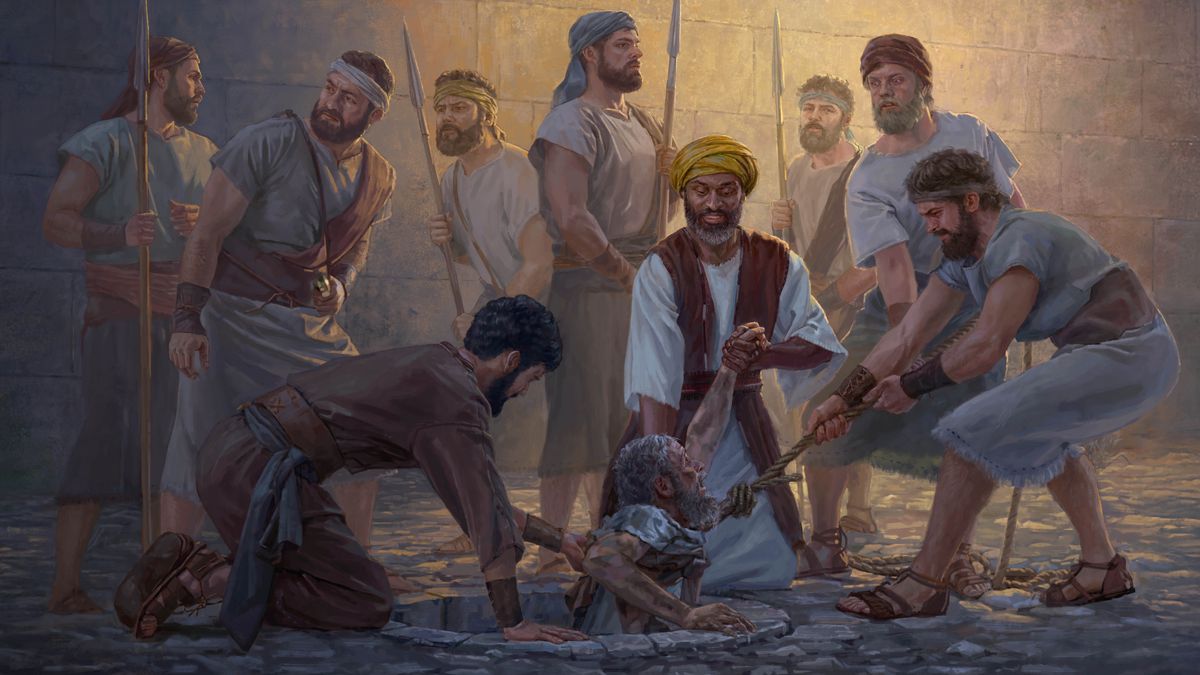
Ebed-melech courageously rescues Jeremiah, who was thrown into a cistern (See paragraphs 12-13)
14. What can we do to benefit fully from what we observe in creation?
14 Second, we can learn more about Jehovah by meditating on his creative works. (Ps. 145:9, 10) Of course, simply observing the natural world is not enough. Some spend their entire lives studying nature but fail to acknowledge God’s qualities or even his existence! The apostle Paul wrote that God’s “invisible qualities are clearly seen from the world’s creation onward, because they are perceived by the things made.” (Rom. 1:20) One translation of this verse says that we can perceive God’s qualities because they are “visible . . . to the eye of reason.” So we must think about and reason on what we see in order to discern the qualities of our Creator.
15. What has Patrick done to get to know Jehovah better, and how can you do something similar? (See also picture.)
15 Many of us live in urban areas that seem distant from the natural world. If this is your situation, can you still learn lessons from creation? Consider Patrick, who lives in Brazzaville, a large city in the Republic of the Congo. He relates: “I strive to observe creation from my balcony. I often see tiny insects or small birds busily looking for food or for a place to live. Once, I observed some birds making their nest. They found and used materials in our neighborhood that were perfectly suited for welcoming small chicks.” But Patrick did not stop there; he thought deeply about the Creator. He says: “I learned that Jehovah cares about the well-being of his creatures, even those that seem insignificant. This assures me that he also cares about me and will not fail to provide me with what I need.”

Get to know Jehovah better by meditating on what you see in creation (See paragraph 15)
16. What helped Mary, Jesus’ mother, come to know Jehovah better, and how can we imitate her? (See also picture.)
16 A third way we can get to know Jehovah better is by meditating on our own experiences. That is what Jesus’ mother, Mary, did. She already knew Jehovah well, and she had “found favor with [him].” (Luke 1:30) But then she was given a weighty assignment—to be the mother of God’s Son. Through the angel Gabriel and Mary’s relative Elizabeth, Jehovah strengthened Mary and reassured her. She later meditated on what her experience had revealed about Jehovah—including his power, mercy, impartiality, and interest in even the lowly ones. (Luke 1:46-55) Just as Mary was appreciative of God’s support, we are grateful when Jehovah gives us help “at the right time.” (Heb. 4:16) When you receive this help, ask yourself: ‘What has this taught me about Jehovah? Which qualities of Jehovah has this experience revealed?’

Get to know Jehovah better by meditating on what he has done for you (See paragraph 16)c
WE WILL NEVER STOP LEARNING
17-18. Why can we say that we will never stop learning about Jehovah?
17 Think of how much more we will learn about Jehovah in the new world. We will receive new scrolls that reveal his requirements for us. (Rev. 20:12) We will be able to interact more closely with the natural world. (Isa. 11:6-9) And we will deepen our understanding of our Father as we experience new things, including our loved ones being resurrected and our getting closer to perfection every day.
18 We will never stop getting to know Jehovah. He has already lived for an eternity, so “his understanding is beyond measure.” (Ps. 90:2; 147:5) We “will never find out the work that the true God has made from start to finish.” (Eccl. 3:11) Therefore, regardless of how long we have been in the truth, may we seize every opportunity to learn more about our loving Father.
SONG 28 Gaining Jehovah’s Friendship
a See the front section in the New World Translation entitled “An Introduction to God’s Word,” question 20.
b See lesson 07 points 5-7 in the Enjoy Life Forever! book.
c PICTURE DESCRIPTION: A brother who suffers from anxiety meditates on how Jehovah helped him to fulfill his assignment at the midweek meeting.
Help Others Come to Know Jehovah
pp. 20–25
SEPTEMBER 28–OCTOBER 4, 2026
SONG 79 Teach Them to Stand Firm
Help Others Come to Know Jehovah
“This means everlasting life, their coming to know you, the only true God.”—JOHN 17:3.
FOCUS
How to help your Bible students get to know Jehovah, including his qualities and what pleases him and what displeases him.
1. How do you feel when you see a Bible student making progress?
HOW do you feel when a Bible student attends his first congregation meeting, begins to comment, shares his faith with others, and in time decides to dedicate himself to Jehovah God? No doubt you are thrilled! Of course, Jehovah deserves the credit for the spiritual progress our Bible student makes. We praise Jehovah when we see how he helps someone to grow spiritually.—1 Cor. 3:5-9; 3 John 3, 4.
2. What is Jehovah’s will for Bible students? (1 Timothy 2:3, 4)
2 God’s will is for “all sorts of people” to “be saved and come to an accurate knowledge of truth.” (Read 1 Timothy 2:3, 4.) Jehovah wants people to come to know him and his purposes as fully as possible. (Jer. 9:24) That means taking in accurate knowledge. The original-language word translated “accurate knowledge” means not merely a collection of facts that someone learns but knowledge that “has its full effect on the person,” as one Bible scholar said. When a Bible student comes to know Jehovah, that knowledge affects the way he lives. And it opens to him the prospect of “everlasting life.”—John 17:3.
3. What will we discuss in this article?
3 Jehovah has given us the privilege of helping others come to know him. In this article, we will discuss the following questions: Why do Bible students need to get to know Jehovah well? How can we teach them what Jehovah is like? And how can we help them put their knowledge of Jehovah to work in their lives?
HELP THE STUDENT TO COME TO KNOW JEHOVAH WELL
4. In harmony with Mark 12:30, what is our primary objective when conducting a Bible study?
4 Jesus said that the greatest commandment is to love Jehovah with our whole heart, soul, mind, and strength. (Read Mark 12:30.) A Bible student must come to know Jehovah in order to love him. We want our Bible student to dedicate himself—not to us, not to a set of teachings, not to an organization—but to Jehovah. Therefore, our primary objective when conducting a Bible study is to help our student come to know and love Jehovah.
5. What will love for Jehovah motivate your Bible student to do?
5 There is a connection between love and obedience. Once your Bible student comes to know and love Jehovah, he will be moved to obey him. Jesus said: “For the world to know that I love the Father, I am doing just as the Father has commanded me to do.” (John 14:31) Similarly, love for Jehovah—more than anything else—will motivate a Bible student to obey him and to stick to him.—1 John 5:3.
6. How will knowledge of Jehovah help your Bible student when making decisions? Illustrate.
6 Bible students who come to know Jehovah well will be more likely to make wise decisions. To illustrate: A commercial airline pilot does not learn to fly by merely studying flight regulations or taking an exam. He must also log many hours in the cockpit. Over time, he learns how the plane reacts in different conditions and how his decisions affect the plane’s performance. Similarly, a Bible student will come to know Jehovah not only through his study but also by seeing how things turn out for him when he makes decisions in harmony with Scriptural principles. As he grows in knowledge of Jehovah and sees how his heavenly Father helps him, he will be equipped to make good decisions in any circumstance.
7. How did knowledge of Jehovah help Joseph to make a good decision?
7 Knowledge of Jehovah helped Joseph when Potiphar’s wife tried to seduce him. From childhood, Joseph had no doubt heard about the accounts of Adam and Eve and of Abraham and Sarah. (Gen. 2:24; 20:3, 6) Joseph could discern from those accounts how Jehovah views marriage and the gift of sexual relations. Joseph came to know Jehovah so well that he rejected the advances of Potiphar’s wife and told her: “How could I commit this great badness and actually sin against God?” (Gen. 39:7-9) Joseph knew what was good and what was bad in Jehovah’s eyes. He understood what would hurt his God. As a result, Joseph made the right decision. If we help our Bible students to get to know Jehovah well and to learn what he is like, they too will make choices that please him.
TEACH HIM WHAT JEHOVAH IS LIKE
8. How can you use the Enjoy Life Forever! book to help a Bible student come to know Jehovah?
8 How, then, can you teach a Bible student what Jehovah is like? Jehovah helped Job to learn more about Him by asking questions—well over 50 of them! (Job 38:1–41:34) We too can ask questions. The questions found in the Enjoy Life Forever! book are designed to help a student progressively learn about Jehovah’s personality. (See the box “Questions That Help Us Teach.”) So use these questions to help your student come to know Him.
9-10. (a) What will help Bible students to get the most out of their Bible reading? (James 5:11) (b) Illustrate how a Bible account can reveal what pleases or what displeases Jehovah.
9 Early in our interactive Bible course, we encourage students to start a routine of Bible reading.a How can we help them to get the most out of their personal reading? We might suggest that each time they read a Bible passage, they consider why Jehovah included it in his Word and what qualities it reveals about him. Notice how the disciple James did just that when he referred to the story of Job. James drew attention not only to a quality of Job—his endurance—but also to qualities of Jehovah—His tenderness and mercy.—Read James 5:11.
10 We want our students to discern how each Bible account reveals what pleases or what displeases Jehovah. For example, perhaps our student consults the chart “Get Started Reading the Bible” in the Enjoy Life Forever! book and tells us that he has chosen to read the story of Daniel in the lions’ den. We might encourage him to meditate on such questions as: ‘Why did Jehovah save Daniel? What does this tell me about what makes Jehovah happy?’ (Dan. 6:10, 22) He might also ask himself: ‘What happened to the men who had accused Daniel? What does this tell me about what displeases Jehovah?’ (Dan. 6:4, 5, 24) Finally, he can think about other qualities of Jehovah that are evident in the account.—Dan. 6:26, 27.
11. How can we help our student to see his Bible study as a gift from Jehovah?
11 We are happy when our student appreciates the benefits he receives from his Bible study. However, we should help him to see that the Source of these benefits is Jehovah, the Grand Instructor. (Isa. 30:20, 21) Our student may thank us for what he is learning and perhaps even praise us for the way we teach. While these sincere expressions of gratitude are not wrong, we should try to redirect such praise and gratitude to Jehovah.
HELP HIM PUT HIS KNOWLEDGE TO WORK
12-13. How can getting to know Jehovah help a student when he finds a Bible account difficult to understand? (See also picture.)
12 To benefit fully from accurate knowledge, we must use what we know. So how can you help your student to put his knowledge to work? First, teach him to recall what he knows about Jehovah when he reads a Bible account that he finds difficult to understand. While reading about divine judgments, for example, he may wonder why Jehovah executed some people but spared others. How might you help your student to reason on the matter?
13 You can encourage your student to reflect on what he has learned about Jehovah. How precious is life to Jehovah? (2 Pet. 3:9) How far has he gone to save us—even though we are sinners? (Eph. 2:4, 5) Does Jehovah punish people who do not deserve it? On the other hand, does he allow anyone who deserves punishment to escape it? (Ex. 34:6, 7) Sometimes, a Bible account does not provide the details that would make Jehovah’s decision more understandable to us. However, we do not need those details. We know our God, and we are convinced that our God always does what is right.

Teach your student to recall what he knows about Jehovah when he finds a Bible account difficult to understand (See paragraphs 12-13)
14. How can you help a student if he finds it hard to get along with someone in the congregation?
14 Consider a second way a Bible student can put his knowledge of Jehovah to work. Suppose your student is now attending meetings, but he finds it hard to get along with someone in the congregation. Perhaps he has been offended by that publisher. Encourage your student to consider how Jehovah views our brothers and sisters. What sacrifice has Jehovah made to show his love for them? (John 3:16) How important is our Christian unity to him? (Ps. 133:1) How does he feel when we strive to protect that unity? (2 Cor. 13:11) Help your student to see how pleased Jehovah will be when we focus on the positive qualities of others rather than on their faults.
15-16. (a) When facing a major decision, how can a Bible student imitate Jesus? (John 8:29) (b) How did Marianne help her student to make a good decision? (See also picture.)
15 Finally, you can help your Bible student to use his knowledge of Jehovah to make good decisions. You might first direct his attention to lesson 35 of the Enjoy Life Forever! book, entitled “How to Make Good Decisions.” However, what if your student has prayed and done research but still struggles to make a decision? He may feel overwhelmed by the number of Bible principles that bear on the topic. You can suggest that he reflect on Jesus’ example. How did Jesus make decisions? He said: “I always do the things pleasing to [my Father].” (Read John 8:29.) Encourage the student to ask himself, ‘Based on what I have researched and on what I have learned about Jehovah, what choice would please him?’ Any decision that pleases Jehovah is a good decision.
16 A woman in Chile who was studying the Bible faced a major decision. She was being pressured by her family to accept a well-paying job that would interfere with her meeting attendance. Her Bible teacher, Marianne, relates: “I urged her to reflect on how her decision would make Jehovah feel. Would he be happy or sad? I also encouraged her to pray to Jehovah specifically about the situation and to observe how he would answer. She refused the job offer and soon found employment that allowed her to attend meetings.” Note that rather than tell the student what to do, Marianne helped her to meditate on what she already knew about Jehovah. As a result, this experience strengthened the student’s relationship not only with Marianne but also with Jehovah. Marianne says about her student: “She learned that Jehovah cares for us if we put his worship first.”

Help your Bible student learn to make decisions that please Jehovah (See paragraphs 15-16)b
BLESSINGS FOR THOSE WHO COME TO KNOW JEHOVAH WELL
17. Besides learning the facts, what else do we want Bible students to do?
17 Our interactive Bible course covers many important teachings. Students study basic Bible doctrines—including the condition of the dead, the ransom, and the Kingdom. They also learn about organizational aspects—such as the meetings, the elder arrangement, and the role of the Governing Body. However, we want our students to do more than just learn facts. We want them to get to know Jehovah well.
18. What blessings are in store for those who come to know Jehovah?
18 What a privilege it is for us to teach others to come to know Jehovah! Even now, those who come to know and worship Jehovah are blessed with the happiest life possible today. (Ps. 25:12-15) In the future, all who “gain the knowledge of the one who is true,” Jehovah, will enjoy eternal life. (1 John 5:20) But that is not all. The Bible tells us that those who strive to come to know and love Jehovah are “known by him.” (1 Cor. 8:3) Yes, Almighty God takes notice of us and acknowledges us as his friends. What a splendid reward for coming to know the only true God!
SONG 84 Reaching Out
a The goal stated in lesson 05 of the Enjoy Life Forever! book is: “Begin reading the Bible regularly, using the chart ‘Get Started Reading the Bible.’”
b PICTURE DESCRIPTION: A reenactment of Marianne’s Bible student refusing a job offer.
Allowing Jehovah to Refine Me
pp. 26–30

LIFE STORY
Allowing Jehovah to Refine Me
I WILL never forget the first day I reported for work in the Bindery at Bethel in Brooklyn, New York, U.S.A. As soon as I stepped onto the factory floor, I was overwhelmed by the loud noise and the relentless movements of the bindery machines. Paper dust floated in the air, and a strong smell of oil filled the area.
Among the many things that caught my attention, the people left the deepest impression on me. Here were young brothers and sisters doing what appeared to be monotonous work. They were not in the limelight. Yet, they were happy and content. Their example taught me what it means to serve God humbly.
Through the years, Jehovah has been refining me to become a better servant of his. But first, let me tell you about my search for the truth when I was a Buddhist.
SEARCHING FOR GOD AS A CHILD
I was born and raised in Chicago, Illinois, U.S.A., the eldest of four children. My parents had emigrated to Chicago from Japan to pursue the so-called American dream. They wanted their children to receive the best education possible and to be successful in life.
My parents were devout Buddhists. My mother had been raised in a home that included a Buddhist temple. Her father and two brothers served as Buddhist monks. Buddhism thus played a significant role in my childhood. The first thing I would do after returning home from school was burn incense and offer rice and water to our Buddhist idol. On Sundays, we would go to a Buddhist temple where we chanted to a similar idol—only it was bigger and gilded with gold.
When I was about seven, I remember staring at the idol we had in our home and thinking to myself, ‘What will my life be like after I die?’ Buddhism had taught me that I would exist somewhere in the spirit realm after death. It dawned on me that one day my life would end. I might exist as a spirit, but I would no longer enjoy life as a human. How sad! Suddenly, feelings of helplessness overwhelmed me.
As I entered my mid-teens, the Buddhist rituals I engaged in seemed meaningless. Something was missing in my life. (Matt. 5:3) Deep within, I felt that there had to be an all-powerful, living God. I wanted to know him. I thought that perhaps the Bible had the answers. So I bought a used King James Version at a Buddhist festival—of all places!

With Wilson Bashou, who taught me the truth
When I was 17, a brother named Wilson Bashou approached me on the street while I was walking my dog. He asked, “Do you know what God promises for the future?” That question led to a deep Bible discussion. Wilson read Revelation 17:1 and asked, “What do the ‘many waters’ that the prostitute is sitting on refer to?” I had no idea. He showed me verse 15, which says that the waters refer to people. I was impressed to learn that Jehovah’s Witnesses let the Bible interpret itself. Before parting, Wilson gave me a copy of the book The Truth That Leads to Eternal Life. That little blue book changed my life.
Ten days later, I attended my first meeting at the Kingdom Hall. I will never forget the warm reception I received. I have attended the meetings ever since. Afterward, Wilson started a Bible study with me. I loved learning about the Bible so much that there were occasions when we would study for up to eight hours at a time. My parents were alarmed, and they strongly opposed my study. But the more I studied, the more I was convinced that this was the truth. I got baptized in 1983.
LEAVING UNIVERSITY TO PIONEER
At the time of my baptism, I was attending a prestigious university and pursuing a career in medicine. My parents had sacrificed so much so that I could receive this education. I could have continued my university studies, but I wanted to give Jehovah my best and serve him full-time.
My father had warned me, “If you quit university, I will kick you out of the house!” I was sad and confused. I loved my parents and did not want to disappoint them. So I would often go out on the campus grounds late at night and pray under the starry skies, “Jehovah, please, help me with this decision.” When I finally decided to quit university, my father told me to get out of the house. I called Wilson to tell him what had happened. And he kindly invited me to live with him. I boarded a bus to his apartment with all my belongings in one bag. I remember feeling an indescribable calm come over me. I knew that I had made the right decision.
I felt like a bird released from a cage! I was finally free to devote myself fully to the ministry. I began pioneering in 1984.
During my years as a regular pioneer, Jehovah taught me valuable qualities, such as persistence. One day, it seemed that I had every reason not to go out in the ministry. I was discouraged because no one could join me for service in the afternoon. I went anyway. After a couple of hours, I made a last call at an apartment building. I was feeling tired and lonely, and it looked as if it would rain. I wondered, ‘Should I quit?’ As I climbed the stairs to the third floor, I saw a young Filipino man standing before me. I thought to myself, ‘Surely, he is not interested.’ How wrong I was! I started a study with that man, and he became my spiritual brother.
REFINED AT BROOKLYN BETHEL
After living with Wilson for two years, I was invited to Brooklyn Bethel in 1985. As I mentioned at the outset, I was assigned to the Bindery. One day while working on the embossing machine, I accidentally ruined hundreds of book covers. The Bindery Office requested that I report the matter. I gave all the reasons for my mistake, but one thing was missing. In a kind tone, the overseer reminded me, “It’s always good to apologize.” In that moment, I learned the importance of acknowledging my mistakes and saying, “I am sorry.”

Giving a tour of the Bindery in Brooklyn
My viewpoint of serving others was refined by observing faithful, older ones of the Bethel family. One time, Brother Milton Henschel, a member of the Governing Body, was sitting at our table for lunch. That day the dining room had an overflow of people, and the waiters were frantically working to distribute the food. We, the younger brothers at the table, were quietly complaining about the slow service. Without saying a word, Brother Henschel got up and along with the waiters started serving pitchers of water and plates of bread and butter. That humble act of service is forever etched in my mind. It reminded me of how Jesus served his apostles.—John 13:3-5.
“YOU SHOULD STUDY JAPANESE!”

With Michiko Oda and her husband
In 1987, I made a trip to Japan and was impressed to see the zeal and humility of the publishers there. I wanted to help them, but the problem was that I had not learned Japanese. One sister at Bethel, Michiko Oda, looked me straight in the eye and said, “You should study Japanese!” And that is what I did. Little did I know how her words would change my life.
A few months later, I transferred to a Japanese congregation in New York. Learning Japanese opened up many opportunities for me to serve Jehovah God. In 1989, I attended my first Japanese convention in Los Angeles, California. Miwako Onami, a pioneer sister who played a role in the drama, caught my eye.
Miwako and I got married in 1992, and we were privileged to serve together as a couple at Brooklyn Bethel. Miwako is a thoughtful and caring person, always ready to help others. Her example has helped me to refine how I treat others. She is a gift from Jehovah—an endless source of happiness and comfort to me.

On our wedding day
THE JAPAN BRANCH AND THE FIELD
In time, both of Miwako’s parents, who were living in Japan, became seriously ill. So we were kindly allowed to transfer to the Japan branch so that we could be nearby to care for them. We moved there in 1999.
The Bethel family in Japan soon embraced us, and we adjusted to our new home. I was further refined by imitating the positive qualities of the Japanese brothers and sisters, such as their outstanding generosity and hospitality. When it comes to work, they are serious and focused. They also work well as a group. How so? The Japanese culture emphasizes working with others in a spirit of harmony and cooperation for the good of all instead of working alone for personal achievements. Their fine example encouraged me to work humbly with others and to appreciate how my small share contributes to Jehovah’s overall purpose.
Still, because of cultural differences, there were occasions when it was difficult for me to understand why matters were handled in a certain way. I had to learn patience and not to overreact. In time, I refined my viewpoint and realized that Jehovah can bless any decision as long as we submit to the direction he gives us through his organization. In the end, Jehovah is the one who makes things work.
I often compare the refining I received at Bethel to the refining the prophet Moses received. Jehovah helped Moses cultivate meekness during his 40 years as a shepherd. Like Moses, I came from a background of higher education. I had allowed that education to make me proud and self-reliant. Bethel taught me to be humble and to rely on Jehovah. Just as Jehovah patiently refined Moses, Jehovah has done the same for me over the years.

Working at the Japan branch
We cared for both of Miwako’s parents for some 24 years until their death. There were many phone calls, anxious moments, and trips to the hospital. The health of Miwako’s mother, Masako, deteriorated to the point where she could barely get up to walk. It was not easy for Masako to attend congregation meetings and go out in the ministry. In her final weeks, she had to use a wheelchair. Yet, through all of this, her love for Jehovah never waned. Her face beamed with joy whenever she spoke about the truth. Masako’s example of serving God and finding contentment and happiness no matter what the circumstance has been a source of inspiration for me.

Preaching with Miwako in Okinawa
In 2024 we experienced a dramatic change in our lives. After serving at Bethel for over 30 years, we were assigned to the field. We currently serve as special pioneers on the island of Okinawa and have the privilege of witnessing to families who are stationed in the nearby military base. The good training we received at Bethel helped make this transition to the field much smoother. We try to maintain a good schedule and to make the best use of our time by remaining focused on our ministry and working hard. Jehovah kindly blessed us with Bible students who have become like family to us. We are learning firsthand the importance of loving people. Miwako and I thank Jehovah every day for this beautiful assignment.
DETERMINED TO BE REFINED EVEN MORE BY JEHOVAH
My family, although no longer opposed, has yet to join me in pure worship. Even so, Jesus promised that those who leave their families to become his disciples would receive 100 times more now in the form of a spiritual family. (Mark 10:29, 30) This has certainly proved true in my case. All the families around the world who have loved and cared for me over the years as their own are just too numerous to recall.
I still have the very same Truth book that Wilson placed with me. That blue book is a powerful reminder of how Jehovah kindly let me find him. (1 Chron. 28:9) I am determined to continue to be refined by him and to help others learn the truth that leads to eternal life.
Repair the Damage Quickly!
p. 31

Repair the Damage Quickly!
HAS a brother or a sister hurt you to the extent that now there is damage to your relationship? To repair the damage and remain friends, you need to act quickly and with the right motive.a
To illustrate, a fractured bone must be treated so that it can eventually function well without pain. But the pain will continue if the fracture is not given prompt attention. Worse yet, the bone may become permanently misaligned and unable to function properly.
Like a fractured bone, a damaged relationship with a fellow Christian should be treated quickly. Otherwise, the pain of a broken friendship will continue. Resentment could grow, and you may lose your friend. Jesus said: “Be quick to settle matters.” (Matt. 5:25) So approach your friend and talk kindly but openly about the matter. Why might this be hard? Consider two reasons.
First, you may be tempted to ignore the situation without resolving it, perhaps because you are uncomfortable talking about problems.b Consider Euodia and Syntyche, Christian sisters who apparently could not resolve a disagreement. Their problem likely lingered, since even the apostle Paul, who was far away in Rome, heard about it. He urged them to do whatever was needed to restore their unity. (Phil. 4:2) With humility, good communication, and true forgiveness, their friendship could thrive again.
Second, you may expect the other person to acknowledge his fault. But you want to regain your friend, not establish blame. A doctor treating a broken bone will focus on healing it, not on investigating every detail of what caused the break. When you talk to your friend, do not focus on who is to blame for the damage. Instead, remember how much you value the friendship and concentrate on what you need to do to repair it.
Why not talk to your brother or sister today, aiming to repair the damage and restore your friendship? “Do not let the sun set while you are still angry.” (Eph. 4:26) By taking steps to repair the damage quickly, you will help to safeguard our “uniting bond of peace.”—Eph. 4:1-3.
a Minor upsets should be settled privately and forgiveness should be extended freely. (Matt. 5:23, 24) Some serious personal offenses may require the assistance of the elders. (Matt. 18:17) A Christian would seek such assistance, however, only after following the steps outlined at Matthew 18:15, 16.
b If we are offended by a fellow believer, but there is no damage to our friendship, we may simply choose to overlook the offense.—Prov. 26:20.
Prepare Upbuilding Comments
p. 32
STUDY TIP
Prepare Upbuilding Comments
At our congregation meetings, we have the privilege to encourage our brothers and sisters through our comments. (Heb. 10:24, 25) How can we prepare comments that truly build others up?
Pray to Jehovah. Ask him to help you make a comment that honors him and encourages others.—Ps. 35:18.
Aim to do more than simply read from the publication. When you answer in your own words, others will benefit as they hear your expression of faith.
Keep your comment brief. Short and simple comments are often the most encouraging and allow more people to participate in the meeting.—Prov. 10:19.
Keep your comment positive. Avoid using your comment to counsel or criticize the congregation or a fellow Christian.
Even if you are not called on to comment, you can still build others up. Listen attentively, and express appreciation for their comments.—Prov. 10:21.