The Watchtower — Study Edition · August, 2026
Study Edition
pp. 1–32

Study Edition
AUGUST 2026
STUDY ARTICLES FOR: OCTOBER 5–NOVEMBER 1, 2026
© 2026 Watch Tower Bible and Tract Society of Pennsylvania
This publication is not for sale. It is provided as part of a worldwide Bible educational work supported by voluntary donations. To make a donation, please visit donate.jw.org.
Unless otherwise indicated, Scripture quotations are from the modern-language New World Translation of the Holy Scriptures.
Table of Contents
p. 32
Table of Contents
IN THIS ISSUE
Study article for October 5-11, 2026
2 Resist Satan’s Tactics—Trust In Jehovah and In Jesus
Study article for October 12-18, 2026
Study article for October 19-25, 2026
14 An Appeal on the Basis of Love
Study article for October 26, 2026–November 1, 2026
20 Cherish “the Privilege of Fearlessly Rendering Sacred Service”
26 Life Story—My Grand Creator Noticed Me
31 Did You Know?—What activities took place at city gates in Bible times?
Resist Satan’s Tactics—Trust In Jehovah and In Jesus
pp. 2–7
OCTOBER 5-11, 2026
SONG 55 Fear Them Not!
Resist Satan’s Tactics—Trust In Jehovah and In Jesus
“Oppose the Devil, and he will flee from you.”—JAS. 4:7.
FOCUS
Don’t be fooled by Satan’s attempts to misrepresent Jehovah God and Jesus Christ.
1. What tactic does Satan use to try to break the integrity of God’s servants?
FROM the moment we decide to serve Jehovah, Satan and his demons become our unrelenting enemies. But Satan knows that he cannot overpower us as long as we have Jehovah’s support. So the Devil tries to undermine that support by getting us to turn our back on Jehovah. One way he does this is by trying to make us doubt that Jehovah and his Son are truly on our side.—2 Cor. 11:14; Jas. 1:6.
2. Why is it important that we have confidence in Jehovah God and in Jesus Christ?
2 In the midst of a battle, soldiers need to have confidence in their leaders. If they were to lose that confidence, they might act independently. This could cost them their lives. In a similar way, we are soldiers in a spiritual battle against “wicked spirit forces.” (Eph. 6:12) Satan the Devil knows that if we lose confidence in Jehovah God and in Jesus Christ, we will likely reject their lead and support. So he does all he can to weaken our confidence in them. In this article, we will examine how he used this tactic in the past and how he is still using it today. Then we will consider how we can resist his schemes. In the next article, we will examine two other tactics Satan uses against us in our spiritual warfare.a
SATAN MISREPRESENTED JEHOVAH AND JESUS
3. How was Eve’s confidence in Jehovah undermined by Satan?
3 Early in human history, Satan set out to turn Adam and Eve away from Jehovah. Satan deceived Eve into believing that her Creator did not have her best interests at heart. Satan asked her: “Did God really say that you must not eat from every tree of the garden?” (Gen. 3:1-5) Satan convinced Eve that Jehovah was imposing unreasonable limits on both her and her husband. Sadly, Eve and later Adam sided with the enemy Satan. They turned their back on Jehovah—the One who had given them everything.—Gen. 3:6.
4. In the days of Job, how did Satan misrepresent Jehovah?
4 Since the time of Adam and Eve, Satan has continued to misrepresent Jehovah. For example, Satan incited Job’s false friends to move Job to doubt that Jehovah loved him and valued his faithful course. (Job 22:1-3) The Devil assumed that personal tragedies would cause Job to reject Jehovah. Although Job was under great pressure from Satan’s scheme, that faithful man maintained his integrity, never losing sight of his friendship with God.—Job 27:1, 5.
5. How did Satan try to prevent people from following Jesus? (Matthew 11:19)
5 Centuries later when Jesus came to the earth, Satan tried to prevent people from following Jesus. One way he did this was by inciting hateful religious leaders and others to spread lies about Jesus. And in the end, they had him executed as a common criminal.—Read Matthew 11:19; 27:27-31; Mark 14:55, 56; John 8:41-45.
6-7. In what ways did Satan attack Jesus’ early disciples?
6 After Jesus’ death, Satan turned his attention to the work of Jesus’ followers. First, the Devil tried to introduce doubts about Jesus’ resurrection. Under Satan’s influence, a false story circulated that Jesus’ disciples had stolen his body. (Matt. 28:11-15) Then during the days that followed, Satan tried to intimidate the congregation by means of persecution. Satan wanted to make the work that their Master had entrusted to them appear too difficult for them to carry out.—Acts 7:57–8:1; 12:1-3; 28:22.
7 Although some of the early Christians gave in to this pressure to stop preaching, most stood firm and refused to keep silent. They recognized that Satan and the demons were their real enemies. (Acts 4:18-20; 1 Pet. 5:8) What about today? What tactics is Satan using to try to discourage us from serving Jehovah?
SATAN CONTINUES TO MISREPRESENT JEHOVAH AND JESUS
8. How does Satan use false religion to spread lies about Jehovah and about Jesus?
8 Today, one of Satan’s main tactics is to obscure the truth about Jehovah and about Jesus. As “the father of the lie,” the Devil spreads lies about them by means of false religion. (John 8:44) For example, he has blinded people about the true identity of Jehovah and of his Son. (2 Cor. 4:3, 4) Christendom often presents the Father and the Son as being equal. As a result, people tend to ignore the Father, whose name they do not know, and worship the Son. Neither Jehovah nor Jesus approves of such worship. (Matt. 4:10; John 4:23) When people are blinded in such ways, they may be difficult to reason with or may even oppose our ministry.
9. Under Satan’s influence, what has false religion kept people from learning? (Jeremiah 23:26, 27)
9 When we start a relationship, one of the first things we do is learn the person’s name. Satan seeks to prevent people from having a close friendship with Jehovah by keeping them from even knowing His name. Thus, Satan has long used false religion to make people forget God’s name. (Read Jeremiah 23:26, 27.) That enemy has even made sure that God’s name—which the Bible likens to a strong, protective tower—is omitted from many translations of the Bible. (Prov. 18:10) The Devil is also behind the lie that Jehovah causes suffering. As a result, sincere people may struggle to see Jehovah as a Friend they can draw close to. (Jas. 4:8) However, Satan also seeks to undermine the faith of Jehovah’s people.
10. Why might a Christian become angry with Jehovah?
10 When we are going through personal challenges, Satan wants us to believe that Jehovah doesn’t care about us. Satan hopes that we will become angry if Jehovah allows our suffering to continue. (Prov. 19:3) Those who begin to feel this way may even wonder: ‘What is the point of continuing to follow Jehovah’s laws and principles? It doesn’t seem to benefit me!’ This type of thinking could lead us to come under Satan’s influence.
11. How is Satan raising doubts about Jehovah’s standards? (See also picture.)
11 Satan uses such tools as social media to raise doubts about Jehovah’s standards. On these platforms, many people express the view that the moral values found in the Bible are outdated and that everyone should be free to set his own standards. Most certainly, “the ruler of the world” has been very skilled at blurring the lines between what is good and what is bad.—John 14:30; Isa. 5:20; 1 Tim. 4:1, 2.

Satan’s world bombards us with material that undermines God’s standards (See paragraph 11)
12. Why should we avoid Satan’s propaganda?
12 Listening to Satan’s propaganda could cause us to drift away from Jehovah. A young sister whom we will call Shannon relates: “It took me a while to realize that the morals I was being taught in school and the people I was associating with were distorting my sense of right and wrong. The more time I spent on social media, the more I wanted to copy the values of those I met online. I gradually began to drift away from Jehovah, my family, and my brothers and sisters.” Eventually, Shannon found her way back to her heavenly Father and escaped from the Devil’s snare. What helped her?
13. What do you learn from Shannon’s experience?
13 Shannon realized that she needed to work hard to remain friends with Jehovah and Jesus. She says: “I prayed and worked in harmony with my prayers by doing research in our publications. The video Young People Ask—How Can I Make Real Friends? helped me a lot.b In that dramatization, a young sister was experiencing many of the same challenges that I was. She humbly turned to her parents and asked for help. I did the same. My parents, the elders, and mature Christian sisters in the congregation helped me to break free from my bad association. I came to understand that the truth is not only about going to meetings and pleasing my parents but about making the truth my own and maintaining a close personal relationship with Jehovah.”
BE CONVINCED THAT JEHOVAH AND JESUS ARE YOUR FRIENDS
14. How can we avoid Satan’s attempts to weaken our faith? (See also picture.)
14 To remain friends with Jehovah, we must choose our associates wisely. (Jas. 4:4) We should also be careful not to believe everything we read or hear that is put out by the world. For instance, we could draw wrong conclusions if we believed material that consisted of half-truths or outright lies. But if we study the Bible and our publications and regularly associate with mature Christians, we will not be easily swayed. The better we know the truth, the more likely we will be to succeed in rejecting Satan’s attempts to weaken our faith.—Prov. 13:20; Acts 17:11.

We resist Satan’s efforts by reflecting on how we can maintain a close personal relationship with Jehovah (See paragraph 14)
15. How can we build our confidence that Jehovah and Jesus are on our side?
15 By examining the Bible carefully, we can build our confidence that Jehovah and Jesus are on our side. (Prov. 22:19) As we meditate on accounts that show how much Jehovah and Jesus care for humans, we will be moved to count on them as reliable friends. The Bible is filled with reassurances that Jehovah and Jesus love us. For example, Jehovah describes his feelings for his people as being stronger than those of a nursing mother for her child. (Isa. 49:15) He considers any who cherish his name as “a treasured possession.” (Mal. 3:16, 17, ftn.) And the Bible reveals the depth of Jesus’ love for us by recording his sentiments about his sacrifice.—John 15:12, 13.
16. How can recalling our own experiences or listening to those of others benefit us? (Psalm 118:5, 6)
16 Reflecting on the support that Jehovah and Jesus give us today can also help us to become convinced of their love for us. We can remind ourselves of times when we felt that Jehovah was near, and we can draw strength from those memories. We can also ask our brothers and sisters how they have experienced this help. (Prov. 22:17) By doing so, we will build our confidence that whatever challenges we face, Jehovah and Jesus are on our side.—Read Psalm 118:5, 6.
17. According to John 10:29, what assurance does Jesus give to all those who stay close to him and to his Father?
17 We all want to remain close friends of Jehovah God and Jesus Christ. But until Satan and his demons are destroyed forever, we will need to contend with their attempts to weaken our confidence in Jehovah and in Jesus. (Rev. 20:1-3, 10) To resist our enemies’ tactics, we must maintain a close personal relationship with Jehovah and remain convinced that he and his dear Son love and value us. Then, as Jesus said, no one will be able to “snatch [you] out of the hand of the Father.”—Read John 10:29; Jas. 4:7.
18. What will we consider in the following article?
18 In the following article, we will examine two other tactics Satan uses against us during our spiritual warfare—attempts to cause division within the congregation and opposition from the outside. How can we successfully fight against these? We shall see.
SONG 150 Seek God for Your Deliverance
a Satan does not directly cause all the trials we face. But he is responsible for “the spirit of the world,” which influences opposers to mistreat God’s people. So whether directly or indirectly, Satan is behind many of the challenges we face in our spiritual warfare.—1 Cor. 2:12; 1 John 5:19.
b To find other tools that can help young people develop a strong relationship with Jehovah, see the Spirituality page in the Teens and Young Adults section on jw.org. In JW Library®, see the heading Spirituality in the article series “Young People Ask.”
You Can Win the Battle!
pp. 8–13
OCTOBER 12-18, 2026
SONG 129 We Will Keep Enduring
You Can Win the Battle!
“We have a struggle, not against blood and flesh, but against . . . the wicked spirit forces in the heavenly places.”—EPH. 6:12.
FOCUS
Always remember that true Christians are fighting against wicked spirit forces, not against one another.
1. Whom must we all fight against? (Ephesians 6:11, 12)
AS SERVANTS of Jehovah, we do not engage in physical warfare. (Isa. 2:4; John 18:36) However, the Bible describes a fight that none of us can avoid—a struggle against wicked spirits. (Read Ephesians 6:11, 12.) How can we hope to succeed against such powerful enemies? Above all, we need to rely on Jehovah’s support. But we must also recognize the tactics that Satan and his demons use against us and our spiritual family.
2. What will we discuss in this article?
2 In the preceding article, we considered how the Devil tries to undermine our trust in Jehovah God and in Jesus Christ. In this article, we will discuss two other tactics that Satan uses in his fight against us. He tries to break up our unity with our brothers and sisters. And he stirs up opposition in an attempt to distract or frighten us, hoping to stop us from carrying out the work Jehovah has given us to do.
SATAN TRIES TO DIVIDE US
3. In what way does Satan try to divide us?
3 Satan tries to cause division between us and our brothers and sisters. His goal is to cause us to fight against one another instead of fighting against him. How does he try to get us to do that? Many people in Satan’s world are harsh and unloving. They often do not trust one another. Satan hopes that their example will rub off on us and that we will develop a critical, cynical view of our friends in Jehovah’s organization and turn on them.—Rom. 16:17.
4. Why did King Saul turn against David? (See also picture.)
4 Consider an example. King Saul turned against loyal David. At first, Saul loved this young man. He was thoroughly impressed by David’s ability as a warrior. (1 Sam. 18:5) In time, though, Saul became consumed with jealousy when he saw that David was more popular with the people than he was. As a result, Saul engaged in a prolonged campaign to kill David. (1 Sam. 18:9-11) It would have suited Satan’s interests if David were killed. How so? At Jehovah’s direction, David had already been anointed as the future king of Israel. (1 Sam. 16:13) Satan would have been delighted if that purpose failed. Imagine Satan watching with satisfaction as jealous Saul became obsessed with killing the man Jehovah had chosen to be the next king.
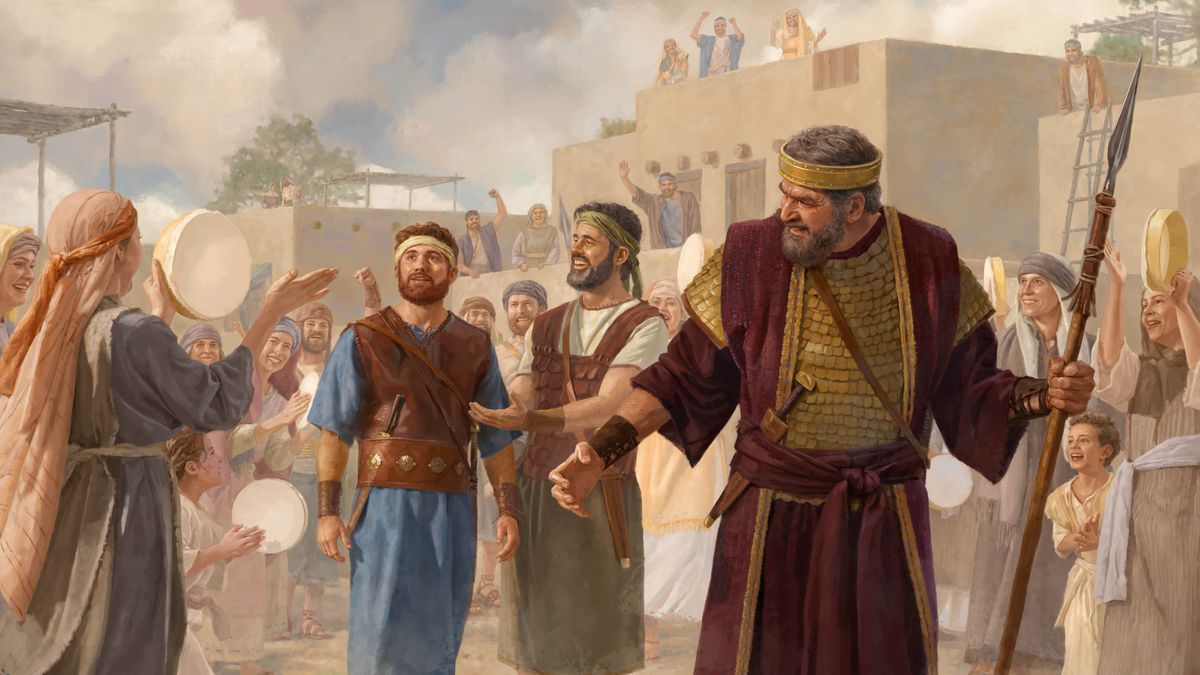
Unlike loyal Jonathan, who supported David, Saul became jealous of David and lost faith in Jehovah (See paragraphs 4, 6)
5. Why does the Devil want us to develop a jealous and envious spirit? (James 3:14-16)
5 Satan knows that our unity leads to Jehovah’s blessing and support. (Ps. 133:1) Because Satan seeks to destroy that unity, he wants us to become jealous and envious of others, just as Saul was of David. Satan knows that if we become jealous of our brother or sister, it will be very difficult to show them love. (Mark 12:30, 31) If that were to happen, would Jehovah find our worship acceptable? The disciple James wrote in very strong terms about the danger of allowing a jealous spirit to develop in us.—Read James 3:14-16.
6. What do you learn from the example of Jonathan? (See also picture.)
6 When we stand together as a united brotherhood, we can avoid allowing jealousy and envy to take root in our heart. Consider the fine example of Jonathan, the son of Saul. Unlike his father, who was jealous of David, Jonathan told his young friend David that he had complete faith that Jehovah’s purpose would succeed. “You will be king over Israel,” Jonathan said reassuringly. With true humility, Jonathan acknowledged Jehovah’s will and supported David as Israel’s next king.—1 Sam. 23:16, 17.
7. How can we avoid giving the Devil an opportunity to break up our unity? (Ephesians 4:25-27)
7 Satan would also like to use our differences to break up our unity. He wants us to believe that because of differences in opinions, personalities, race, or culture, we cannot get along with one another. How can you avoid giving him an opportunity to create divisions? Resolve any disagreements or problems quickly. (Read Ephesians 4:25-27.) Deepen your love for your brothers and sisters. Keep a proper view of them. Despite being so different, we are all members of one body. (1 Cor. 12:12) Our fellow Christians stand beside us, fighting the same enemies we are fighting—Satan and the demons.—1 Pet. 5:8, 9.
8. How should we react when a fellow Christian says or does something that hurts us?
8 When a fellow worshipper says or does something that hurts you, remember that you are just as imperfect as he is. If you work closely together with others, it is realistic to expect some friction to develop. (Eccl. 7:20) When that happens, follow the inspired counsel to put up with one another. And if someone hurts you, be quick to forgive. (Col. 3:12-14) Cooperate with Jehovah and Jesus in their purpose to keep our Christian family united.—John 17:20, 21.
SATAN USES OPPOSITION TO DISCOURAGE US
9. What is another way that Satan tries to discourage us?
9 Another way that Satan tries to discourage us is through persecution. The apostle Paul warned that all true Christians will face persecution. (2 Tim. 3:12) Persecution involves injustice. We could become so consumed by the desire to get justice, to be vindicated, or to take revenge that we lose sight of the all-important Kingdom-preaching work—the work Jehovah has given us to do.—Rom. 12:19-21.
10. How did Isaac respond to injustice?
10 Consider the example of Abraham’s son Isaac. Envious of Isaac’s prosperity, the Philistines, his neighbors, made a hostile move—they stopped up wells that Abraham’s servants had dug. (Gen. 26:12-18) Water was very important in caring for families and livestock. So Isaac chose to move farther away and dig other wells. However, the Philistines claimed ownership of the water in that location too. This kind of injustice could have been discouraging. Yet, Isaac prevented the quarreling between his shepherds and the Philistines from escalating. How? By pursuing peace. He moved yet again, and Jehovah blessed him. (Gen. 26:19-25) When we face injustice, can we likewise respond with mildness and patience?
11. How did Jesus react to the challenges he faced?
11 Centuries later when Jesus, the promised Messiah, arrived, he faced many challenges. For example, some of Jesus’ relatives thought that he was out of his mind. (Mark 3:21) Religious leaders constantly challenged his authority to preach. (Luke 11:15, 16) One of his closest associates betrayed him. (Matt. 26:14-16) Chief priests joined political authorities to have him sentenced to death. (Mark 15:1, 13-15) But Jesus did not allow opposition to cause him to slow down in Jehovah’s service. And he never showed a vengeful attitude. When Jesus was arrested, the apostle Peter tried to come to his defense. Peter cut off the ear of a slave of the high priest. But Jesus did not agree with Peter’s violent reaction and miraculously healed the man’s wounds. (Luke 22:50, 51) In all these instances, Jesus never allowed the challenges he faced to distract him or cause him to seek revenge.
12. According to Matthew 5:43, 44, how should we treat those who oppose or persecute us?
12 Similarly today, we face situations that could discourage us. Satan tries to keep us from carrying out the preaching work. Unbelieving family members or others may oppose or even persecute us. Yet, Jesus instructed us to love even those who persecute us. (Read Matthew 5:43, 44.) This rules out responding with hostility when we suffer persecution. Rather, following Jesus’ clear direction, we do our best to treat all men kindly, patiently, and respectfully even if they oppose us or our work.—1 Cor. 13:4.
13. Why should we respect governments even if they oppose us? (See also picture.)
13 Government authorities also deserve our respect even if they enact laws that restrict our freedom of worship or if they make life hard for us in some other way. Why? Because God’s Word requires it of us. (Rom. 13:1, 2) Satan may not be directly behind every unjust decision that governments make. Yet, he likely hopes that we will react negatively or critically to those decisions. He would be delighted to see us abandon our neutral stand. In the world, people mount protests against decisions they do not like. That type of action is not for Christians! (Prov. 24:21, 22, ftn.; Eccl. 8:2, 3) If we were to lose our balance and compromise our neutral stand, we would really be giving in to Satan’s desires.—John 15:19.

Will you resist the world’s efforts to make you compromise your neutrality? (See paragraph 13)
14. What should we keep in mind about those who oppose God’s people?
14 Some who formerly opposed the truth have in time become zealous Witnesses. (1 Tim. 1:12, 13) Keep this in mind when “people reproach you and persecute you and lyingly say every sort of wicked thing against you.” (Matt. 5:11) Pray that those in authority will allow us to continue worshipping peacefully. (1 Tim. 2:1, 2) Pray also for your opposing family members, workmates, and schoolmates. Ask Jehovah to help you to see what you can do to touch their heart. And be patient! A woman who became a Witness after opposing her husband for many years said, “Much good can be achieved with patience, patience, and still more patience.”
15. Why is it unrealistic to try to correct all the injustices that we see or suffer today?
15 We would soon expend a lot of our time and energy if we tried to correct all the injustices that we see or suffer today. (Eccl. 1:15) Jehovah knows exactly what we are enduring. (Ps. 37:18) Very soon, his Kingdom will undo all the harm that Satan and his agents have caused. (1 John 3:8; Rev. 21:5) In the meantime, we must remain patient and show love for our neighbor. We should focus our time and energy on helping as many as possible to become Jehovah’s friends.
WE CAN WIN THE BATTLE!
16. What will help us to win the battle against wicked spirit forces? (See also pictures.)
16 The Bible assures us that we can win the battle against wicked spirit forces. (Jas. 4:7; 1 John 5:4, 5) As we struggle against them, God’s Word states that faith will be the key to our success. (Eph. 6:16) So continue to build up your faith in Jehovah God and Jesus Christ. Let that faith motivate you to continue to love your brothers and sisters and remain united with them.

We can win the battle against wicked spirit forces by promoting love and unity among our brothers and sisters (See paragraph 16)
17. What should we be determined to do?
17 May we never succumb to whatever tactics the Devil may use in the coming days to try to divide and discourage us. Jehovah and Jesus promise to remain on our side as long as we stick to them. Our brothers and sisters are united with us in the struggle against our principal enemy, Satan. As for those who oppose us, we must try our best to follow Jesus’ counsel to be kind to them. (Luke 6:27, 28) So continue to resist Satan’s tactics, confident that you will succeed in your struggle against the wicked spirit forces.
SONG 149 A Victory Song
An Appeal on the Basis of Love
pp. 14–19
OCTOBER 19-25, 2026
SONG 106 Cultivating the Quality of Love
An Appeal on the Basis of Love
“I would rather appeal to you on the basis of love.”—PHILEM. 9.
FOCUS
What we learn about promoting peace in the congregation from the apostle Paul, Philemon, and Onesimus.
1. What responsibility do we all have?
WE CHERISH the peace we enjoy among Jehovah’s people. This peace gives us a taste of how good life will be in Paradise. (Isa. 32:17, 18) Although Jehovah grants us this peace, we have a personal responsibility to maintain and protect it. (Rom. 12:18) How can we promote peace in the congregation when interacting with others? When we offend someone? When someone offends us? The answers are found in an appeal made on the basis of love. This appeal involved three Bible characters: the apostle Paul, Philemon, and Onesimus.
THE APPEAL
2. Summarize the account of Philemon and Onesimus. (Philemon 8, 9, 17)
2 Read Philemon 8, 9, 17. In his letter to Philemon, Paul exhorts him to welcome back his slave Onesimus. Paul appeals to Philemon’s love for Christ and for his fellow Christians. Are you familiar with the account? Philemon was a brother in the congregation in Colossae, known for his outstanding faith and love. He had an unbelieving slave named Onesimus, who abandoned him and fled to Rome, possibly robbing him before leaving. (Philem. 18; see study note.) While in Rome, Onesimus developed a close friendship with Paul and became a Christian. (Col. 4:9) Under Roman law, however, Onesimus had to return to his master, so Paul sent him back to Philemon.—Philem. 12, 13; see study note on “I am sending him back to you.”
3. What concerns may Paul have had about sending Onesimus back? (See also picture.)
3 How would Philemon react to Onesimus’ return? Legally, he had the right to have Onesimus severely punished. Would he exercise that right? How would the congregation react? What if other masters and slaves became divided over the matter? Paul knew that the situation could potentially disrupt the congregation’s peace. So he wrote a letter to Philemon and sent it via Tychicus. (Eph. 6:21, 22; Col. 4:7-9; see study note on Colossians 4:7.) At the same time, Paul also sent a letter to the congregation in Colossae. Let us examine what we can learn from the examples of Paul, Onesimus, and Philemon based on those two letters.
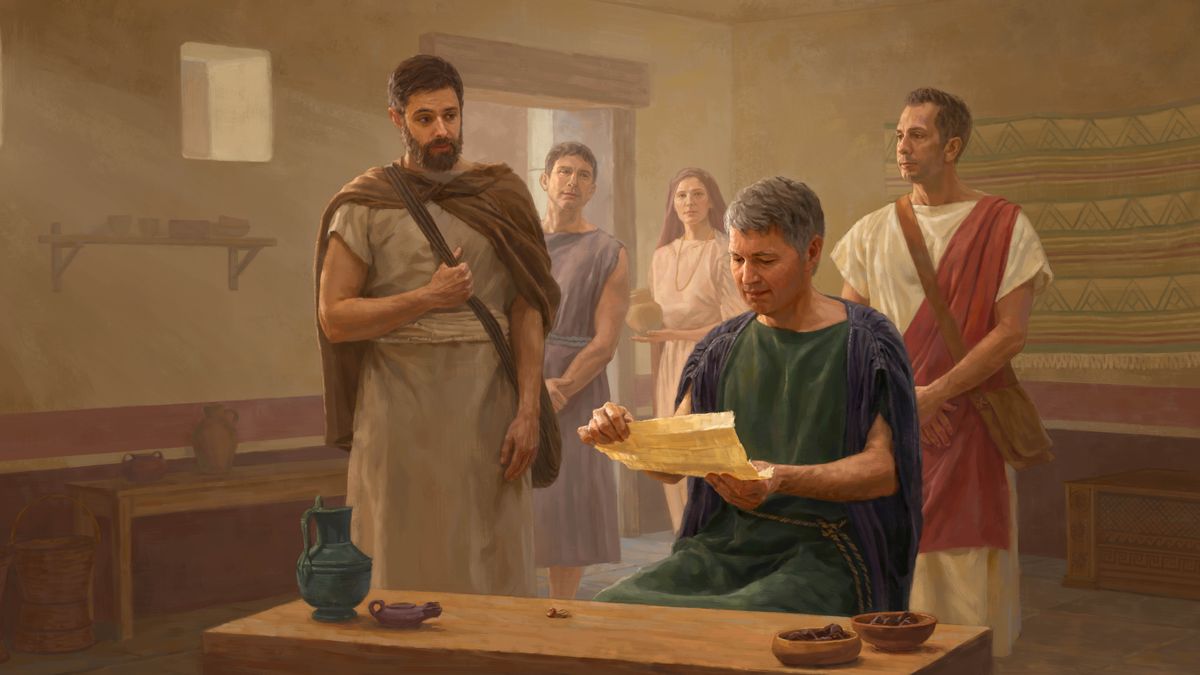
Philemon reads Paul’s letter aloud in front of a group of onlookers that includes Onesimus and Tychicus (See paragraph 3)
LESSONS TO LEARN FROM PAUL’S EXAMPLE
4-5. How can elders contribute to the peace of the congregation?
4 What can we learn from Paul’s example? Paul treated others in a way that promoted peace. His example shows how we can help to promote peace in the congregation when interacting with others.
5 Paul treated Philemon as a friend. (Philem. 17) Paul did not think he could just order Philemon around, as if he were his master. (2 Cor. 1:24) Paul viewed Philemon as a fellow worker and reminded him of their friendship. What a good example Paul set for Philemon regarding how to treat Onesimus, his new brother! It also serves as a fine example for all of us, especially for those who serve as elders in the congregation. Elders who treat others as friends are a force for peace. As loving shepherds, they do not ‘lord it over’ the flock. (1 Pet. 5:1-3) Instead, they spend time with God’s sheep, listen to them, value them, and support them in times of need. Like Paul, elders who treat others as friends set a fine example for the flock and contribute to an environment where peace can flourish.
6. Why is commendation important?
6 Paul commended Philemon. (Philem. 4, 5, 7) We all need commendation. Why? For one thing, many of us struggle with feelings of insecurity. We may worry about our appearance, whether others like us, or whether we may lose a cherished privilege of service. These feelings are normal. However, they can sometimes make us anxious, overly sensitive, defensive, or even competitive—characteristics that can hinder our efforts to promote peace. A person can better cope with his feelings of insecurity if he receives commendation. (Prov. 12:25) It reassures him that he is loved and appreciated. Would you like to have that effect on others? If so, look for opportunities to commend others sincerely. Commend others not just for good results but also for the efforts they put forth. Simply put, when you see something positive, say something positive.
7. Why should we think carefully about what we say regarding others? (Philemon 10-12)
7 Paul spoke positively about Onesimus. (Read Philemon 10-12.) How might Paul’s tender words about Onesimus have affected Philemon? Would they have influenced how Philemon felt about, spoke to, and treated Onesimus? Surely! Similarly, what we say about fellow worshippers affects how others feel about them and treat them. Speaking positively about our brothers and sisters helps others treat them kindly. Unfortunately, the opposite is also true. Speaking negatively about our brothers and sisters may influence others to treat them unkindly. But to speak well of others, we must first think well of them. What can help us to do that? Consider a custom that Paul had.
8. What could help us to think and speak positively about fellow worshippers? (See also pictures.)
8 Paul regularly thanked Jehovah for Philemon’s fine qualities. (Philem. 4, 5) He did the same for many others. (1 Cor. 1:4-7; Phil. 1:3-5; Col. 1:3, 4; 1 Thess. 1:2, 3) Paul was not blind to the negative traits of his brothers and sisters, but he looked for their good qualities. And it was his custom to thank Jehovah for such friends. If you find it difficult to speak positively of others, remember this: If you cultivate the habit of thinking positively about others and of praying sincerely for Jehovah to bless them, you will be more inclined to speak positively about them.

Like Paul, take a positive view of fellow Christians both in thought and in word (See paragraph 8)
9. Why is Paul’s positive tone especially remarkable?
9 Despite facing challenging circumstances, Paul treated Philemon kindly. Have you ever lost your patience with someone when you were tired or under stress? When we have been experiencing difficult circumstances, it can be easy to take our frustrations out on others. With that in mind, consider Paul’s circumstances around the time when he wrote to Philemon. Just a few years before, Paul was violently attacked and then unjustly detained. He was held in custody in Jerusalem and in Caesarea. Then, he was transferred to Rome but suffered shipwreck along the way. And now as he wrote to Philemon, Paul was still “a prisoner,” under house arrest in Rome. (Philem. 1) But did Paul allow his stressful experiences to affect the way he addressed Philemon? No. Paul’s letter to Philemon was kind and tactful. The lesson? We can contribute to peace by doing our best to treat others kindly even when we are tired, stressed, or enduring a trial. In turn, the peaceful atmosphere we promote helps us cope with our challenges.
LESSONS TO LEARN FROM ONESIMUS’ EXAMPLE
10. What can we learn from Onesimus’ example?
10 We all do and say things that offend others. Onesimus’ example teaches us how to restore peace when that happens. He did something that sounds simple but is often difficult to do. He admitted his mistake and did his part to reconcile with Philemon. Onesimus surely knew that Roman law required that he return to his master. So he made a costly and exhausting trip of over 1,400 kilometers (900 mi) to return to Philemon. He had to be willing to give up his freedom and possibly accept other consequences for his actions. That could not have been an easy choice. And what if he felt that he was justified in running away from Philemon? If he did feel that way, he did not let it stop him from returning to his master and doing what he could to promote peace between them as spiritual brothers.
11. What can we do to restore peace when we have offended someone? (See also pictures.)
11 If you have offended someone, take the initiative to restore peace. (Matt. 5:23-25) True, this may be difficult, but the resulting peace will be worth it. Start with a sincere apology. Be willing to listen to the other person and acknowledge his feelings. Accept responsibility for your mistake. Avoid justifying your actions or shifting the blame. Doing so can weaken an apology, prolong a dispute, or even make things worse. It takes humility to apologize, but that is often a quicker way to peace.—Rom. 14:19.

Like Onesimus, be quick to show humility and to promote peace (See paragraph 11)
LESSONS TO LEARN FROM PHILEMON’S EXAMPLE
12. Why was Paul confident that Philemon would forgive Onesimus?
12 Philemon’s example teaches us how to maintain peace when someone wrongs us. Did Philemon forgive Onesimus and receive him back kindly? The account does not say. But Paul was confident that Philemon would. (Philem. 17, 21) Paul knew that Philemon had qualities that would incline him to forgive. What qualities?
13. Why is love key to maintaining peace? (Colossians 3:14)
13 Philemon loved his brothers. (Philem. 5) Philemon lived up to his name, which means “Loving.” He was known for his outstanding love, a quality that would be key in forgiving Onesimus. In fact, in Paul’s letter to Philemon’s congregation in Colossae, he described love as “a perfect bond of union.” (Read Colossians 3:14.) In other words, no other quality contributes more to peace and unity than love. The more we love others, the easier it becomes to forgive them and treat them kindly. (1 Cor. 13:4-7) Let us see how this worked in Philemon’s case.
14. Why can we say that Philemon was hospitable?
14 Philemon had a quality that strengthens love: hospitality. He opened his home to the congregation for meetings. (Philem. 2) Paul also alluded to Philemon’s hospitality when he asked Philemon to prepare a place for him to stay. (Philem. 22) Philemon’s warm hospitality undoubtedly made others feel welcomed and refreshed.—Philem. 7.
15. How can showing hospitality strengthen our love for others? (See also pictures.)
15 How can imitating Philemon’s hospitable spirit strengthen our love for others? We get to know our brothers and sisters better when we show them hospitality. Spending time with those outside our immediate circle of friends, even those we may not initially be drawn to, helps us to appreciate the variety of personalities that make Jehovah’s people beautiful. Learning about their background, their journey into the truth, or their endurance through trials often deepens our love and respect for them. We see why Jehovah has drawn them to his family of worshippers. (John 6:44) Showing hospitality therefore helps us love our brothers and sisters more, assume the best about them, and forgive them when they make mistakes.

Like Philemon, promote unity in the congregation by showing hospitality (See paragraph 15)
16. How may Philemon have applied Paul’s counsel found at Colossians 3:13?
16 Are you struggling to forgive someone right now? Even if we love our brothers and sisters, forgiving them may be difficult at times. What can help? Consider Paul’s words to the congregation in Colossae, which included Philemon, recorded at Colossians 3:13. (Read.) Imagine Philemon hearing those words read to the congregation in his own home. Whom might he have been thinking about? Was he harboring bitterness toward Onesimus? If so, the application for him was clear: He needed to continue putting up with Onesimus, and he needed to forgive him freely. How can Paul’s advice guide us in our own struggles to forgive?
17. In what way should we “continue putting up with one another”?
17 What did Paul mean by “continue putting up with one another”? He was encouraging us to be patient with and kind to fellow believers even when they irritate or offend us. In the same verse, Paul highlighted Jehovah’s heartwarming example. Jehovah has reasonable expectations for his worshippers. He is aware of our limitations but focuses on our good qualities. (Ps. 103:13, 14; 130:3) Because of that, he continues to extend his undeserved kindness and mercy to us. (Lam. 3:22, 23) If we do our best to view our fellow worshippers as Jehovah does, we will find it easier to be patient in putting up with their mistakes—just as they patiently put up with ours. To illustrate: When we remember how beautiful a plant is when it blooms, we are motivated to care for it when it is not in bloom. Similarly, if we remember the good in our brothers and sisters, we will feel motivated to forgive them and treat them kindly even when they let us down.
18. What are you determined to do?
18 Jehovah appreciates everything you do to contribute to peace in your congregation. Daily look for opportunities to promote peace. Continue to speak kindly to and about others. Apologize. Make amends when you offend someone. And cultivate strong love for your brothers and sisters—the kind of love that helps you forgive freely. By doing these things, you will be a force for peace in your congregation. And you will be among the meek ones who “will possess the earth” and “find exquisite delight in the abundance of peace”—forever!—Ps. 37:11.
SONG 154 Unfailing Love
Cherish “the Privilege of Fearlessly Rendering Sacred Service”
pp. 20–25
OCTOBER 26–NOVEMBER 1, 2026
SONG 62 The New Song
Cherish “the Privilege of Fearlessly Rendering Sacred Service”
“He has raised up a horn of salvation . . . to grant us . . . the privilege of fearlessly rendering sacred service.”—LUKE 1:69, 74.
FOCUS
To help us appreciate the gift of salvation as well as the privilege and the responsibility that come with it.
1. What is Zechariah’s prophecy about?
“WHAT will this young child turn out to be?” (Luke 1:57-66) The neighbors and the relatives were curious about John, the son who was born miraculously to aged priest Zechariah and his elderly wife, Elizabeth, who had been barren. Jehovah used Zechariah to answer that question. He explained that the long-awaited Messiah would soon arrive and that John would prepare repentant people to recognize and follow that one. (Amos 3:7; Luke 1:67-79) But Zechariah did more than relate what his son, John, would do.a As we will see in this article, Zechariah’s message was prophetic and it involves us today. From his message, we will learn about three things we should cherish: (1) the gift of salvation, (2) the privilege of sacred service, and (3) the responsibility to preach.
THE GIFT OF SALVATION
2. (a) According to Luke 1:67-73, what gift is promised to God’s people? (b) Who is the “powerful savior” mentioned at Luke 1:69?
2 Read Luke 1:67-73. God had promised to give his people a wonderful gift: salvation. But salvation by whom? Zechariah said: “[Jehovah] has raised up a powerful savior for us in the house of David.” (Luke 1:69; see study note.) That “powerful savior” was to be the Messiah. The Jews of Zechariah’s day already expected the promised Messiah and knew that he would be a descendant of Abraham through the royal line of David. (Gen. 22:17, 18; Matt. 22:42) Why, then, did Jehovah move Zechariah to announce the coming of this “powerful savior”? Because the Messiah’s arrival was closer than ever! Within six months, a young woman named Mary would give birth to Jesus, who, as the angel Gabriel said, would be called “God’s Son” and would rule as King on “the throne of David his father.” (Luke 1:30-35) The “powerful savior” was raised up when Jesus got baptized at age 30. At that time, Jehovah anointed him with holy spirit as the promised Messiah. (Matt. 3:16, 17) An exciting development indeed!
3. From whom or from what did first-century Jews need to be saved?
3 The first-century Jews needed to be saved. But from whom or from what? Zechariah answers: “Salvation from our enemies and from the hand of all those hating us.” (Luke 1:71) Did this mean that Jesus would save the Jews from the oppressive Roman authorities? No. Rather, the Jews needed to be saved from the chief source of oppression, Satan. (Heb. 2:14, 15) Satan is responsible for causing mankind, including the ancient Jews, to become enslaved to sin and death. Additionally, the Jews were unable to keep the Mosaic Law perfectly. For that reason, they came under a curse from which they needed to be saved. (Rom. 3:20; Gal. 3:10, 13) Thus, they needed what Jehovah promised through Zechariah—“salvation . . . by forgiveness of their sins.”—Luke 1:77.
4. From whom and from what do we need to be saved today?
4 What enemies do we need to be saved from today? Like the Jews in Jesus’ day, we are enslaved to sin and death. (Rom. 5:12) In addition, Satan and the demons are sources of oppression. They try to deceive us, hoping to turn us away from true worship. They even influence individuals and organizations—some of whom are among “those hating us”—to oppose our worship. We need to be saved from such enemies.
5. How does Jesus deliver us from the condemnation of sin?
5 How does our Savior rescue us from these enemies? Consider how Jesus delivers us from sin. During his earthly ministry, Jesus taught his followers how to worship Jehovah acceptably. Then he gave his life as a ransom, “so that everyone exercising faith in him might not be destroyed but have everlasting life.” (John 3:16; Matt. 20:28) We do our best to follow what Jesus taught about giving Jehovah acceptable worship. But we are still imperfect, so we ask Jehovah to forgive us when we fall short of his standards. Then on the basis of the ransom, Jehovah kindly accepts our worship. (1 John 2:1, 2) In these ways, our Savior Jesus delivers us from the condemnation of sin.
6. What will Jesus accomplish as King on “the throne of David”? (See also picture.)
6 How will Jesus save us completely from sin and death, from Satan and his demons, and from “those hating us”? Since 1914, Jesus has been ruling in heaven on “the throne of David his father.” (Luke 1:32, 33) As King of God’s Kingdom, he and his heavenly corulers along with his holy angels will wipe out all of God’s earthly enemies at Armageddon. Then during the Thousand Year Reign, Jesus will raise the dead and, together with his 144,000 corulers, gradually restore mankind to perfection. (John 5:28; Rev. 22:1, 2) By the end of the thousand years, they will have done away with inherited sin and death. (1 Cor. 15:26, 55-57) They will then crush out of existence Satan, his demons, and all humans who side with them during the final test. (Rev. 20:7-10) Loyal worshippers will finally enjoy a relationship with Jehovah that is unhindered by sin, death, or any opposer! We will forever praise our God and cherish “his indescribable free gift,” which includes our salvation through Christ Jesus.—2 Cor. 9:15.

Jehovah’s gift of salvation through Jesus Christ (See paragraph 6)
THE PRIVILEGE OF SACRED SERVICE
7. According to Luke 1:74, 75, what privilege does Jehovah grant his people?
7 Read Luke 1:74, 75. Jehovah’s gift of the ransom grants us something special. Zechariah called it “the privilege of fearlessly rendering sacred service.” Our “sacred service” to Jehovah includes all aspects of true worship. We render Jehovah sacred service when we preach, pray, study his Word, and worship at our meetings, assemblies, and conventions. Our sacred service also includes other activities directly related to our worship, such as serving at Bethel and building and maintaining Kingdom Halls and Assembly Halls.
8. What do we not need to fear?
8 In what sense do we render Jehovah sacred service “fearlessly”? First, we no longer need to fear death. Because we have the firm hope of everlasting life, we can focus on pleasing Jehovah instead of on trying to squeeze all we can out of a short life in this system. Even when persecutors threaten us with death, we refuse to give in to fear. We confidently maintain our integrity because we know that if we were to die, Jesus would bring us back to life. (John 6:39, 40) Second, we don’t need to fear that Jehovah will reject us because of our inherited sinfulness. We enjoy Jehovah’s love and approval, confident in his merciful provision to forgive our sins.—1 John 4:9, 10.
9. What struggle do some Christians have?
9 Some Christians, however, may struggle to believe that Jehovah accepts their worship. They might feel unworthy of Jehovah’s approval, perhaps because of a traumatic experience they had in the past. Or they may be tormented by guilt over sins they committed long ago, even though they sought Jehovah’s forgiveness and the help of the elders. If this is your struggle, what can you do?
10-11. What can we do if we feel that we are badly broken and are suffering emotional pain? Illustrate.
10 Consider an illustration. A man breaks his leg and visits a doctor. After the doctor sets the broken leg, he may prescribe physical therapy to help the patient restore strength and mobility to the leg and eventually walk on it again. What if the injured person is afraid that his leg is too damaged ever to regain full mobility? He needs to trust the doctor and patiently stick to the prescribed therapy. In time his leg may heal, allowing him to walk or even to run.
11 In a similar way, if you feel badly broken by sin and are suffering emotional pain, trust in Jehovah. Know that in his undeserved kindness and mercy, Jehovah applies to you the spiritual healing power of the ransom. (John 1:16, 17; Rom. 3:23, 24; 1 John 3:19, 20) Apply the “prescribed therapy”—prayer, study, and spiritual activities. (Ps. 1:2; 1 Thess. 5:17; Heb. 10:25) Like physical healing, spiritual healing may take time and its progress may be imperceptible at first. But you can trust the spiritual healing process. So never give up on Jehovah or on yourself. Keep up your good spiritual routine. (Phil. 3:16) And thank Jehovah daily for the strength he gives you to continue worshipping him faithfully. We can all be grateful to God and Christ for the precious privilege of fearlessly rendering sacred service!
THE RESPONSIBILITY TO PREACH
12. How did John the Baptist prepare the ways of Jehovah? (Luke 1:76-79)
12 Read Luke 1:76-79. Zechariah next addressed his infant son, saying: “You will go ahead of Jehovah to prepare his ways.” How did John the Baptist accomplish that? As an adult, he became a zealous preacher. He urged the Jews to repent of their sins, get baptized, and accept the coming Messiah. After he baptized Jesus, John publicly identified him as Jehovah’s representative, saying: “See, the Lamb of God who takes away the sin of the world!” John then encouraged his own disciples to follow Jesus, the Messiah.—John 1:29, 34-36, 40, 41.
13. How was the coming of the Messiah “a daybreak” for God’s people?
13 While John clearly identified Jesus as the Messiah, more witnesses were needed. Why? According to Zechariah, the coming of the Messiah would be “a daybreak,” the dawn of a new era, an extraordinary event! Surely, the news about this great gift deserved the widest possible publicity—far beyond what one man, such as John, could provide. Who, in addition to John, would help broadcast this important message of salvation?
14. What important work did Jesus and his disciples do? (Isaiah 61:1, 2)
14 Jesus did a great deal of witnessing. He fulfilled Zechariah’s words by bringing “light to those sitting in darkness and death’s shadow.” Jesus had tremendous compassion for the downtrodden common people. He shared with them the comforting, enlightening message of “the year of Jehovah’s goodwill.” (Read Isaiah 61:1, 2; Luke 4:16-21) He zealously proclaimed: “The Kingdom of the heavens has drawn near.” Still, he knew that many more proclaimers would be needed. So he trained his disciples to preach that same message.—Matt. 4:16, 17; 10:7; 28:19, 20.
15. Why is preaching today more important than ever?
15 As Christ’s followers today, we cherish the responsibility we have to continue spreading Jehovah’s message of salvation. In fact, preaching about Jesus’ ransom and God’s Kingdom is now more important than ever. Why? Consider what lies ahead. Mankind will soon face a period of “great tribulation such as has not occurred since the world’s beginning.” (Matt. 24:21) During that time, more may respond to the good news of salvation and take sides with Jehovah because they recall what we preached. Then Jesus will lead his corulers and the angels in the fight against all human opposers and bring true worshippers into God’s righteous new world. (Matt. 25:34; Rev. 16:16; 19:19) How vital it is, then, that we preach the good news now!—Matt. 24:14; Mark 13:10.
16. What are you determined to do? (See also pictures.)
16 Zechariah’s words found at Luke 1:68-79 remind us of three things that we cherish: Jehovah’s marvelous gift of salvation, the privilege of serving him fearlessly, and the responsibility to preach his comforting message. Have you accepted Jehovah’s gift by putting faith in Christ’s ransom and by dedicating yourself to Jehovah? Do you treasure your privilege to serve him? If so, zealously embrace your responsibility to preach “the year of Jehovah’s goodwill.” Share the good news of Jehovah’s coming “day of vengeance,” the day when God’s Kingdom will eliminate his and our enemies and usher in the earthly Paradise. Invite all who love God to join us in “fearlessly rendering sacred service to him with loyalty and righteousness before him all our days.”—Luke 1:74, 75.

If we accept God’s gift and cherish our privilege, we will embrace our responsibility to preach (See paragraph 16)b
SONG 159 Give Jehovah Glory
b PICTURE DESCRIPTION: In the first photo, two sisters preach from door to door. In the second photo, a brother witnesses to a workmate during a break. In the third photo, a sister gives a presentation at school, explaining the evidence for design in creation while her teacher and fellow students listen attentively.
My Grand Creator Noticed Me
pp. 26–30

LIFE STORY
My Grand Creator Noticed Me
AS A student, I did not enjoy school, and my grades were poor. I preferred to do things alone and not be noticed. I certainly had no reason to expect that God would notice me. Why not?
Growing up in a secular, atheist environment in Paris, France, I did not believe in God. Instead, I embraced the theory of evolution. I accepted it without question as many do, assuming that what was taught at school must be true. This teaching seemed logical, so I saw no reason to examine further evidence about how life originated.

I grew up in an atheistic family in Paris, France
My parents had a negative view of religion. They reasoned that if there were a God, the world would not be full of suffering and injustice. And because I saw so much religious hypocrisy, I too thought that it was foolish to believe in a loving God. I even made fun of those who believed in God.
Now, however, I am convinced not only that the Creator exists but that he cares about me, despite my weaknesses. Let me tell you what changed my mind and how that conviction changed my life.
In my late teens, I was called up for compulsory military service and sent for one year to French Guiana in South America. This remote and beautiful location would have a lasting impact on me.
When I was 20, I returned to Paris. My life soon became a weekly repetition of working hard during the week and drinking and partying hard on the weekend. But this life was empty. Any pleasure was short-lived and had no real purpose. I became disillusioned with corruption, racism, and poverty in society. Innocent people were suffering. The environment was being abused. I wanted something better. My mind went back to South America.
I SEARCHED FOR A BETTER LIFE IN THE RAINFOREST
I returned to one of the remote villages in French Guiana where I had served in the army. I was hoping that my life would take on greater meaning if I was surrounded by nature, smoking cannabis and enjoying myself. But after a while, the old pattern emerged. I worked all week so that I could party on the weekend.
At about that time, someone gave me a Bible. I read some of it, hoping to find good advice to help me live better. But I didn’t understand what I was reading.
I had friends who were also searching for the meaning of life, and they invited me to live with them in their informal community in the rainforest, a place they called Unity.

(Left) A hut in a community called Unity
(Right) While living in the rainforest
In the forest, life was simple, and we felt free. We did everything at our own pace without being accountable to anyone. We rose at sunrise, went to bed at sunset, grew our food, played music, and smoked cannabis. We took care of the land and shared everything we had with one another. We were vegetarians because we did not want to harm the animals. We had little respect for authority, and we did not hesitate to break the law if that was more convenient for us and if no one would get hurt.
We wanted to remake the world as we thought it should be. No one in our community had authority over others, and we respected one another regardless of our background. However, I realized that in the end, we all had our own interests and weaknesses and the same problems society faced eventually came up among us too. Some stayed in the community for only a few days; others, for weeks or months. I stayed for over two years.
While living in the rainforest, I saw how generously the earth provides everything we need. One day, I decided to count the seeds of a papaya. There were too many, and I gave up. I thought: ‘Why is the earth so generous to us? It’s like a home that has been carefully prepared for someone’s arrival.’ I realized that it could not be blind chance. But who had arranged all of this for us? There had to be a Creator. But I knew nothing about him.
I continued to read the Bible. But now, I wanted to find out what God required of me. I started praying and making the sign of the cross, not knowing what it meant. I wondered whether the Creator’s name was Jah, as was mentioned in some of the songs we sang in our community.
GETTING TO KNOW MY GENEROUS FATHER
When I think back to when I started praying, I feel that the Creator noticed that I wanted to know more about him. One of my friends in the community had met Jehovah’s Witnesses and obtained the book You Can Live Forever in Paradise on Earth.a As I read it, I was amazed at what I was learning! I loved the prospect of living eternally on an earth transformed into a paradise. That’s what I was looking for—to live in an ideal setting on earth and in peace with people I love, without ever having to die. I wanted to draw closer to the generous Creator who purposed this wonderful future for us.
I understood that I needed to make changes in my life, but I also realized that I would need help. So I asked another friend to put me in contact with Michel, a Witness missionary with whom he was studying.
On the very day I met Michel, he invited me to a convention in Matoury, near the capital, Cayenne, more than 240 kilometers (about 155 mi) away. I had very long hair and a scruffy goatee. I wore purple and pink pants with bleach designs all over them and a shirt several sizes too large. Despite my appearance, the brothers and sisters provided me with transportation, food, and accommodations. The love and generosity of the Witnesses convinced me that I had found the truth.
At that convention, 1 Timothy 5:8 was discussed. This verse explains that a good family head will care for those in his household. I learned that Jehovah applies this principle to himself and will always care for those in his family. So I reasoned that if I put Jehovah’s will first in my life, I didn’t need to worry; he would look after me. In time, I became convinced of this as I observed Michel’s example. He focused on doing Jehovah’s will; yet, he lacked nothing and was happy.
As I progressed in my Bible study, I made changes. I decided to stop smoking tobacco and cannabis. Right after making that decision, I threw the remaining tobacco and cannabis into a fire and never smoked again. I began attending some meetings. At one meeting, I asked a brother to cut my long hair, which he did right there at the Kingdom Hall.
After a few weeks, I left the community in French Guiana and returned to France. I found a Kingdom Hall and resumed my Bible study. Although my life had improved, my family was puzzled at how much I had changed. I no longer smoked, got drunk, or went to wild parties. However, they did not appreciate my blunt attempts to preach to them. I later learned that I needed to be more tactful and considerate of their feelings.
I got baptized in 1996. I prayed to Jehovah that I could become a missionary like Michel. This seemed to be the best way for me to show my gratitude to Jehovah.
MORE BLESSINGS FROM MY HEAVENLY FATHER
In my congregation, a beautiful sister named Claudine caught my attention. I noticed that she was zealous in the ministry, and her comments at the meetings showed me that she loved Jehovah very much. I was interested in courtship, but I first wanted to know if Claudine was interested in missionary service. She was! We married in April 2000.

(Left) On our wedding day
(Right) Giving a talk to a Chinese group, 2006
The following year, we began pioneering together. Sometime later, we decided to learn Mandarin to support a Chinese group in a nearby congregation. I found it very difficult to learn this language. I had to adjust to a new way of thinking and to be creative in presenting the truth. Honestly, I never learned to speak Mandarin well. But I did my best, and we spent unforgettable and wonderful years with the Chinese brothers and sisters. Not only was it a great blessing but it was excellent training for later assignments.
DEALING WITH CHALLENGES
Over the years, I’ve had to overcome difficulties. For example, I believed that my efforts to give Jehovah and my brothers and sisters the best were never good enough. So I spent far more time than was necessary preparing my teaching assignments. Still, I was discouraged because I constantly fell short of my unreasonably high standards. (Eccl. 7:16) I needed to learn that Jehovah is a loving Father who does not demand perfection but who appreciates our personal best.
In Paris, I was assigned as a substitute circuit overseer. I felt too young and inexperienced for this role. But I learned that Jehovah’s holy spirit helps us accomplish far more than we can do alone.
I struggled with another challenge. Since childhood, I have suffered from hyperhidrosis, which involves excessive sweating. This condition especially affects my hands. It worsens during stressful situations, such as when I am addressing an audience at an assembly or a convention. But I can minimize this physical reaction by praying to Jehovah for peace of mind. The problem has not disappeared, but when I rely more on Jehovah, I remain calmer and sweat less.
In 2011, Jehovah kindly granted a long-standing request of our hearts. We began missionary service in New Caledonia, an island group in the southwest Pacific, more than 16,000 kilometers (10,000 mi) from Paris. This assignment too presented challenges. We had to adjust to new foods, such as cassava, taro, and yams. And we had to get used to the crowing of roosters and the barking of dogs interrupting our sleep early in the morning. We also had to adapt to a new style of conversation. The local people often respond, not with words, but merely by raising their eyebrows.

I learned the truth in French Guiana, got baptized in France, and am currently serving with my wife in New Caledonia
Jehovah has also helped us to adjust to new theocratic assignments. We served as field missionaries and for a few years as Bethelites. We attended the School for Kingdom Evangelizers, and now we are in the circuit work. We have experienced Jehovah’s support through his holy spirit in each assignment. He has taught me that personal weaknesses do not necessarily make us less useful to him. So I pray often and earnestly for help to accomplish what is needed. Although I still do not feel at ease before an audience, with God’s help, I have been able to provide encouragement and direction to the congregations we visit.
Through all these changes, Claudine has been a constant support for me. She is very patient with my imperfections. She is supportive in the work we share, always ready to give a zealous witness. She does not complain about the hot weather and the challenges of being in the circuit work.

Serving in the circuit work in New Caledonia
At my first convention, I learned that Jehovah, the Grand Creator, always cares for his worshippers. As a result, I have gained many blessings. Jehovah has helped me to have the right view of authority and to be humble. I stopped associating with friends from the world so that I could live by Jehovah’s standards, but Jehovah has more than made up for this by providing me with many true friends. I have found a wonderful wife. And I have the magnificent hope of enjoying Jehovah’s generosity for all eternity.—Mark 10:29, 30.
a Published by Jehovah’s Witnesses but now out of print.
Did You Know?
p. 31
Did You Know?
What activities took place at city gates in Bible times?
CITY gates were more than just entry points. With so many people passing through them, they became busy centers of daily life. The Bible mentions city gates over 50 times, and it describes the activities that took place there.
People gathered at city gates. The Hebrew word for “gate” refers to more than just the front door of a city. It conveys the idea of a built-up area at the entrance of a city or a town. In some places, there were broad public squares inside the gates where large groups of people could meet.—Neh. 8:1.
Merchants set up markets near city gates. Some gates in Jerusalem, such as the Fish Gate and the Sheep Gate, may have taken their names from the goods that were sold nearby.—Zeph. 1:10; John 5:2.

City gates were busy centers of daily life
People cared for both business and personal matters at city gates. Abraham and Boaz made official transactions in front of witnesses at city gates. (Gen. 23:10-15, 17, 18; Ruth 4:1, 10) Some travelers would spend the night in the public square near the city gates if no one offered them hospitality. (Judg. 19:15-21) People also went to the city gates to hear the latest news.—2 Sam. 18:24, 25.
Judges held court near city gates. They decided on cases before onlookers who could hear both the testimony and the outcome. (Deut. 21:18-20) This public setting encouraged the judges to be just and fair in their decisions. After the judges made a decision, officials carried out the sentence right away. (Deut. 25:2) At the city gates, judges were expected to promote justice and good conduct.—Deut. 16:18-20; Job 29:7, 11-17.
Faithful men encouraged the people of Israel who were at the city gates to trust in Jehovah. Prophets and others spoke at the gates because they knew that people gathered there. (1 Ki. 22:10; Jer. 17:19, 20) For instance, Jehu declared before all the people that Jehovah had fulfilled His word against the house of Ahab. (2 Ki. 10:8-10) King Hezekiah gathered his military chiefs at a city gate to encourage them to rely on Jehovah’s help.—2 Chron. 32:6-8.
The Bible says that “true wisdom” cries aloud and raises its voice “at the entrances of the city gates.” (Prov. 1:20, 21) Back in ancient Israel, it was at the city gates that faithful men gave wise counsel and rendered fair decisions. Today, Jehovah’s wisdom is recorded in the Bible and his servants everywhere are helping people turn to this source of true wisdom.
The Tree That Wakes Up Early
p. 32
BIBLE FACT
The Tree That Wakes Up Early
The almond tree is one of some 30 types of trees mentioned in the Bible. It is among the earliest trees to blossom following winter. Its lovely pink or white flowers can be seen as early as late January. Fittingly, the Hebrew name for the almond tree literally means “awakening one.” Is there a similarity between that tree and its Creator?
The footnote to Jeremiah 7:25 shows that Jehovah describes himself as rising early. The March 15, 2011, issue of The Watchtower states: “Just as the almond tree ‘awakened’ early, so Jehovah was figuratively ‘getting up early’ . . . to warn his people about the consequences of disobedience. . . . And he would not rest—he would ‘keep awake’—until his prophetic word was accomplished.”—Jer. 1:11, 12.
The white blossoms of the almond tree are also used in the Bible to illustrate the white-headedness of old age. (Eccl. 12:5) And likely because of their delicate beauty, the tree’s flowers served as a pattern for the cups on the branches of the tabernacle lampstand.—Ex. 37:17-20.