The Watchtower — Study Edition · April, 2026
Study Edition
pp. 1–32

Study Edition
APRIL 2026
STUDY ARTICLES FOR: JUNE 8–JULY 5, 2026
© 2026 Watch Tower Bible and Tract Society of Pennsylvania
This publication is not for sale. It is provided as part of a worldwide Bible educational work supported by voluntary donations. To make a donation, please visit donate.jw.org.
Unless otherwise indicated, Scripture quotations are from the modern-language New World Translation of the Holy Scriptures.
Table of Contents
p. 32
Table of Contents
IN THIS ISSUE
2 Life Story—Jehovah Has Trained Me From My Youth
Study article for June 8-14, 2026
8 “The God of Truth” Always Fulfills His Purpose
Study article for June 15-21, 2026
14 Maintain the Right View of Adversity
Study article for June 22-28, 2026
20 Learn From “the God of All Comfort”
Study article for June 29, 2026–July 5, 2026
Jehovah Has Trained Me From My Youth
pp. 2–7

LIFE STORY
Jehovah Has Trained Me From My Youth
I STARED at the slip of paper that the brother had just handed me. On it were the words, “David Splane, April 8, 1953: ‘Proclaiming the World’s Doom.’” “What’s this?” I asked. The brother answered, “This is your assignment to present a talk in the Theocratic Ministry School.”a I protested, “I didn’t sign up for this!”
But I am getting ahead of myself. I was born during World War II in Calgary, Canada. In the late 1940’s, a young pioneer named Donald Fraser knocked on our family’s door and Mother accepted a Bible study. She fell in love with the truth, but serious health problems prevented her from being very active in the congregation. Still, she progressed to baptism in 1950. Sadly, she passed away less than two years later. My father was an unbeliever at the time, but he agreed to have the Witnesses conduct her funeral service.
A few days after the funeral, an older anointed sister named Alice invited me to attend a congregation meeting. She knew me because I had been going to weekend meetings with my mother when she was well enough to attend. I asked my father if I could go. He agreed and decided to go with me “just once” to thank the brother who had given the talk at my mother’s funeral. That night, the Theocratic Ministry School and Service Meeting were held. It would have been impossible to pick a more appropriate first meeting for my dad to attend. He had taken a course in public speaking and was fascinated by what he heard at the meeting. My dad decided to attend that meeting every week. Little by little, he began to attend other meetings.
In those days, the Theocratic Ministry School servant would start the meeting by reading out the names of the brothers who were enrolled, and they each answered, “Present.” One night, I asked to have my name read out at the next meeting. The brother warmly commended me but didn’t ask if I understood what was involved.
I had no idea I was volunteering to give talks at the school—I just wanted to have my name read out! The following week, my name was called and I proudly answered, “Present.” After the meeting, I received warm commendation. Several weeks later, I was handed the speaking assignment I referred to at the beginning of this article.
I was in trouble! Back then, students were expected to prepare six- to eight-minute talks. There was no assignment just for reading the Bible. My father helped me prepare the talk and made me practice it 20 times before I delivered it. Afterward, I received valuable counsel. Over the years, Jehovah has trained me through my dad, capable brothers and sisters, and His organization.
THE TRAINING CONTINUES
Alice, whom I mentioned earlier, trained me when I started in the ministry. In those days, we were encouraged to read three scriptures to the householder and then offer a bound book. When it was my turn to speak at the door, Alice would introduce herself, start the conversation, and then invite me to read the first scripture. From there, I would take over the presentation, read the second and the third scriptures, and offer the publication. Later, I learned how to introduce myself at the beginning of the call. After my dad got baptized in late 1954, he took over some of my training in field service. As a single parent, he did what he could to raise me in the truth. Where theocratic activities were concerned, he was a very disciplined person. I always knew what we would be doing on meeting nights and on Saturday and Sunday mornings.
I was just an average student at school; however, some of the training I received during my 12 years there has benefited me throughout my life. For example, I learned how to add long columns of figures. I also received a fairly solid grounding in English grammar. The English courses I took and a class in creative writing have been helpful in my present assignment working with the Writing Department.
I am often asked about my interest in music. Both of my parents were interested in music. At age seven, I took piano lessons for a while, but my teacher was not very impressed with my ability. She suggested to my dad that I stop taking lessons. I can understand why—I wasn’t very motivated at the time.
After a few months, my dad located another teacher. This time, I studied both piano and voice, and I flourished. As a boy soprano, I had a pleasant voice and won some competitions. My goal in studying music was to obtain a degree that would allow me to teach music and support myself in the full-time ministry. As I got closer to obtaining the degree, however, I realized that I would have to spend a lot of time studying for exams regarding harmony, music history, and composition. So I gave up my studies and enrolled as a regular pioneer. The year was 1963.
PIONEERING BRINGS JOYS
After I pioneered for a year, I was assigned as a special pioneer to Kapuskasing, Ontario. My pioneer partner Daniel Skinner was more than twice my age. He taught me a lot about how a congregation functions. I was appointed to serve on the Congregation Service Committee at age 20, so I had a lot to learn. I am thrilled that the organization again emphasizes the training of young brothers. If they apply themselves, they can be useful to Jehovah even at a very young age!
Kapuskasing had its challenges. In winter, temperatures could dip to 44 degrees below zero Celsius (-47°F) or sometimes “warm up” to 33 degrees below zero (-27°F). Dan and I mostly walked everywhere. However, one of the many joys of the assignment was meeting a sister named Linda Cole, who later became Linda Splane.
Linda was a zealous publisher who had many good calls. She was generous, warmhearted, and outgoing. Her mother, Goldie, was a faithful sister. Her dad, Allen, initially opposed the truth. Despite Allen’s opposition, Goldie regularly brought Linda and her brothers, John and Gordon, to the Kingdom Hall and trained them in field service. At one time or another, Goldie, Linda, John, and Gordon all pioneered. Years later, Allen accepted the truth and became fully involved in the congregation.
In 1965, I was invited to attend a monthlong course of the Kingdom Ministry School at Canada Bethel to receive more training. At that school, I was invited to fill out an application to attend Gilead. I had never considered missionary work―I didn’t think I had what it took―but I filled out the application. I was accepted to the 42nd class. At Gilead, we regularly received progress reports from our instructors. The first report I received encouraged me to learn everything I could about the organization while I was at school. That was certainly appropriate counsel for a 21-year-old to receive.
One of the courses offered at Gilead was instruction on dealing with the media: the radio stations, the television stations, and the press. I found it fascinating. Little did I realize how beneficial that course would be in the future, as I will later explain.
OFF TO SENEGAL
A few days after graduation, Michael Höhle, my missionary partner, and I were on our way to our foreign assignment in Senegal, Africa. At the time, there were about 100 publishers in the country.
After I had been in my assignment for several months, I was invited to work at the branch office one day a week. The “branch office” was just one room in a missionary home. As modest as the operation was, Emmanuel Paterakis, the branch servant, never let me forget that the branch represented Jehovah’s organization in that country. On one occasion, Brother Paterakis decided that we should write a general letter of encouragement to the missionaries. In those days, there was no easy or inexpensive way to duplicate the letters, so they were prepared individually on a manual typewriter. That was a lot of work, especially since no erasures were allowed—ever!
As I got ready to return to my own missionary home late that evening, Brother Paterakis handed me an envelope. He said, “David, the Society has written to you.” When I later opened the envelope, I found one of the letters I had typed! That incident taught me to respect the organization without regard for how large or small the local operation may be.

With fellow missionaries in Senegal, 1967
I became friends with a number of publishers in the congregation and spent most Saturday evenings with local families. Those were happy times! We still keep in touch. And I have been able to use my knowledge of French when visiting branches around the world.
In 1968, Linda and I got engaged. For several months thereafter, I tried to find part-time work so that Linda and I could pioneer together in Senegal, but employers there were expected to hire local people rather than foreigners. Finally, after I returned to Canada, we got married and received an assignment as special pioneers in Edmundston, New Brunswick, a small city on the border of the province of Quebec.

On our wedding day, 1969
PIONEERING IN NEW BRUNSWICK AND QUEBEC
There were no publishers in town and few Bible studies. The Catholic religion dominated almost every aspect of people’s lives. Nearly every house had the sign No Jehovah’s Witnesses. At the time, the idea of respecting such a sign wasn’t stressed as much as it is now, so we went to every home whether there was a sign or not. Each week, a Catholic organization put a notice in the local newspaper: “Let’s have a witch hunt for Jehovah’s Witnesses.” Only four “witches,” Victor and Velda Norberg and Linda and I, were in town—so there was no mistaking who was meant!
I will never forget the first visit of the circuit overseer. After spending a week with us, he said, “Perhaps the most you can expect to accomplish while you are here is to break down prejudice.” From then on, that became our goal, and it worked! Slowly, people began to see the difference between humble Jehovah’s Witnesses and privileged Catholic clergy. There is now a small congregation in that city.
After we spent about a year in that isolated assignment, we were invited to support a large congregation in Quebec City. We spent six pleasant months with the hospitable brothers and sisters there before being invited into the traveling work.
For the next 14 years, we served circuits in the province of Quebec. Those were exciting times! The work in Quebec was at full throttle, and it was not uncommon to see several families in the same congregation working toward baptism!
REMEMBERING THOSE WHO WORKED SO HARD
French-Canadian brothers and sisters are easy to love. They are straightforward, joyful, and enthusiastic. However, it was not always easy for them to accept the truth, and family opposition can be intense. Some very young people have been given an ultimatum by their unbelieving parents, “Stop studying with Jehovah’s Witnesses or leave home!” Few, if any, have given in to that pressure. Jehovah must be very proud of them!
At this point, I would be remiss if I did not mention the outstanding group of regular and special pioneers who served in Quebec in those years. Most of them came from other parts of Canada. In addition to mastering the French language, they had to learn about the local culture and the way of thinking, much of which was shaped by the Catholic religion.
Special pioneers were often assigned to serve in isolated territories where there were no publishers. Because of local prejudice, it was hard to find accommodations and even harder to find a bit of part-time work. Even newly married couples lived in groups of four, six, or eight in order to share expenses. They just couldn’t afford to live on their own. These devoted pioneers were hard workers. When they started a study, they gave it their full attention. Now that Quebec is no longer in need of outside help, many of those pioneers have gone on to areas where there is a greater need.
When we served congregations in the circuit work, we usually tried to work with teenagers on Saturday mornings. This allowed us to learn firsthand what challenges they were facing. Some of the teenagers we worked with are now serving abroad as missionaries or in other responsible roles.
In those days, some congregations could not reimburse us for our travel expenses, so we sometimes ran out of money by the end of the month. On those occasions, we had to rely entirely on Jehovah, since he was the only one who knew our circumstances. He never let us down. Somehow, we could always travel from one congregation to the next.
LESSONS FROM FAITHFUL BROTHERS
I mentioned earlier how much I benefited from our public relations course at Gilead. In those days in Quebec, we had many opportunities to give a positive witness on the radio, on television, and in the press. I was often assigned to work with Léonce Crépeault, a fellow traveling overseer who was adept at dealing with the media. When approaching an important executive in the news industry, rather than try to come across as a professional, he would say: “Sir, my companion and I are just ministers. We know very little about publicity. But we have been assigned to let people know about a large convention that Jehovah’s Witnesses will be holding. Any help you can give us would be much appreciated.” That humble approach opened many doors that otherwise might have remained closed.
Later, the branch assigned me to work with Brother Glen How, one of our lawyers, on sensitive cases that could attract media attention. I benefited from my training at Gilead and from the experience I gained with Léonce. It was a real privilege to work with Brother How. He was absolutely fearless when dealing with the legal system but was, above all, a man of God. He had a deep love for Jehovah.
In 1985 we were assigned to serve a circuit close to my father’s home in western Canada, which allowed us to provide needed support for him. He passed away three months later. We continued serving circuits in western Canada until 1989 when we were surprised to receive an invitation to join the United States Bethel family. That meant leaving the traveling work after nearly 19 years. Over those years, we stayed in hundreds of homes and shared thousands of meals with hospitable brothers and sisters. We are deeply grateful to all who opened their homes and shared their tables with us!
WE MOVE TO THE UNITED STATES
When we arrived in Brooklyn, I was assigned to work in the Service Department. I will always be grateful for the training I received there. One of the lessons I learned was to make sure of the facts and to assume nothing. Then in 1998, I was assigned to the Writing Department, where I am still learning how to write. For several years, I was privileged to assist Brother John Barr, who was the coordinator of the Writing Committee. I will always treasure the training I received and the time I spent with him. He had a beautiful Christian personality.

With John and Mildred Barr
It is a real pleasure to work side by side with the humble brothers and sisters who serve in the Writing Department. They approach their assignment prayerfully and are fully aware that any good they accomplish is because of Jehovah’s spirit, not because of any natural ability they have.

Conducting the Watchtower chorus at the 2009 annual meeting

Handing out Bibles at the 2014 international convention in Seoul, Korea
It has also been a privilege for Linda and me to visit our faithful fellow believers in 110 countries. We have witnessed firsthand the love of the missionaries, of the Branch Committee members, and of other full-time servants. What a blessing it was to have also observed the zeal and steadfastness of the local publishers, who put Kingdom interests first despite the threat of war, economic hardship, and persecution. Jehovah must love them very much!
Over the years, Linda has been a tremendous help to me as I try to fulfill my assignments. She is a real people person who is always looking for ways to help others. She is also very good at initiating informal conversations. She has had considerable success in attracting people to the truth, including some who were formerly inactive. Linda has been a real gift from Jehovah! As we get older, we are deeply grateful to have the help of younger brothers and sisters who assist us with our travel and other needs.—Mark 10:29, 30.
When I look back on the last eight decades, I am thankful. I agree with the psalmist who wrote: “O God, you have taught me from my youth, and until now I keep declaring your wonderful works.” (Ps. 71:17) I intend to keep on doing that for as long as I live.
a Today this training is part of our midweek meeting.
“The God of Truth” Always Fulfills His Purpose
pp. 8–13
JUNE 8-14, 2026
SONG 8 Jehovah Is Our Refuge
“The God of Truth” Always Fulfills His Purpose
“You have redeemed me, O Jehovah, the God of truth.”—PS. 31:5.
FOCUS
Building our confidence that Jehovah will keep all his promises and that soon the Kingdom will put an end to lies and deception.
1. Why can we be confident that we are safe from Satan’s wicked lies? (Psalm 31:2-5)
WE LIVE in a world dominated by Satan. Lies, deception, and betrayal are commonplace. It can be hard to know whom to trust. Businessmen cheat their competitors. Advertisers mislead consumers about the products they are promoting. And some people have found that they cannot even count on their close friends to keep their word. Yet, how reassuring it is to know that we can always put our trust in Jehovah! He is “the God of truth.” (Read Psalm 31:2-5.) Truth is woven into his personality—it is part of who he is. In everything he says and does, Jehovah is dependable and reliable.
2. What will we discuss in this article?
2 In this article, we will first discuss some reasons why we can trust in Jehovah with all our heart. Then we will consider how the God of truth will bring an end to the Devil’s wicked world and what God is doing even now to accomplish His purpose. This discussion will help us to be bold and fearless Witnesses of Jehovah.
WHY WE CAN TRUST IN THE GOD OF TRUTH
3. Why can we have absolute confidence in Jehovah?
3 We can trust in Jehovah because he is the Creator. He is the Maker of the heavens and the earth and the Source of all life. (Gen. 1:1; Ps. 36:9; Rev. 4:11) He is also the Sustainer of life. He created the ecosystems that make life on earth possible. He is and will always be in complete control of the universe. So we can confidently entrust our life and our future to our all-wise and all-powerful Creator.
4. How do we know that Jehovah loves us?
4 We can trust in Jehovah because he loves us. Jehovah created humans because he wanted to share the beautiful gift of life with them. Jehovah stated his purpose with the following words: “Let us make man in our image, according to our likeness.” (Gen. 1:26) He gave us free will. He created a beautiful home just for us. (Ps. 115:16) And he blessed our first parents with the exciting assignment to turn that home into a paradise. (Gen. 1:28; 2:15) He put all the riches and resources of the planet at their disposal. Truly, these actions prove that “the loyal love of Jehovah is for all eternity.”—Ps. 103:17.
5. (a) How did Jehovah keep his word despite the efforts of the Devil to destroy the human family? (b) What are some promises that God has fulfilled? (See the box “God’s Record of Telling the Truth.”)
5 We can trust in Jehovah because he is always true to his word. Jehovah did not create the earth “simply for nothing, but formed it to be inhabited.” (Isa. 45:18, 19) When Adam and Eve rebelled, they came under the sentence of death. So it might have seemed as if God’s purpose were being derailed. But Jehovah is the Fulfiller of all that he promises. (Isa. 46:10, 11) His purpose to fill the earth with righteous men and women was not affected. That is why Jehovah allowed Adam and Eve to have children. And He provided His only-begotten Son as a ransom to save Adam’s descendants and to give them the marvelous hope of living forever.—John 3:16.
THE GOD OF TRUTH FULFILLS HIS PURPOSE
6. What did Jehovah foretell after the rebellion in Eden?
6 The one who incited Adam and Eve to rebel against God was “the original serpent, the one called Devil and Satan.”a (Rev. 12:9; Gen. 3:4, 5; John 8:44) Jehovah pronounced a judgment against him, namely, that he would eventually come to an end. (Gen. 3:15) Before that would occur, many would follow Satan and act like him. However, some would stick loyally to Jehovah.
7. Who follow the Devil, and what will be their end?
7 Those who are following Satan the Devil are rebellious angels and humans. Because these oppose, or resist, God’s purpose, they make themselves part of Satan’s offspring. But at God’s appointed time, Satan and those who follow him will be destroyed.—Dan. 2:44; Rom. 16:20.
8. What action did Jesus take in 1914? (See also pictures.)
8 What evidence gives us confidence that God’s purpose to bring an end to Satan and his wicked followers will be fulfilled? In 1914, Jesus started the war against Satan the Devil and his demons and cast them down to the earth. (Rev. 12:7-9) Although the battle itself took place in heaven, those on earth have certainly felt the effects of that battle. “Woe for the earth and for the sea,” the Bible says, “because the Devil has come down to you, having great anger, knowing that he has a short period of time.” (Rev. 12:12) Since 1914, Satan’s attention has been focused on the earth, and as a result, world conditions have gone from bad to worse. Indeed, “woe for the earth”! Soon, though, Jesus will “complete his conquest” and Satan and all his supporters will be removed. (Rev. 6:2) Jesus will vindicate Jehovah’s name once and for all. (Ps. 45:4-6) Everyone will know that Jehovah is the God of truth!—Ezek. 38:23.
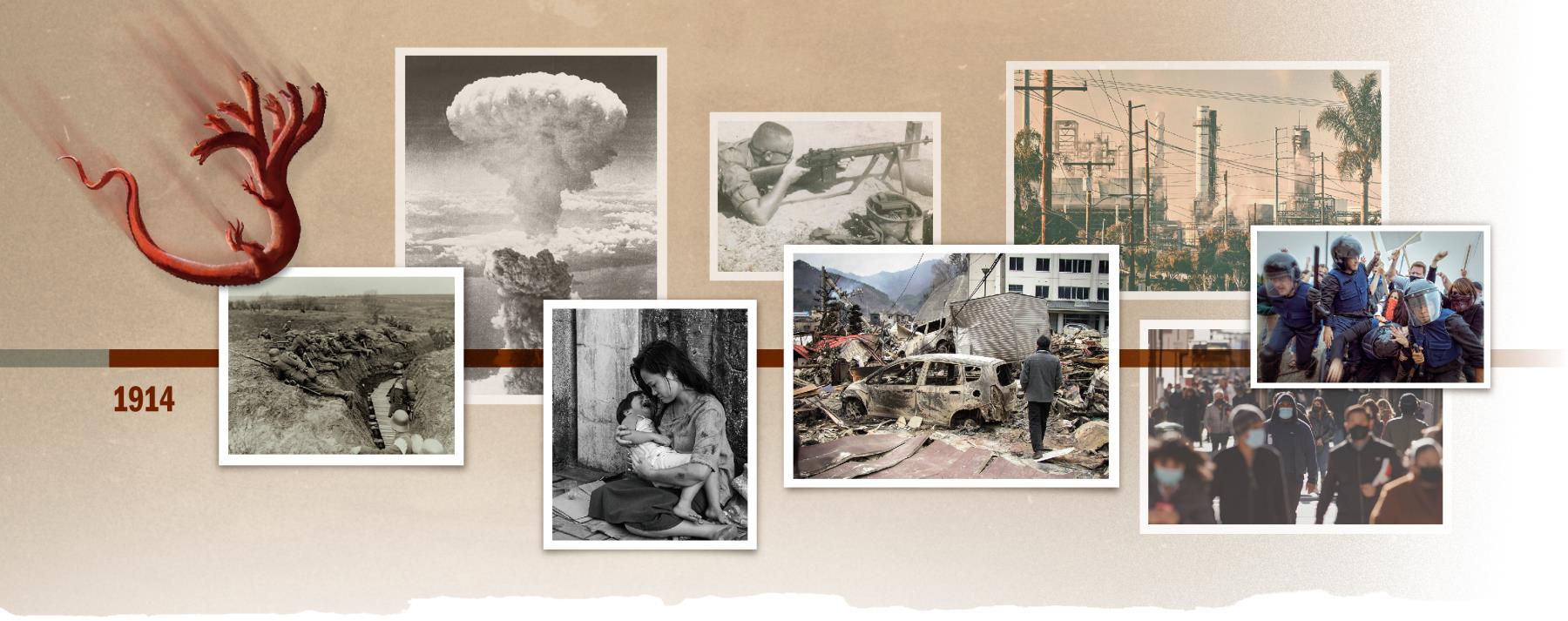
World War I: U.S. National Archives photo; bomb: USAF photo; pandemic: blvdone/stock.adobe.com; riot: inhauscreative/E+ via Getty Images
Ever since 1914, world conditions have worsened (See paragraph 8)
THE GOD OF TRUTH GATHERS ALL LOVERS OF TRUTH
9. Whom is Jehovah gathering today?
9 Meanwhile, Jehovah is gathering “all things together in the Christ, the things in the heavens and the things on the earth.” (Eph. 1:10) “The things in the heavens” refer to the anointed, whom Jehovah has selected to rule with Christ in heaven. “The things on the earth” refer to those who will live forever in Paradise on earth. All these worshippers of Jehovah are actively engaged in exposing Satan’s lies and in helping those with honest hearts to come to a knowledge of the truth.
10. How is Jehovah freeing people from the lies of false religion? (Revelation 14:6, 7)
10 Jehovah is gathering lovers of truth by means of the greatest witnessing work that the world has ever seen. (Read Revelation 14:6, 7.) Although Jehovah uses humans to tell others about the good news, the angels are involved in gathering honesthearted people into the Christian congregation. This witnessing work exposes the lies taught by Babylon the Great, the world empire of false religion, which the Devil has used for centuries to spread lies about Jehovah. (Rev. 18:2, 4) Soon, all false religions will be completely destroyed, and all who love the God of truth will give him the glory that he so richly deserves.—Rev. 17:16.
11. How can we identify Jehovah’s true worshippers?
11 Lovers of truth come from all social, economic, and cultural backgrounds and from all nations. (Rev. 7:9, 10) When they heard “the good news,” they recognized the ring of truth and gladly joined themselves to Jehovah’s people. (Mark 13:10) As time goes on, it becomes clearer and clearer who are worshipping God acceptably and who are not. The prophet Malachi foretold: “You will again see the distinction between a righteous person and a wicked person, between one serving God and one not serving him.” (Mal. 3:18) By their conduct and their preaching work, Jehovah’s servants show that they are worshipping the God of truth.
12. How does the preaching work help to accomplish Jehovah’s purpose?
12 By preaching the “good news of the Kingdom,” we obey Jesus’ command and, at the same time, fulfill prophecy. (Matt. 24:14; 28:18-20) And as a result of this work, people all over the world are becoming Christ’s disciples with the prospect of worshipping the God of truth forever. What an amazing privilege it is to have a share in accomplishing Jehovah’s purpose!
LOOK TO THE FUTURE WITH CONFIDENCE
13. Who are Satan’s special targets, and why?
13 Satan the Devil is very angry because he knows that “he has a short period of time” before his world is destroyed. (Rev. 12:12, 13) He specifically targets the earthly representatives of God’s Kingdom, those “who observe the commandments of God and have the work of bearing witness concerning Jesus.” (Rev. 12:17; 14:12) Anyone who supports them and the work that they are doing is also a target of Satan’s attacks.
14. What will happen when Satan attacks Jehovah’s people? (See also picture.)
14 After the destruction of Babylon the Great, Satan’s agents will make an all-out attack against Jehovah’s people. That attack will result in the war of Armageddon. (Rev. 16:13, 14, 16) Jesus and the heavenly armies will rescue Jehovah’s worshippers and will completely destroy all the remaining elements of the Devil’s world. (Rev. 19:19-21) Gone will be all liars, wicked people, and deceptive schemers. (Rev. 21:8) The God of truth and righteousness will truly be vindicated.

Jesus and his heavenly army riding into the war of Armageddon to destroy God’s enemies (See paragraph 14)
15. Why can we look to the future with confidence? (Isaiah 65:16, 17) (See also picture.)
15 Today the world is more divided than ever. But with Jehovah’s help, his servants remain united. The process of gathering people is already in motion. Nothing can stop Jehovah from blessing his people and the work that they are doing. (Read Isaiah 65:16, 17.) We look to the future with confidence. The apostle Paul’s words found at Romans 8:38, 39 assure us: “Neither death nor life nor angels nor governments nor things now here nor things to come nor powers nor height nor depth nor any other creation will be able to separate us from God’s love that is in Christ Jesus our Lord.”

In the new world, today’s problems will not be called to mind (See paragraph 15)
16. Why do you trust in Jehovah with all your heart?
16 We have every reason to trust in Jehovah, the God of truth. He is our Creator. He loves us deeply. The great crowd is rapidly expanding, as people of all nations are coming to worship Jehovah. (Isa. 60:22; Zech. 8:23) We know that he always fulfills his purpose and that he will soon act to end Satan’s web of deception and lies. We pray as David did: “May Jehovah God be praised, . . . who alone does wonderful things. May his glorious name be praised forever, and may his glory fill the whole earth.”—Ps. 72:18, 19.
SONG 2 Jehovah Is Your Name
a That former angel is not identified by a personal name. He is described only by such terms as “Devil” [Slanderer] and “Satan” [Resister].
Maintain the Right View of Adversity
pp. 14–19
JUNE 15-21, 2026
SONG 122 Be Steadfast, Immovable!
Maintain the Right View of Adversity
“Though distress and difficulty come upon me, I remain fond of your commandments.”—PS. 119:143.
FOCUS
Having the right view of adversity can help us to deal with it successfully.
1-2. What do we need to do in order to deal with our adversities successfully? (See also picture.)
ARE you currently facing injustice, family opposition, or persecution because of your faith? Are you enduring poor health or the effects of old age? Or are you dealing with a tragedy, perhaps the loss of a loved one? Like so many of Jehovah’s precious sheep, you may have a life “filled with trouble and sorrow.”—Ps. 90:10.
2 To deal with our adversities successfully, we must view them correctly. What does this involve? We can illustrate it this way: The problems you face in life are like the hazards you may come across while driving a car. Depending on the hazard, you might steer left or right, slow down, or temporarily stop. To take appropriate action, though, you must see the hazard clearly. You cannot see it if your windows are obscured by snow or mud. Similarly, to deal with our adversities successfully, we need to see them as Jehovah does. In this article, we will consider (1) the right way to view our adversities, (2) how a wrong view of our situation can harm us, and (3) some steps we can take to maintain the right view when adversity strikes.

We need to view our adversities correctly so that we can deal with them successfully (See paragraph 2)
THE RIGHT VIEW OF ADVERSITY
3. What must we accept about life in this wicked system?
3 Adversities are unavoidable in this wicked system. As long as we are imperfect and Satan rules the world, adversities will affect us. Further, as this system nears its end, we will face even more problems, whether from natural or man-made catastrophes or from people who do wicked things. (Matt. 24:8; 2 Tim. 3:13) If Jehovah were to fix all such problems now, it could seem as though he were helping Satan to run this world. In this system, we cannot help but be affected by “calamity.”—Eccl. 9:12, ftn.
4. What additional hardships do Christians face?
4 Christians face added hardships. Jesus often told his disciples that they would be persecuted for their faith. (Matt. 24:9; John 16:2) Knowing this helps us avoid having our faith shaken by such tribulations. (1 Thess. 3:3, 4) When we endure trials because we have strong faith, we can be sure that we are still on the road leading to everlasting life. In addition, we show what side we are on in the great issue, the one between Jehovah and Satan. As part of his attack on God’s name, Satan claims that humans serve God only for selfish reasons. To try to prove his point, he targets Jehovah’s people with intense attacks. (Job 1:9-11) When we endure because of our love for Jehovah, we make him rejoice.—Prov. 27:11.
5. What can we learn from Ecclesiastes 7:13, 14? (See also pictures.)
5 Jehovah allows adversity. Jehovah never acts wickedly or tests us with evil things. (Jas. 1:13) However, King Solomon wrote that “the day of adversity” is “the work of the true God.” (Read Ecclesiastes 7:13, 14.) As is often the case, the Bible here refers to Jehovah as doing something when he is in fact merely allowing it to happen. Solomon gave good advice that can help us to have the right view of our trials. First, we need to be realistic about our imperfect life in Satan’s world—we will have good days and bad days. When we have a good day, we can show our appreciation for God’s goodness and view the day as a gift from him. Second, Solomon reminds us that we “cannot be certain of anything that will happen,” whether the day will bring us good or adversity. Unexpected problems strike both the righteous and the unrighteous.

We need to be realistic by recognizing that we will have good days and bad days in Satan’s world (See paragraph 5)
6. Why might Jehovah allow us to face trials? (Hebrews 12:7, 11)
6 If we view our trials properly, we will see that Jehovah is teaching us to depend, not on ourselves, but on him. Jehovah never fails to notice our trials or to care about our suffering. Even when he allows us to go into “the valley of deep shadow,” he continues to guide us, to reassure us of his love, and to give us the strength we need to endure. (Ps. 23:4) Adversities can also help us to identify our weaknesses and, with God’s help, to refine our personality. (Read Hebrews 12:7, 11.) For example, Job needed to work on his humility. Jehovah did not cause Job’s trial; yet, He allowed it and used it to help Job learn valuable lessons. (Job 42:1-6) Regardless of what may befall us, though, we know that whatever Jehovah permits cannot harm us permanently. When we faithfully endure our trials, we come off “completely victorious.”—Rom. 8:35-39.
7. Why can you be happy even when you are persecuted for your faith?
7 We can be happy during persecution. If you are being persecuted for your faith, do not think that you have lost Jehovah’s blessing. On the contrary, such opposition indicates that you have his approval. (Matt. 5:10-12) With the right viewpoint, you can find joy and maintain your self-respect when you are persecuted for being a Christian, just as the apostles did. (Acts 5:40-42) In addition, you might help non-Witnesses to learn the truth and “glorify God.” (1 Pet. 2:12) Like Joseph, you can be successful during adversities—not just when they are over.—Gen. 39:3, 23.
8. What further incentive do we have to endure our trials?
8 Our trials will come to an end. Job’s experience reminds us that our hardships will come to an end. In fact, “Jehovah blessed the last part of Job’s life more than the beginning.” (Job 42:12) Jehovah likewise promises to bless “the last part” of your life, the part that continues forever, more than the brief beginning that may be filled with trouble. What an incentive that is for each of us to endure to the end!—Matt. 24:13.
HOW A WRONG VIEW CAN HARM US
9. How could a wrong view of our adversity harm us?
9 Regardless of the adversity we are facing, we need to have the proper view of it in order to avoid creating further problems for ourselves. For instance, we might feel that Jehovah has actually caused our adversity. For a time, Job felt that Jehovah had caused his problems, and this wrong view led him to try “to prove himself right rather than God.” (Job 32:2) Similarly, Naomi at first blamed Jehovah for her calamities. (Ruth 1:13, 20, 21) If Job and Naomi had held on to such wrong viewpoints, they would have damaged their relationship with Jehovah. (Prov. 19:3) Yet, Jehovah helped them to gain a correct view of their problems and blessed them for their loyalty.
10. When we are under trial, what might we begin to wonder about?
10 Even if we are certain that Jehovah has not caused our trials, we might begin to wonder whether he still cares about us. Such a negative view can sap our strength. (Prov. 24:10) King David and the prophet Habakkuk each faced adversity and at times questioned whether Jehovah was listening to their cries for help. (Ps. 10:1; Hab. 1:2) Yet, they did not stop praying. Jehovah assured those faithful men of his support, and he will do the same for you.—Ps. 10:17.
11. What could happen to us if we do not have the correct view of trials?
11 Without the correct view of trials, we might be surprised by them, perhaps feeling that such things should not happen to us. (1 Pet. 4:12) Jesus’ disciples struggled to understand that he would face intense persecution. (Luke 18:33, 34) Despite Jesus’ clear statement about what lay ahead of him, the apostle Peter downplayed the adversity. Jesus knew that such thinking could hinder him from doing Jehovah’s will, so he rebuked Peter. (Mark 8:31-33) And even after Jesus’ death, his disciples continued to be slow to understand those events. Still, Jesus did not give up on them. When he spoke with them after his resurrection, he helped them to gain the right view of his suffering by “fully opening up the Scriptures to [them].” (Luke 24:25-27, 32, 44-48) By meditating on what Jesus was teaching them, they would be helped to prepare for the opposition they would soon face as his followers. Considering Scriptural truths can help us prepare for adversity as well.
12. How could a wrong view of our situation make us feel?
12 A wrong view of our situation could make us feel that it is worse than it really is. Jesus showed one way this can happen in his illustration of the workers in the vineyard. Some workers were distressed about what they thought were unfair wages, but the master told one of them: “Fellow, I do you no wrong.” (Matt. 20:10-13) The complaint of the workers was based, not on an injustice, but on their mistaken expectations. Today some Witnesses have had to battle similar feelings—for example, when they missed out on a privilege of service or had to relinquish one. What practical things can we do to have the right view of a difficult situation?
STEPS WE CAN TAKE WHEN ADVERSITY STRIKES
13. What might happen when adversity strikes?
13 You may know the Scriptural truths about adversity. You may have even shared them with others to help them cope with trials. Yet, when adversity hits you personally, you might struggle to keep the right viewpoint. For instance, you might feel that Jehovah is punishing you or that he is not listening to your prayers. What steps can you take to maintain the right perspective?
14. What can you pray for when you are suffering? (Philippians 4:13)
14 Ask Jehovah for his support. Tell Jehovah about your suffering and how it is affecting you. You can pray specifically for the way you want Jehovah to help you. You can ask for his holy spirit to give you the strength and the wisdom you need to endure. Remember, though, that Jehovah may answer your prayer in a way that you do not expect. (Eph. 3:20) He might also direct the angels or your brothers and sisters to support you. (Ps. 34:7) So accept Jehovah’s help in whatever way he provides it. He gives his spirit generously, and it can make you equal to any challenge.—Read Philippians 4:13.
15. What will help you to endure adversity? (See also picture.)
15 Maintain a spiritual routine. Do what you can even if you are not able to keep up the routine you had before. You need to fill your mind with God’s thoughts even more during times of “distress and difficulty.” (Ps. 119:143) Continue to read the Bible regularly, to study it, and to meditate on it. Share in the ministry to the extent you can, and attend meetings and participate in them. Stay connected with your brothers and sisters. Resist any urge you might feel to isolate yourself.—Prov. 18:1.

Do what you can to maintain a spiritual routine (See paragraph 15)
16. What doubts might you face when adversity strikes, and how can you resolve them? (2 Corinthians 10:4, 5)
16 Resolve your doubts. When adversity strikes, you may need to overturn “strongly entrenched” ideas, including doubts about yourself or about Jehovah. (Read 2 Corinthians 10:4, 5.) You can resolve such doubts by using “the knowledge of God” found in the Bible and in the publications of his organization. For example, do you doubt that Jehovah still approves of you? Study the experiences of the apostle Paul. During his ministry, he suffered extreme adversities; yet, these only strengthened his conviction that he was an approved minister of Christ. (2 Cor. 11:23-27) Do you wonder whether Jehovah has really forgiven you for past mistakes? If so, compile a list of scriptures that show that Jehovah does forgive sins. (Isa. 43:25) Then read these verses and meditate on them. (Ps. 119:97) Has a tragedy led you to question God’s promise to protect his faithful servants? Research the subjects of why God permits suffering and how he safeguards us spiritually no matter what befalls us. (Ps. 91:9-12) Also, read the accounts of brothers and sisters who successfully coped with tragedy.a
17. What should we do when adversity strikes?
17 Are you currently enjoying a good day, free from significant hardships? Then thank Jehovah and make the best use of the opportunity to reflect on his goodness. (Eccl. 7:14) But when adversity strikes, maintain the right view of it and keep your trust in Jehovah strong. As you do so, Jehovah will “make the way out so that you may be able to endure it.” (1 Cor. 10:13) But what about our dear brothers and sisters? How can we help them when they face adversity? Our next article will consider that subject.
SONG 150 Seek God for Your Deliverance
a For instance, the life story “A Happy Family, Shattered and Rebuilt” found on jw.org recounts how Brother David Maza and his family coped with the devastating loss of his son.
Learn From “the God of All Comfort”
pp. 20–25
JUNE 22-28, 2026
SONG 90 Encourage One Another
Learn From “the God of All Comfort”
“Comfort others . . . with the comfort that we receive from God.”—2 COR. 1:4.
FOCUS
How to comfort others by following the examples of Jehovah and of those who imitate him.
1. Why should we comfort others?
WE ARE all “distressed by various trials,” so we at times need comfort and encouragement. (1 Pet. 1:6) Just as we appreciate receiving comfort from others, we should be quick to provide it to those who are suffering adversity. (Matt. 7:12) Jehovah, “the God of all comfort,” shows us how to “comfort others in any sort of trial.” We can follow his example by “comforting one another.” (2 Cor. 1:3, 4; 1 Thess. 4:18) We do so, not because we have to, but because we love our brothers and sisters. In this article, we will consider (1) the meaning of comfort as described in the Bible, (2) how we can comfort others, and (3) what we can do when we need comfort.
COMFORT AS DESCRIBED IN THE BIBLE
2. In the Bible, what range of meanings can the word translated “comfort” have?
2 In the Bible, the Greek word translated “comfort” can have a wide range of meanings, depending on the context. It can mean “encourage,” “exhort,” or “urge.” (Rom. 12:8; see study note “encourages.”) The literal meaning of this word is “to call to one’s side.” So we can picture a friend coming quickly to the aid of his companion who is suffering, providing whatever help or support he needs. Regardless of the type of help that friend gives, true comfort produces the same outcome—the one suffering is built up and strengthened.
3. How did Barnabas set an example in comforting others? (See also picture.)
3 Consider a Bible example. A Christian named Joseph displayed such an outstanding ability to encourage and comfort others that the apostles called him Barnabas, which means “Son of Comfort.” (Acts 4:36) That name fit him so well that the Bible never again refers to him by his given name. On various occasions, Barnabas lived up to his name by coming to the aid of his fellow believers when they needed help. For instance, when the recently converted disciple Saul arrived in Jerusalem, he wanted to meet the disciples. However, they were afraid of him because of his reputation as a persecutor. But Barnabas trusted Saul and introduced him to the apostles.—Acts 9:26-28.
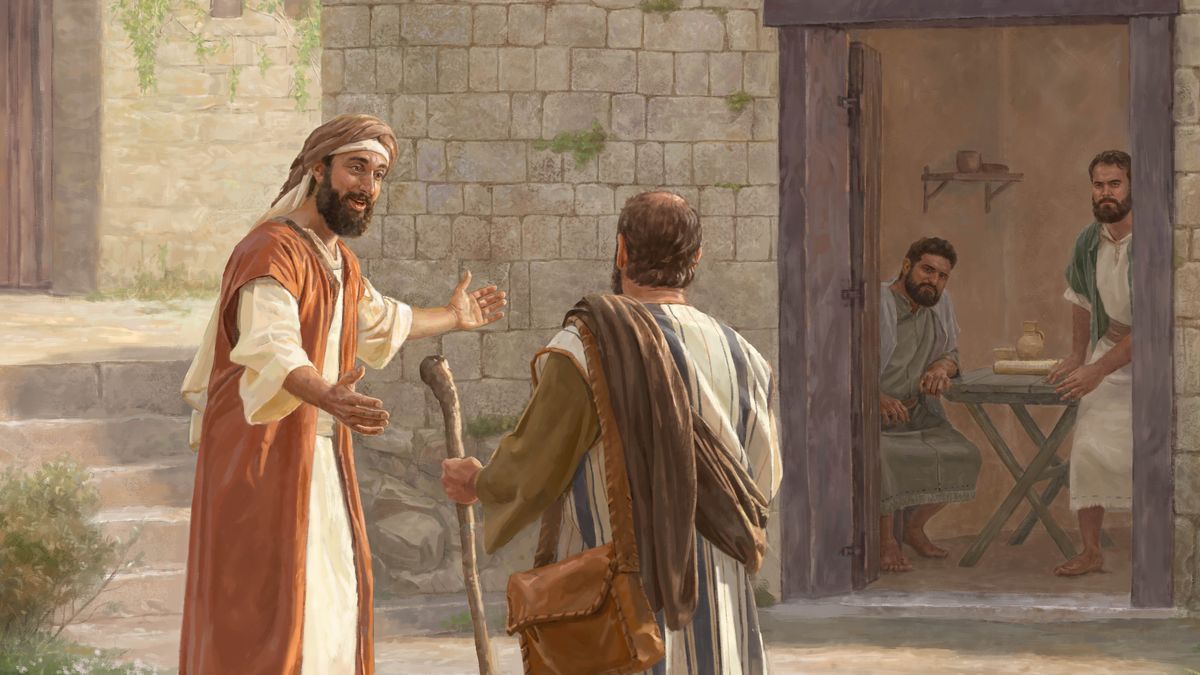
Barnabas lived up to the meaning of his name (See paragraph 3)
HOW TO COMFORT OTHERS
4. What is one of the best ways to provide comfort? (Romans 1:11, 12)
4 Visit them if possible. Jehovah uses his servants to provide comfort to others. For instance, when the prophet Elijah was depressed, Jehovah used an angel to encourage him. (1 Ki. 19:4-7) The apostle Paul also recognized the power of visiting his brothers in person to encourage them. (Read Romans 1:11, 12.) When you visit someone to provide comfort, allow time for more than just a brief interaction. (1 Cor. 16:7) If you are unable to visit someone in need, however, do not underestimate the power of a phone call, a letter, a card, or a text message to strengthen him. Will you allow Jehovah to use you to provide comfort to others?
5. What challenges can we expect to face?
5 As the last days become more critical, we can expect to face increased challenges when we try to comfort our brothers and sisters in person. During Paul’s imprisonment in Rome, Onesiphorus, who was from Ephesus, searched for him at the risk of being imprisoned or even being put to death. (2 Tim. 1:16-18) Witnesses in Russia have shown a similar spirit when their brothers and sisters are being persecuted for their faith. When Witnesses are brought to trial, their brothers and sisters are present in the courtroom to show their support, even though doing so could put their own freedom at risk. Why not prepare yourself to follow their brave example by studying how God’s people in ancient and in modern times have supported one another and have found joy despite persecution?
6. How can we imitate Jehovah as we comfort others? (See also picture.)
6 Listen to them. When the prophet Elijah felt that his life was in danger, he poured out his heart to Jehovah. Our loving God listened to Elijah as he expressed his concerns even though He already knew what was troubling him. Jehovah even listened patiently as Elijah repeated himself! (1 Ki. 19:9, 10, 14) Jehovah also allowed the prophet Habakkuk to express his concerns and doubts in a way that could have seemed as if he were challenging God’s authority. (Hab. 1:2, 3) Today, Jehovah listens closely to our prayers even though he already knows what we need. We can imitate Jehovah by listening carefully and respectfully when our brothers and sisters speak. “Be quick to listen” as they talk, and avoid interrupting or taking offense, even if they seem to be speaking rashly or if they are repeating themselves.—Jas. 1:19; Eccl. 7:9.

Imitate Jehovah by listening carefully when your brothers and sisters speak (See paragraph 6)
7. How can we discern the needs of someone in distress?
7 Discern what a person needs. We cannot read hearts as Jehovah does, so we can only discern what comfort a person needs if we listen to him attentively. Do not assume that you know what the person needs because you know what you would need if you were in a similar situation. We are all different. So take your time, listen carefully, and ask tactful questions that will help to draw out his feelings.—Prov. 20:5.
8. How did Jesus comfort Martha and Mary after Lazarus died? (See also pictures.)
8 Consider how Jesus comforted Martha and Mary after the death of their brother, Lazarus. Both women had suffered the same loss; yet, Jesus comforted them in different ways. After Martha spoke with him, Jesus shared truths about the resurrection and helped to reinforce her faith in that loving provision. But when Mary came to him weeping, Jesus apparently did not mention the resurrection. Instead, he wept with Mary and asked where Lazarus had been laid. (John 11:20-35) The lesson? When we comfort those who are suffering, we must discern their needs rather than try to use a one-size-fits-all approach.

When comforting others, strive to discern what they need (See paragraph 8)a
9. How can we use the Bible to comfort others? (Romans 15:4, 5)
9 Use the Bible. When you share “the comfort from the Scriptures” with someone, you can help that person to gain hope. (Read Romans 15:4, 5.) That hope, in turn, provides further comfort and encouragement. (Isa. 40:31) How can you find a Bible passage to encourage someone? Some keep a list of verses that they consult when needed, such as those under the topic “Comfort” in Scriptures for Christian Living. Ask Jehovah to help you to use his Word in the best way possible in order to provide encouragement. His spirit can help you to recall appropriate scriptures when you need them.—John 14:26.
10. Why must we speak kindly when we try to encourage someone?
10 Speak kindly. The original-language word used for “comfort” can also be rendered “exhort,” or “urge.” At times, you might need to exhort, or urge, the person you are comforting to adjust his thinking. If that becomes necessary, think carefully before you speak so that your words heal rather than hurt. (Prov. 12:18) Jehovah set the perfect example when he spoke with Elijah, who was mistaken about the value of his work and about the scope of Israel’s apostasy. Jehovah kindly helped Elijah to correct his thinking without directly pointing out his errors. (1 Ki. 19:15-18) With kindness and careful thought, you can do the same. When you give talks or make comments at Christian meetings, always speak kindly and positively as you try to encourage and strengthen your brothers and sisters.
11. What do those in distress often need? (1 John 3:18)
11 Provide practical help. Those who are in distress often need more than words of comfort. (Read 1 John 3:18.) Barnabas set a good example when he sold some property and donated the proceeds to support his newly baptized brothers and sisters who were in need. (Acts 4:36, 37) Many of our fellow Christians today follow his fine example by providing practical help to those who need it. Gabriela, from Poland, was devastated when a flood severely damaged her home. She relates: “I was really frightened and worried, and so were my parents, who lived with me. I wondered how I was going to cope. But brothers from nearby congregations came and did a lot of work in just one day. That experience strengthened my faith that Jehovah is directing his people to comfort those who are suffering.”
12. How can you help your fellow Christians when you faithfully endure trials?
12 Endure your trials. Paul told the Thessalonians that he gained comfort and renewed energy when he learned about their faithful endurance. He knew that his work among them had not been in vain. (1 Thess. 3:5-8) Paul, in turn, hoped to comfort his brothers—even those who had not met him—by means of his struggles in their behalf. (Col. 2:1, 2) Similarly, when our fellow Christians see how Jehovah is helping us to endure our trials successfully, they are greatly encouraged.
13. What must we continue to do as we encourage others?
13 Be patient. Brothers and sisters who are discouraged may not respond immediately to our efforts to comfort them. But the Scriptures admonish us to “keep encouraging one another.” The expression “keep encouraging” describes an ongoing activity. (1 Thess. 5:11) Be patient as you continue to console and comfort those who need your support. (1 Thess. 5:14) Of course, at times, each of us will need to receive comfort. What can we do then?
WHEN YOU NEED COMFORT
14-15. What should we do when we are facing times of anxiety or distress?
14 Pray to Jehovah. Ask him to comfort you in times of anxiety or distress. (Ps. 94:19) Be specific in your prayers, pouring out your heart to him. (Ps. 62:8) Granted, Jehovah already knows how you feel even before you pray. But sharing your innermost thoughts in heartfelt prayer demonstrates your faith. And Jehovah never fails to respond in his own way to prayers offered in faith. (Mark 11:24) Philippians 4:6, 7 urges us: “Let your petitions be made known to God; and the peace of God that surpasses all understanding will guard your hearts and your mental powers.”
15 Ask others for help. Share your feelings with a mature friend, or confide in a trusted elder. Your brothers and sisters can be a source of comfort, but they may not know how you feel or what you need unless you tell them. (Prov. 14:10) You can ask them to listen empathetically or to share a scripture or an article that they have found comforting.
16. What might happen when others try to encourage you, but what should you remember?
16 Be patient and forgiving. Your brothers and sisters might make mistakes when they try to encourage you. For instance, they might say or do something that makes you feel worse, not better. If that happens, be patient with them. (1 Cor. 13:4, 7) And remember the words found at James 3:2: “If anyone does not stumble in word, he is a perfect man.” Focus on the good motives of your brothers and sisters. Bear in mind that “the spirit, of course, is eager, but the flesh is weak.”—Matt. 26:41.
17. What should we be determined to do?
17 We all need comfort and encouragement, and our need will only increase as the last days become more critical and as God’s enemies oppose us more furiously. Let us be determined to exert ourselves in comforting one another.
SONG 130 Be Forgiving
a PICTURE DESCRIPTION: An elder listens with empathy to a brother who recently lost his wife in death. Later, the elder visits a brother who lost his wife some time ago, and they reminisce about their fond memories of her.
Keep Strengthening Your Friendship With Your Mate
pp. 26–31
JUNE 29–JULY 5, 2026
SONG 131 “What God Has Yoked Together”
Keep Strengthening Your Friendship With Your Mate
“There is a friend who sticks closer than a brother.”—PROV. 18:24.
FOCUS
A happy marriage is built on a close friendship between a husband and a wife and on their mutual love for Jehovah.
1. Why are good friends a gift from Jehovah?
GOOD friends are a gift from Jehovah. (Jas. 1:17) They love God, and they love us. They share in our joy when we are happy, comfort us when we feel down, and give us honest advice when we need it. They are loyal, and we can trust them. Such friends truly “make the heart rejoice”!—Prov. 27:9.
2. Why is it important for a married couple to keep strengthening their friendship? (Matthew 19:6)
2 It is important for a man and his wife to be the best of friends. They cannot take their friendship for granted—they need to keep working at strengthening it. If they neglect their friendship, they could start feeling lonely, frustrated, even angry. But if they keep nurturing their friendship, they can enjoy the closest bond that two humans could ever have. (Read Matthew 19:6.) In this article, we will see how married couples can keep strengthening their friendship. But first, let us consider how single Christians can choose a mate who will become their best friend for life.
HOW TO CHOOSE A LIFELONG FRIEND
3-4. What will help a person to find a good marriage mate? (Proverbs 18:22)
3 Before we make any big decision, we need to think about the possible risks, benefits, and outcomes. Big decisions can affect our life for a long time, so it is important to consider them carefully.
4 When choosing a lifelong friend—a marriage mate—we are making one of the most important decisions we will ever make. Since Jehovah created the marriage arrangement, it makes sense to look to him for guidance when choosing a mate. He wants a man to find a good wife, and He wants a woman to find a good husband. Jehovah always knows what is best for us. (Read Proverbs 18:22; Isa. 48:17, 18) The principles found in God’s Word can help a Christian to find someone who is right for him or for her.
5. Why is it important to choose a baptized person as a mate?
5 When we get baptized, we become friends of God. (Ps. 25:14) If you would like to get married, you should choose your prospective mate from among Jehovah’s friends. (1 Cor. 7:39) By doing so, you show appreciation for Jehovah’s standards and you will come to see your mate as a blessing from Jehovah. (Prov. 19:14) You will also avoid the problems that come from being “unevenly yoked” with an unbeliever. (2 Cor. 6:14) How unwise it would be to date an unbeliever, perhaps reasoning that suitable options among fellow Christians are limited. Neither would you want to rationalize that if you date an unbeliever, he may learn the truth.
6-7. What kind of questions should be answered during courtship?
6 Of course, not just any baptized person is a suitable mate. Look at your prospective mate objectively.a Ask yourself: ‘How does he treat his family? Is he considerate and respectful? Who are his friends? How does he handle disagreements? Does he insist on having his own way, or is he willing to yield when no Scriptural principle is involved? What is his attitude toward money?’
7 You could further ask yourself: ‘Does my friend show a deep love for Jehovah? Is he putting on “the new personality”? Will he help me to keep serving Jehovah more fully? Do we share the same spiritual goals? Can I see us becoming not just good friends but the closest of friends?’ (Col. 3:9, 10) If you are a sister, will the brother you are dating be a good friend and a good family head? (1 Cor. 11:3) If you are a brother, will the sister you are dating be willing to accept your authority as a head despite your imperfections? It takes time to answer such questions. Therefore, use your courtship to get to know your prospective mate well.
8-9. What can help someone who is courting to make a wise decision? (See also picture.)
8 During courtship, you are more likely to make a wise decision if you try to discern what the person is really like. Find out how others view your friend. You might ask about the person’s reputation and qualities. For example, is he or she known for being humble, kind, and reasonable? Sarah, a sister in French Guiana who married a brother named Daniel, says: “I got opinions about Daniel from the brother who was his flatmate and pioneer partner, from an elder in Daniel’s congregation, from mutual friends, and from sisters in his congregation.” You might kindly ask the person you are dating if there is anything from his or her past or present that you would need to know, since some factors or habits might later cause serious marital difficulties.
9 Do not ignore nagging doubts you might have or honest observations that mature friends make. With such an approach, you will be able to decide whether it is wise to continue the courtship or not.b Now, for the rest of this article, let us turn our attention to couples who are already married.

During courtship, try to discern what the other person is really like (See paragraphs 8-9)
SPEND TIME TOGETHER BUILDING YOUR FRIENDSHIP
10. Why is it good for a husband and wife to give their time and attention to each other?
10 A husband and wife can keep their friendship and marriage strong by making time for each other, no matter how busy they are. This gives them an opportunity to talk about everyday happenings, share their deepest thoughts and feelings, show affection to each other, and simply have fun together.
11. What can threaten the friendship between a husband and wife?
11 A husband and wife who are close friends prefer to be together rather than apart. Of course, they may sometimes have to be apart temporarily. But being apart for long periods of time can be dangerous. For example, some have accepted a job in another country, keeping them away from their family for an extended period. Although there may be some financial advantages to such an arrangement, a prolonged absence can be disastrous for a marriage.
12-13. (a) What have some married Christians done in order to spend time with their mate? (See also picture.) (b) Where does our relationship with our mate fit in? (See the box “Your Mate’s Place in Your Life.”)
12 Note what some married couples have done to ensure that they regularly spend time together. Leah, in Guam, says: “My husband and I enjoy doing a variety of things together. We rarely attend social events or outings separate from each other.” Roxanne, in the United States, adds: “As demands on our time have increased, we’ve come to see the need to schedule time together, just as we do with other important events.” (Compare Amos 3:3.) Damien, in France, makes this point: “We’ve learned to take an interest in and even to love what the other one is passionate about.” (Matt. 7:12) And Katie, also in the United States, says: “We sometimes put our phones away so that they don’t distract us.”
13 Above all, spend time together in spiritual activities. Myriam, in France, says: “We start our day by reading the Bible and then sharing what we liked and what we can apply in our life. I cherish these moments.” She adds: “I also love it when we pray together and I hear the depth of my husband’s love for Jehovah.” Katie, quoted earlier, says: “Our favorite time together is in the ministry. It’s refreshing to hear each other express our faith, and we keep learning new things from each other.”—Prov. 27:17.

Strengthen your marriage by regularly spending time together as friends (See paragraphs 12-13)
STICK TOGETHER WHEN CHALLENGES ARISE
14-15. Why should a couple do their best to overcome challenges that may arise in their marriage? Illustrate.
14 As imperfect humans, married couples will experience challenges in their marriage. The Bible realistically says that married people “will have tribulation in their flesh.” (1 Cor. 7:28) A study note on this verse says that this expression “refers to problems and trials that are common to a married couple.” When such problems arise, why should they do their best to stick together and overcome the challenge?
15 Consider an illustration. If a famous building or work of art is damaged, the owners will most likely decide to restore it. They may devote enormous amounts of money and other resources to the restoration work, which may take years to complete. Why? Because that building or artwork is precious to them. Similarly, all marriages are precious. Even in the best of marriages, conflicts will arise. However, just as a damaged building or a work of art can often be repaired, a troubled marriage can be saved. The restoration process will likely take time and involve some hard work, and yet, Jehovah will be pleased if the couple work hard to strengthen their marriage and remain together. (Mal. 2:16) By doing so, they show love and respect not just for each other but also for Jehovah, the Originator of marriage.
16. According to 1 Corinthians 13:4-8a, what can help a couple who are facing a serious challenge in their marriage? (See also picture and the box “Help to Strengthen Your Friendship.”)
16 If problems arise in your marriage, do not be quick to separate. (1 Cor. 7:10, 11) Instead, ask yourself, ‘Could I do more to strengthen our friendship?’ Review what the Bible says about showing love, and ask yourself if you can improve in displaying some of the characteristics mentioned at 1 Corinthians 13:4-8a. (Read.) Rather than look for a way out of your relationship, do your best to look for a way back into each other’s heart. Focus on what you can do to rebuild the relationship. Pray for Jehovah to guide you. Get the needed help from our publications and videos, as well as from elders and other mature Christians. By relying on Jehovah, the third and strongest strand in the “threefold cord,” your marriage will not “quickly be torn apart.”—Eccl. 4:12.

Stick together when challenges arise in your marriage (See paragraph 16)
17. How can those contemplating marriage and those who are married find happiness?
17 Jehovah wants all his servants to be happy, including those contemplating marriage and those already married. So if you are single and would like to get married, choose your lifelong friend carefully. And if you are married, continue strengthening your friendship with your mate. Work to overcome challenges that may arise in your marriage, relying on Jehovah’s help. By doing these things, you will “enjoy life” with your beloved mate!—Eccl. 9:9.
SONG 132 Now We Are One
a The questions that follow apply equally to men and to women.
b For more suggestions on getting to know each other, see the article “How to Have a Successful Courtship” in the May 2024 issue of The Watchtower, under the subheading “Get to Know Each Other Well.”
Understand the Bible’s Word Pictures
p. 32
STUDY TIP
Understand the Bible’s Word Pictures
The Bible contains hundreds of word pictures. Yet, many Bible readers struggle to understand them. (Matt. 13:13) What can help you to grasp the right meaning of word pictures used in the Bible? Try these steps:
Identify the topic and the image. Word pictures compare a topic to an image. For example, Revelation 3:3 compares Jesus’ coming (the topic) to the coming of a thief (the image).
Determine how the topic and the image are alike. Find the features and the qualities that make the topic similar to the image.
Draw the correct conclusion. Some similarities between the topic and the image may lead to wrong conclusions. In the example above, Jesus is not coming to steal anything. Rather, the context shows that his coming would be like that of a thief in the sense that it will be unexpected and unannounced.